International Network of People Who Use Drugs, INPUD Secretariat, Unit 2C09, South Bank Technopark, 90 London Road, London, SE1 6LN, UK.
South African Network of People Who Use Drugs; University of Pretoria, Cape Town, South Africa.
Harm Reduct J. 2021 Feb 3;18(1):15. doi: 10.1186/s12954-021-00461-z.
Peer involvement of people who use drugs within HIV and harm reduction services is widely promoted yet under-utilised. Alongside political and financial barriers is a limited understanding of the roles, impacts, contexts and mechanisms for peer involvement, particularly in low- and middle-income settings. We conducted a rapid review of available literature on this topic.
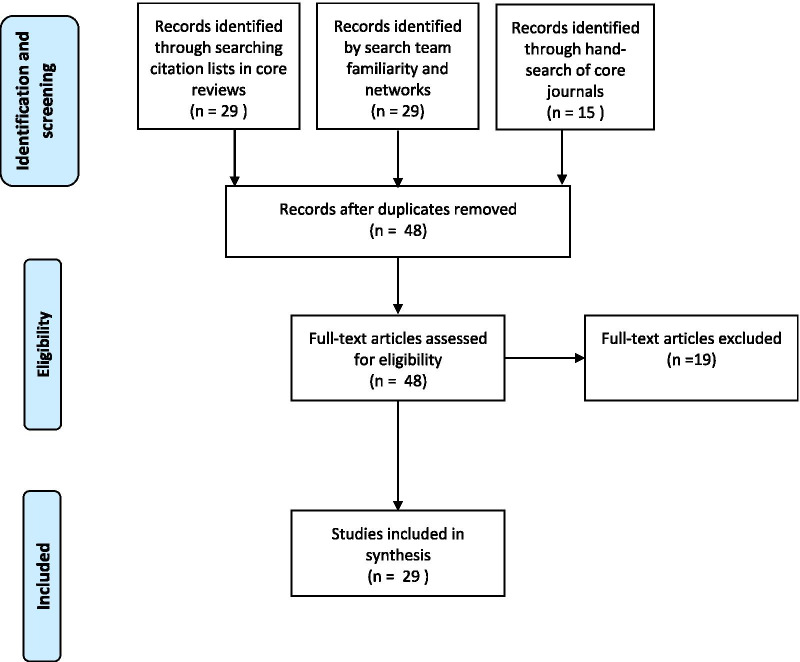
Within a community-academic partnership, we used a rapid review approach, framed by realist theory. We used a network search strategy, focused on core journals and reference lists of related reviews. Twenty-nine studies were included. We developed thematic summaries framed by a realist approach of exploring interventions, their mechanisms, outcomes and how they are shaped by contexts.
Reported outcomes of peer involvement included reduced HIV incidence and prevalence; increased service access, acceptability and quality; changed risk behaviours; and reduced stigma and discrimination. Mechanisms via which these roles work were trust, personal commitment and empathy, using community knowledge and experience, as well as 'bridge' and 'role model' processes. Contexts of criminalisation, under-resourced health systems, and stigma and discrimination were found to shape these roles, their mechanisms and outcomes. Though contexts and mechanisms are little explored within the literature, we identified a common theme across contexts, mechanisms and outcomes. Peer outreach interventions work through trust, community knowledge and expertise, and 'bridge' mechanisms (M) to counter criminalisation and constraining clinic and service delivery environments (C), contributing towards changed drug-using behaviours, increased access, acceptability and quality of harm reduction services and decreased stigma and discrimination (O).
Peer involvement in HIV and harm reduction services in low- and middle-income settings is linked to positive health outcomes, shaped by contexts of criminalisation, stigma, and resource scarcity. However, peer involvement is under-theorised, particularly on how contexts shape mechanisms and ultimately outcomes. Efforts to study peer involvement need to develop theory and methods to evaluate the complex mechanisms and contexts that have influence. Finally, there is a need to expand the range of peer roles, to embrace the capacities and expertise of people who use drugs.
在艾滋病毒和减少伤害服务中,让吸毒者参与同伴工作得到了广泛的推广,但利用不足。除了政治和财政障碍外,对同伴参与的角色、影响、背景和机制的理解也有限,特别是在低收入和中等收入国家。我们对这一主题的现有文献进行了快速审查。
在一个社区学术伙伴关系中,我们使用了快速审查方法,框架是现实主义理论。我们使用了一个网络搜索策略,重点是核心期刊和相关评论的参考文献列表。共纳入 29 项研究。我们根据探索干预措施、其机制、结果以及它们如何受到背景影响的现实主义方法,制定了主题摘要。
同伴参与的报告结果包括降低艾滋病毒的发病率和流行率;增加服务的可及性、可接受性和质量;改变风险行为;减少污名化和歧视。这些角色发挥作用的机制包括信任、个人承诺和同理心,利用社区知识和经验,以及“桥梁”和“榜样”过程。发现刑事定罪、资源不足的卫生系统以及污名化和歧视等背景会影响这些角色、其机制和结果。尽管文献中很少探讨背景和机制,但我们在背景、机制和结果中发现了一个共同的主题。同伴外展干预措施通过信任、社区知识和专业知识以及“桥梁”机制(M)发挥作用,以对抗刑事定罪和限制诊所和服务提供环境(C),有助于改变吸毒行为、增加减少污名化和歧视的艾滋病毒和减少伤害服务的可及性、可接受性和质量(O)。
在低收入和中等收入国家,艾滋病毒和减少伤害服务中的同伴参与与积极的健康结果相关,受刑事定罪、污名化和资源匮乏等背景的影响。然而,同伴参与的理论基础薄弱,特别是关于背景如何影响机制以及最终影响结果的理论基础。研究同伴参与的努力需要发展理论和方法来评估具有影响力的复杂机制和背景。最后,需要扩大同伴角色的范围,接纳吸毒者的能力和专业知识。