Liu Wenhui, Liu Yiping, Ma Fang, Sun Bao, Wang Ying, Luo Jianquan, Liu Mouze, Luo Zhiying
Department of Pharmacy, The Second Xiangya Hospital, Central South University, Changsha, People's Republic of China.
Institute of Clinical Pharmacy, Central South University, Changsha, People's Republic of China.
Cancer Manag Res. 2021 Jan 27;13:765-771. doi: 10.2147/CMAR.S293200. eCollection 2021.
Immune checkpoint inhibitors (ICIs) have transformed the treatment landscape for patients with advanced non-small-cell lung cancer (aNSCLC), but immune-related adverse events (irAEs) have been evidenced curtailed the clinical use of them.
The aim of this study was to research the influences of inflammation-related peripheral blood markers, including neutrophil-to-lymphocyte ratio (NLR) and platelet-to-lymphocyte ratio (PLR) levels, on anti-PD-1 inhibitor-induced irAEs.
A retrospective analysis was conducted of patients treated with PD-1 inhibitors for stage III-IV NSCLC at a single center from 2017 to 2020 were included. Clinical characteristics, peripheral blood markers at the baseline and before subsequent treatment cycles were collected. NLR and PLR were calculated by division of neutrophil and platelet by lymphocyte measured in peripheral blood. The development of irAEs was evaluated and monitored from the therapy start based on CTCAE V4.03.
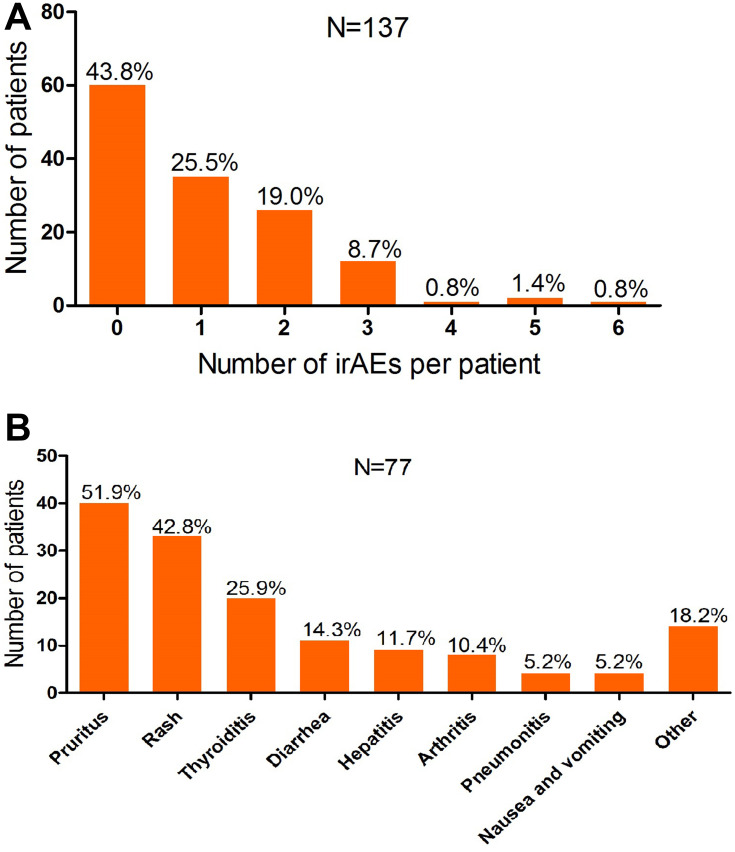
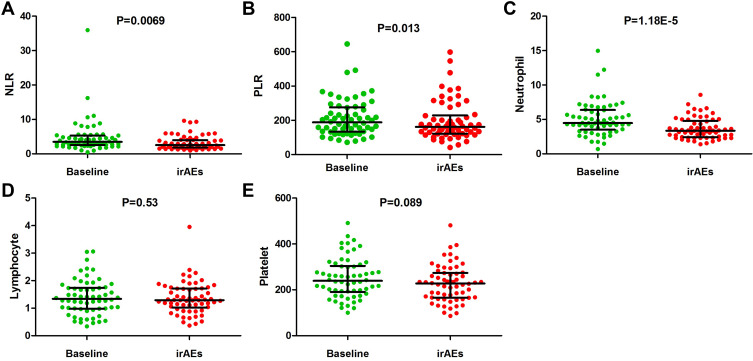
A total of 150 patients were included. Fifty-seven patients had occurred at least one irAEs during follow-up, and mainly grade 1-2 (73.68%). Pruritus, rash and thyroiditis were the most commonly irAEs. Low NLR, PLR and neutrophil at baseline were significantly associated with the development of severe irAEs (-values were 0.023, 0.0016 and 0.009). The levels of neutrophil, NLR and PLR also significantly decreased when occurred irAEs compared with baseline (P-values were 0.0069, 0.017 and 1.18E-5, respectively).
The levels of NLR, PLR and neutrophil were associated with the increased risk of severe irAEs when baseline levels were low. NLR, PLR, and neutrophil are simple and available biomarkers that can be used to help predict severe adverse effects in NSCLC patients treated with anti-PD-1 inhibitors.
免疫检查点抑制剂(ICIs)已经改变了晚期非小细胞肺癌(aNSCLC)患者的治疗格局,但免疫相关不良事件(irAEs)已被证明限制了它们的临床应用。
本研究旨在探讨炎症相关外周血标志物,包括中性粒细胞与淋巴细胞比值(NLR)和血小板与淋巴细胞比值(PLR)水平,对抗PD-1抑制剂诱导的irAEs的影响。
对2017年至2020年在单一中心接受PD-1抑制剂治疗的III-IV期NSCLC患者进行回顾性分析。收集临床特征、基线时和后续治疗周期前的外周血标志物。NLR和PLR通过外周血中测量的中性粒细胞和血小板除以淋巴细胞来计算。从治疗开始基于CTCAE V4.03评估和监测irAEs的发生。
共纳入150例患者。57例患者在随访期间发生至少1次irAEs,主要为1-2级(73.68%)。瘙痒、皮疹和甲状腺炎是最常见的irAEs。基线时低NLR、PLR和中性粒细胞与严重irAEs的发生显著相关(P值分别为0.023、0.0016和0.009)。与基线相比,发生irAEs时中性粒细胞、NLR和PLR水平也显著降低(P值分别为0.0069、0.017和1.18E-5)。
当基线水平较低时,NLR、PLR和中性粒细胞水平与严重irAEs风险增加相关。NLR、PLR和中性粒细胞是简单且可用的生物标志物,可用于帮助预测接受抗PD-1抑制剂治疗的NSCLC患者的严重不良反应。