Department of Medical Oncology, First Affiliated Hospital of Nanchang University, 17 Yongwai Zheng Road, Nanchang, 330000, China.
Department of Medical Oncology, Affiliated Ganzhou Hospital of Nanchang University (Ganzhou People's Hospital), 18 Meiguan Road, Ganzhou, 341000, China.
Cancer Immunol Immunother. 2020 Sep;69(9):1813-1822. doi: 10.1007/s00262-020-02585-w. Epub 2020 Apr 29.
Selected patients with advanced non-small cell lung cancer (NSCLC) benefit from immunotherapy, especially immune checkpoint inhibitors such as PD-1 (programmed cell death protein 1) inhibitor. Peripheral blood biomarkers would be most convenient to predict treatment outcome and immune-related adverse events (irAEs) in candidate patients. This study explored associations between inflammation-related peripheral blood markers and onset of irAEs and outcome in patients with advanced NSCLC receiving PD-1 inhibitors.
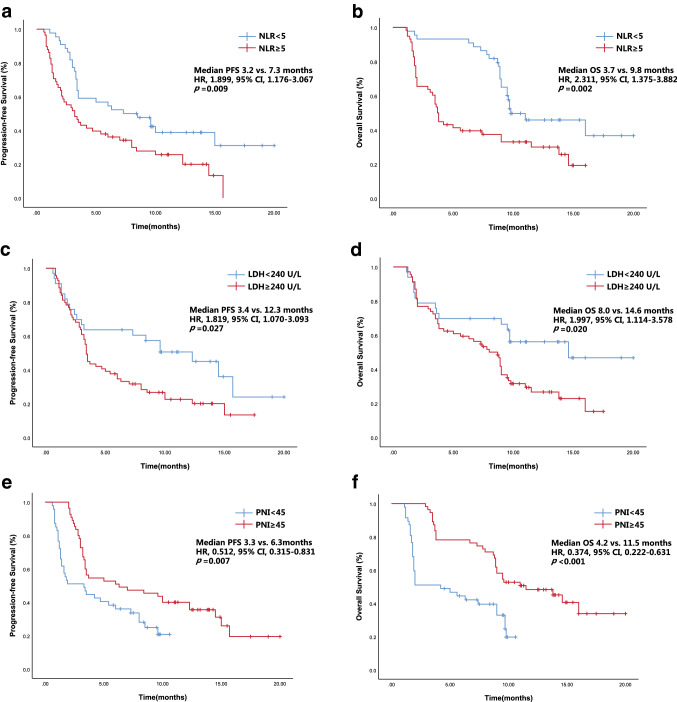
A retrospective analysis was conducted of 102 patients with advanced NSCLC receiving PD-1 inhibitors from January 2017 to May 2019. Cox regression models were employed to assess the prognostic effect of low/high neutrophil/lymphocyte ratio (NLR), lactate dehydrogenase (LDH), and prognostic nutrition index (PNI) on overall survival (OS) and progression-free survival (PFS). Logistic regression models were used to analyze the correlation between peripheral blood markers and the onset of irAEs.
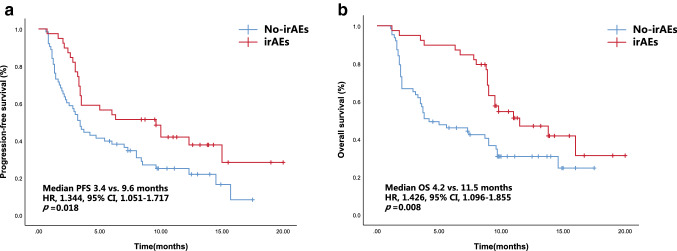
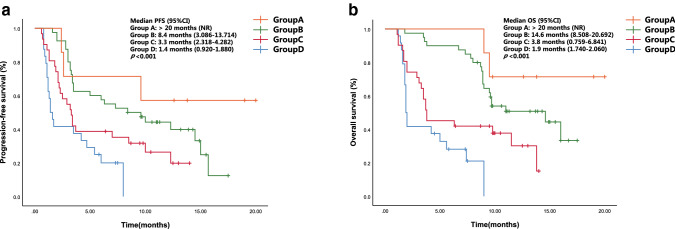
NLR < 5, LDH < 240 U/L, or PNI ≥ 45 was favorably associated with significantly better outcomes compared with higher, higher, or lower values, respectively. The multivariate analysis determined that these parameters were independently associated with both better PFS (p = 0.049, 0.046, 0.014, respectively) and longer OS (p = 0.007, 0.031, < 0.001, respectively). Patients with three favorable factors among NLR, LDH, and PNI had better PFS and OS than did those with two, one, or none. PNI and NLR were associated with the onset of irAEs.
In patients with advanced NSCLC treated with PD-1 inhibitors, pretreatment NLR, LDH, and PNI may be useful predictive markers of clinical outcome and irAEs.
部分晚期非小细胞肺癌(NSCLC)患者可从免疫治疗中获益,特别是程序性细胞死亡蛋白 1(PD-1)抑制剂等免疫检查点抑制剂。外周血生物标志物最便于预测候选患者的治疗结果和免疫相关不良事件(irAEs)。本研究探索了接受 PD-1 抑制剂治疗的晚期 NSCLC 患者中炎症相关外周血标志物与 irAEs 发生和结局的相关性。
对 2017 年 1 月至 2019 年 5 月期间接受 PD-1 抑制剂治疗的 102 例晚期 NSCLC 患者进行回顾性分析。采用 Cox 回归模型评估低/高中性粒细胞/淋巴细胞比值(NLR)、乳酸脱氢酶(LDH)和预后营养指数(PNI)对总生存期(OS)和无进展生存期(PFS)的预后影响。采用 logistic 回归模型分析外周血标志物与 irAEs 发生的相关性。
与 NLR>5、LDH>240 U/L 或 PNI<45 相比,NLR<5、LDH<240 U/L 或 PNI≥45 与显著更好的结局显著相关。多变量分析确定这些参数与更好的 PFS(p=0.049、0.046、0.014)和更长的 OS(p=0.007、0.031、<0.001)均独立相关。NLR、LDH 和 PNI 中存在 3 个有利因素的患者的 PFS 和 OS 优于存在 2 个、1 个或没有有利因素的患者。PNI 和 NLR 与 irAEs 的发生相关。
在接受 PD-1 抑制剂治疗的晚期 NSCLC 患者中,治疗前 NLR、LDH 和 PNI 可能是临床结局和 irAEs 的有用预测标志物。