Gao Yao, Wei Shan, Gao Fan, Gao Ling, Dang Liangjun, Shang Suhang, Chen Chen, Huo Kang, Wang Jingyi, Wang Jin, Qu Qiumin
Department of Neurology, The First Affiliated Hospital of Xi'an Jiaotong University, Xi'an, China.
Huyi Hospital of Traditional Chinese Medicine, Xi'an, China.
Front Aging Neurosci. 2021 Jan 18;12:615838. doi: 10.3389/fnagi.2020.615838. eCollection 2020.
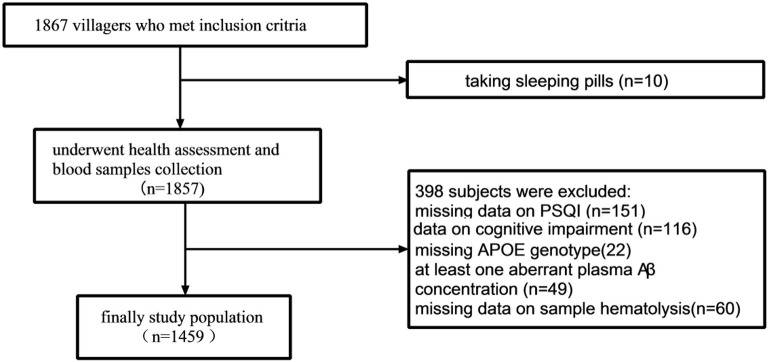
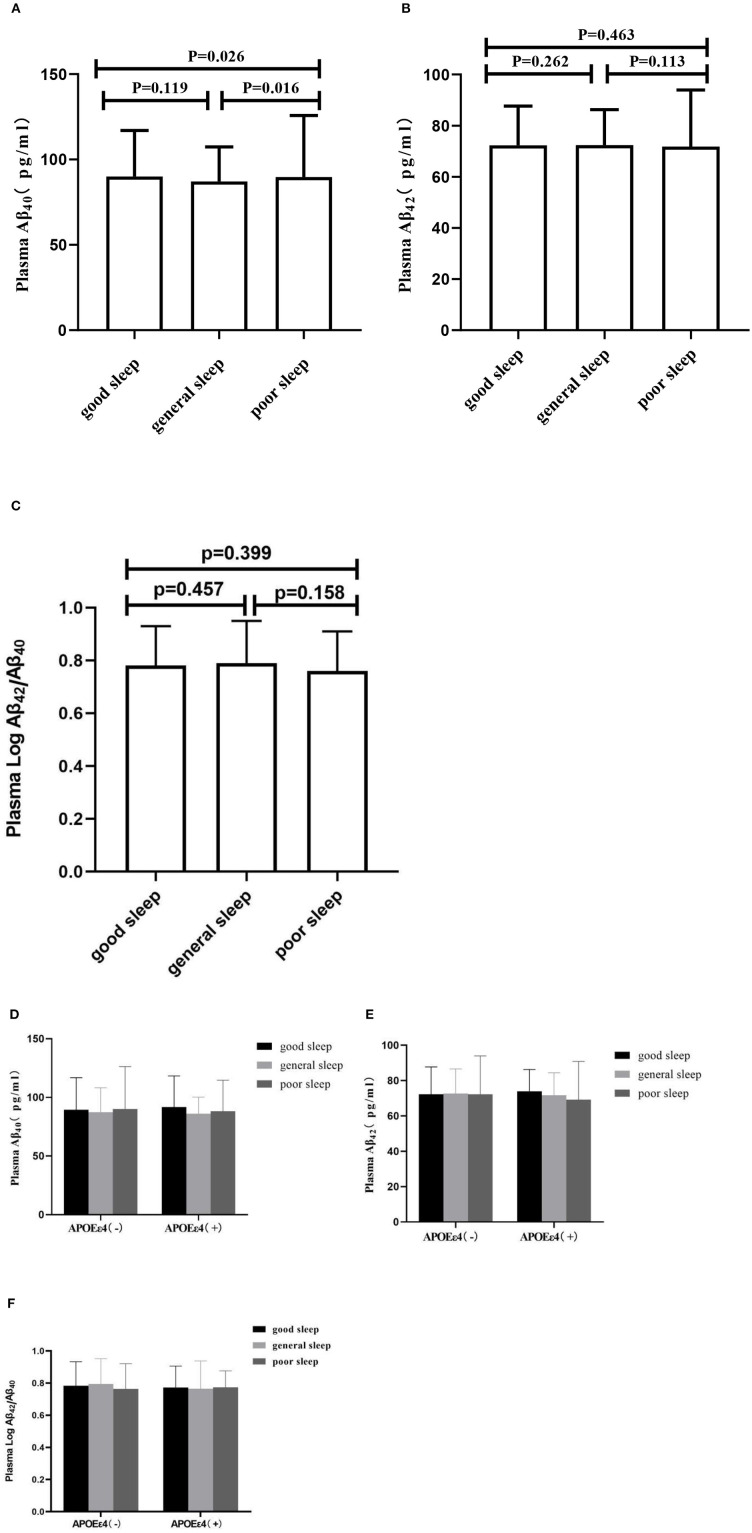
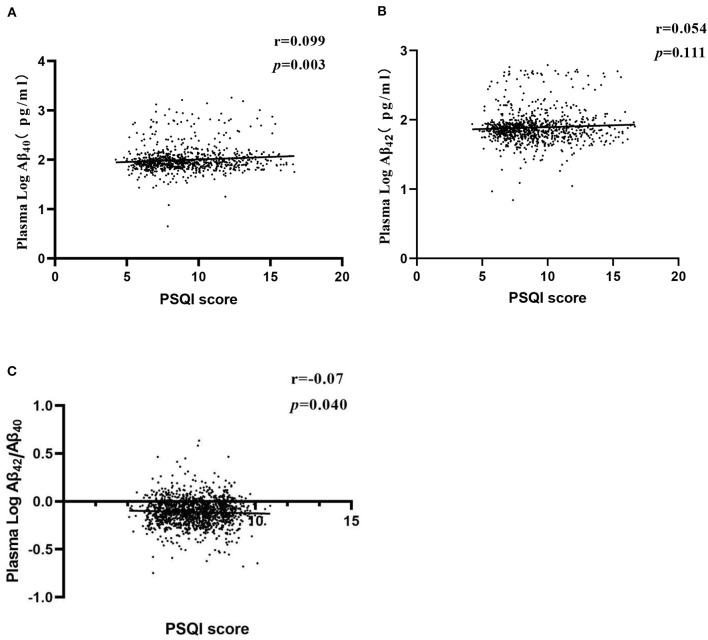
Growing evidence suggests that sleep disturbance is a risk factor for Alzheimer's disease (AD). Amyloid-β (Aβ) deposition in the brain is a main pathophysiology of AD. Considering that peripheral Aβ level is associated with brain Aβ deposition, the present study investigated the relationship between sleep disturbance and plasma Aβ levels. This is a population-based cross-sectional study. A total of 1,459 participants from a village in the suburbs of Xi'an, China, were enrolled from January 3, 2017 to March 26, 2017. Sleep quality was assessed using the Pittsburgh Sleep Quality Index (PSQI), and a PSQI score of <5 points was considered as good sleep quality and a PSQI score of >10 points as poor sleep quality. Cognitive function was assessed with the Mini-Mental State Examination (MMSE). Fasting venous blood was taken in the morning, and the plasma Aβ levels were measured using ELISA. The relationships between plasma Aβ levels and sleep quality were analyzed using multiple linear regression. Among the participants, 231 had poor sleep quality (15.83%). The log-transformed Aβ level had significant differences among the different sleep groups ( = 3.216, = 0.040). The log-transformed Aβ level was higher in the poor sleep quality group than that in the general sleep quality group [87.17 (73.42, 107.34) vs. 89.69 (74.81, 125.79) pg/ml, = 0.016]. In bivariate analysis, sleep quality was negatively associated with the log-transformed plasma Aβ level (β = -0.025, = 0.011). In the community population, poorer sleep quality is associated with a higher plasma Aβ level. This indicated that sleep disturbance might also involve in dysfunction of peripheral Aβ clearance.
越来越多的证据表明,睡眠障碍是阿尔茨海默病(AD)的一个风险因素。大脑中β淀粉样蛋白(Aβ)沉积是AD的主要病理生理学特征。鉴于外周血Aβ水平与脑内Aβ沉积相关,本研究调查了睡眠障碍与血浆Aβ水平之间的关系。这是一项基于人群的横断面研究。2017年1月3日至2017年3月26日,从中国西安郊区的一个村庄招募了1459名参与者。使用匹兹堡睡眠质量指数(PSQI)评估睡眠质量,PSQI得分<5分被认为睡眠质量良好,PSQI得分>10分被认为睡眠质量差。使用简易精神状态检查表(MMSE)评估认知功能。早晨采集空腹静脉血,采用酶联免疫吸附测定法(ELISA)测量血浆Aβ水平。采用多元线性回归分析血浆Aβ水平与睡眠质量之间的关系。参与者中,231人睡眠质量差(15.83%)。不同睡眠组之间,经对数转换的Aβ水平存在显著差异(F = 3.216,P = 0.040)。睡眠质量差的组中,经对数转换的Aβ水平高于一般睡眠质量组[87.17(73.42,107.34)对89.69(74.81,125.79)pg/ml,P = 0.016]。在双变量分析中,睡眠质量与经对数转换的血浆Aβ水平呈负相关(β = -0.025,P = 0.011)。在社区人群中,较差的睡眠质量与较高的血浆Aβ水平相关。这表明睡眠障碍可能也参与了外周Aβ清除功能障碍。