Xie Yuji, Wang Lufang, Li Meng, Li He, Zhu Shuangshuang, Wang Bin, He Lin, Zhang Danqing, Zhang Yongxing, Yuan Hongliang, Wu Chun, Sun Wei, Zhang Yanting, Cui Li, Cai Yu, Wang Jing, Yang Yali, Lv Qing, Xie Mingxing, Li Yuman, Zhang Li
Department of Ultrasound, Tongji Medical College, Union Hospital, Huazhong University of Science and Technology, Wuhan, China.
Hubei Province Key Laboratory of Molecular Imaging, Wuhan, China.
Front Cardiovasc Med. 2021 Jan 18;7:632434. doi: 10.3389/fcvm.2020.632434. eCollection 2020.
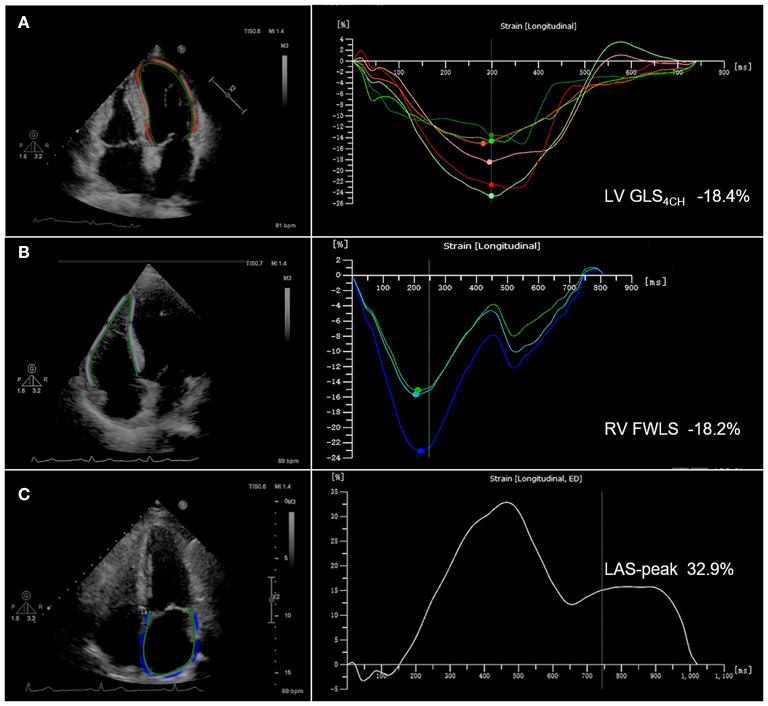
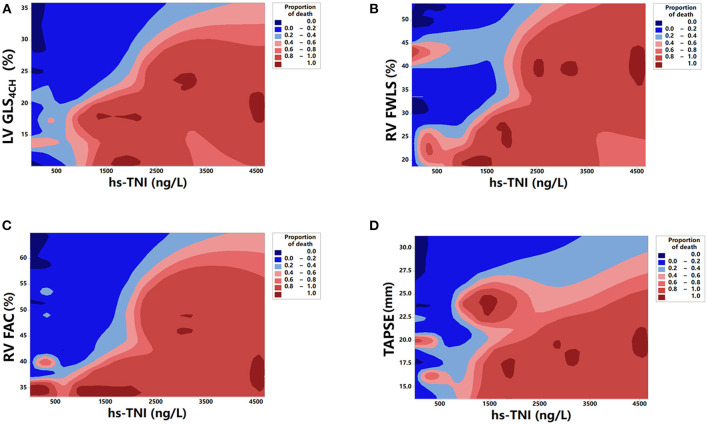
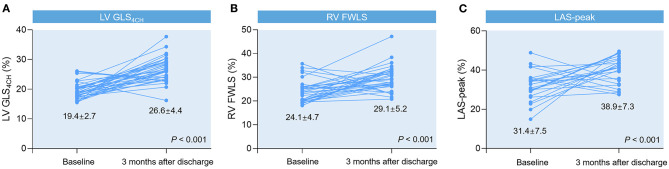
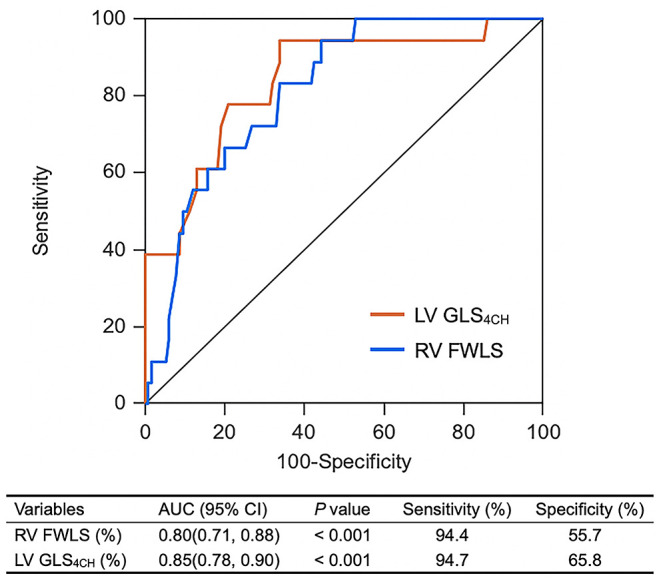
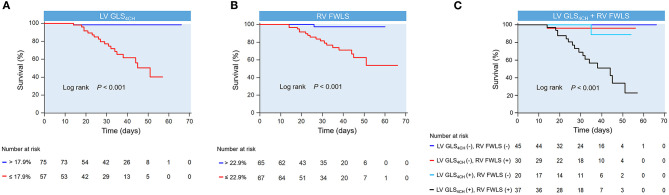
Biventricular longitudinal strain has been recently demonstrated to be predictive of poor outcomes in various cardiovascular settings. Therefore, this study sought to investigate the prognostic implications of biventricular longitudinal strain in patients with coronavirus disease 2019 (COVID-19). We enrolled 132 consecutive patients with COVID-19. Left ventricular global longitudinal strain from the apical four-chamber views (LV GLS) and right ventricular free wall longitudinal strain (RV FWLS) were obtained using two-dimensional speckle-tracking echocardiography. Compared with patients without cardiac injury, those with cardiac injury had higher levels of coagulopathy and inflammatory biomarkers, higher incidence of complications, more mechanical ventilation therapy, and higher mortality. Patients with cardiac injury displayed decreased LV GLS and RV FWLS, elevated pulmonary artery systolic pressure, and higher proportion of pericardial effusion. Higher biomarkers levels of inflammation and cardiac injury, and the presence of pericardial effusion were correlated with decreases in LV GLS and RV FWLS. During hospitalization, 19 patients died. Compared with survivors, LV GLS and RV FWLS were impaired in non-survivors. At a 3-month follow-up after discharge, significant improvements were observed in LV GLS and RV FWLS. Multivariate Cox analysis revealed that LV GLS [hazard ratio: 1.41; 95% confidence interval [CI]: 1.08 to 1.84; = 0.011] and RV FWLS (HR: 1.29; 95% CI: 1.09-1.52; = 0.003) were independent predictors of higher mortality in patients with COVID-19. LV GLS and RV FWLS are independent and strong predictors of higher mortality in COVID-19 patients and can track improvement during the convalescent phase of their illness. Therefore, biventricular longitudinal strain may be crucial for risk stratification and serial follow-up in patients with COVID-19.
最近有研究表明,双心室纵向应变可预测多种心血管疾病的不良预后。因此,本研究旨在探讨双心室纵向应变对2019冠状病毒病(COVID-19)患者的预后影响。我们连续纳入了132例COVID-19患者。使用二维斑点追踪超声心动图获取心尖四腔心切面的左心室整体纵向应变(LV GLS)和右心室游离壁纵向应变(RV FWLS)。与无心脏损伤的患者相比,有心脏损伤的患者凝血功能障碍和炎症生物标志物水平更高,并发症发生率更高,机械通气治疗更多,死亡率更高。有心脏损伤的患者LV GLS和RV FWLS降低,肺动脉收缩压升高,心包积液比例更高。炎症和心脏损伤的生物标志物水平升高以及心包积液的存在与LV GLS和RV FWLS降低相关。住院期间,19例患者死亡。与幸存者相比,非幸存者的LV GLS和RV FWLS受损。出院后3个月随访时,LV GLS和RV FWLS有显著改善。多变量Cox分析显示,LV GLS [风险比:1.41;95%置信区间[CI]:1.08至1.84;P = 0.011]和RV FWLS(HR:1.29;95% CI:1.09 - 1.52;P = 0.003)是COVID-19患者死亡率升高的独立预测因素。LV GLS和RV FWLS是COVID-19患者死亡率升高的独立且有力的预测因素,并且可以追踪其疾病恢复期的改善情况。因此,双心室纵向应变对于COVID-19患者的风险分层和连续随访可能至关重要。