Park John F, Banerjee Somanshu, Umar Soban
Department of Anesthesiology and Perioperative Medicine, David Geffen School of Medicine at UCLA, Los Angeles, CA, USA.
Pulm Circ. 2020 Jul 2;10(3):2045894020936660. doi: 10.1177/2045894020936660. eCollection 2020 Jul-Sep.
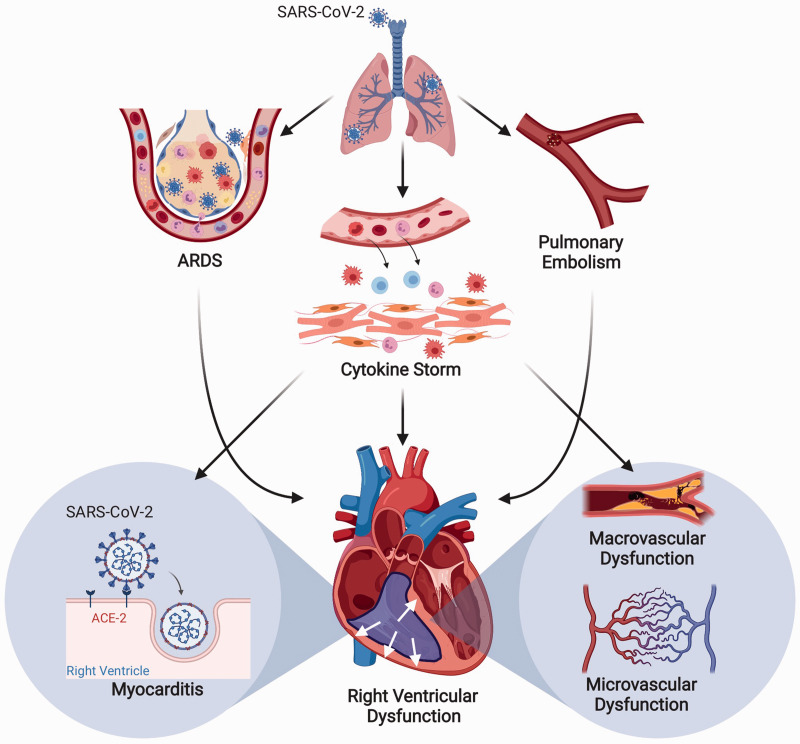
The corona virus disease of 2019 pandemic caused by the SARS-CoV-2 virus continues to inflict significant morbidity and mortality around the globe. A variety of cardiovascular presentations of SARS-CoV-2 infection have been described so far. However, the impact of SARS-CoV-2 on the right ventricle is largely unknown. Due to its pathophysiologic relevance, the right ventricle finds itself in the eye of the storm of corona virus disease of 2019, placing it at higher risk of failure. Increased afterload from acute respiratory distress syndrome and pulmonary embolism, negative inotropic effects of cytokines, and direct angiotensin converting enzyme 2-mediated cardiac injury from SARS-CoV-2 are potential mechanisms of right ventricle dysfunction in corona virus disease of 2019. Early detection and treatment of right ventricle dysfunction may lead to decreased mortality and improved patient outcomes in corona virus disease of 2019.
由严重急性呼吸综合征冠状病毒2(SARS-CoV-2)病毒引起的2019冠状病毒病大流行继续在全球范围内造成重大发病和死亡。迄今为止,已经描述了SARS-CoV-2感染的多种心血管表现。然而,SARS-CoV-2对右心室的影响在很大程度上尚不清楚。由于其病理生理相关性,右心室处于2019冠状病毒病风暴的中心,使其发生衰竭的风险更高。急性呼吸窘迫综合征和肺栓塞导致的后负荷增加、细胞因子的负性肌力作用以及SARS-CoV-2直接介导的血管紧张素转换酶2相关心脏损伤是2019冠状病毒病右心室功能障碍的潜在机制。早期检测和治疗右心室功能障碍可能会降低2019冠状病毒病的死亡率并改善患者预后。