Richter Charlotte, Braunstein Bjoern, Staeudle Benjamin, Attias Julia, Suess Alexander, Weber Tobias, Mileva Katya N, Rittweger Joern, Green David A, Albracht Kirsten
Institute of Movement and Neurosciences, German Sport University Cologne, Cologne, Germany.
Department of Medical Engineering and Technomathematics, University of Applied Sciences Aachen, Aachen, Germany.
Front Sports Act Living. 2021 Jan 18;2:614559. doi: 10.3389/fspor.2020.614559. eCollection 2020.
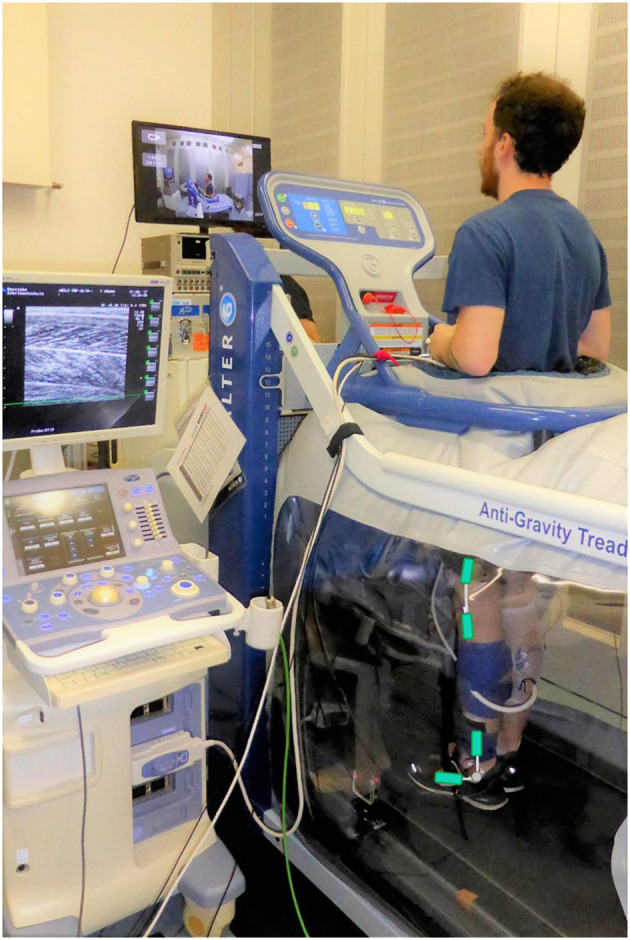
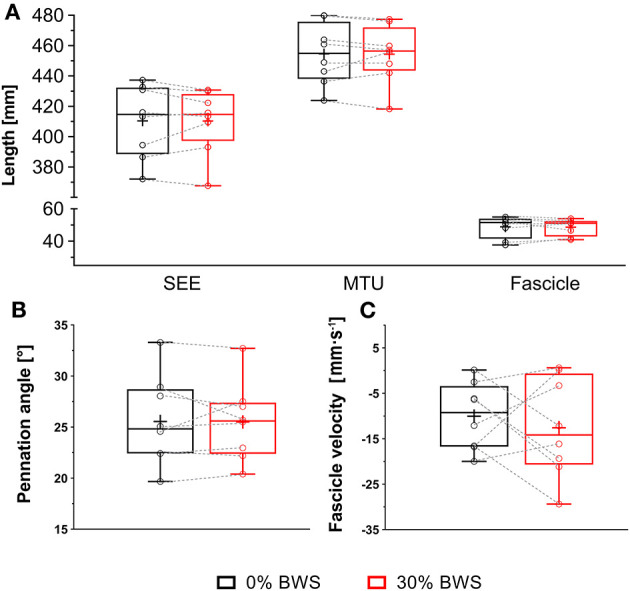
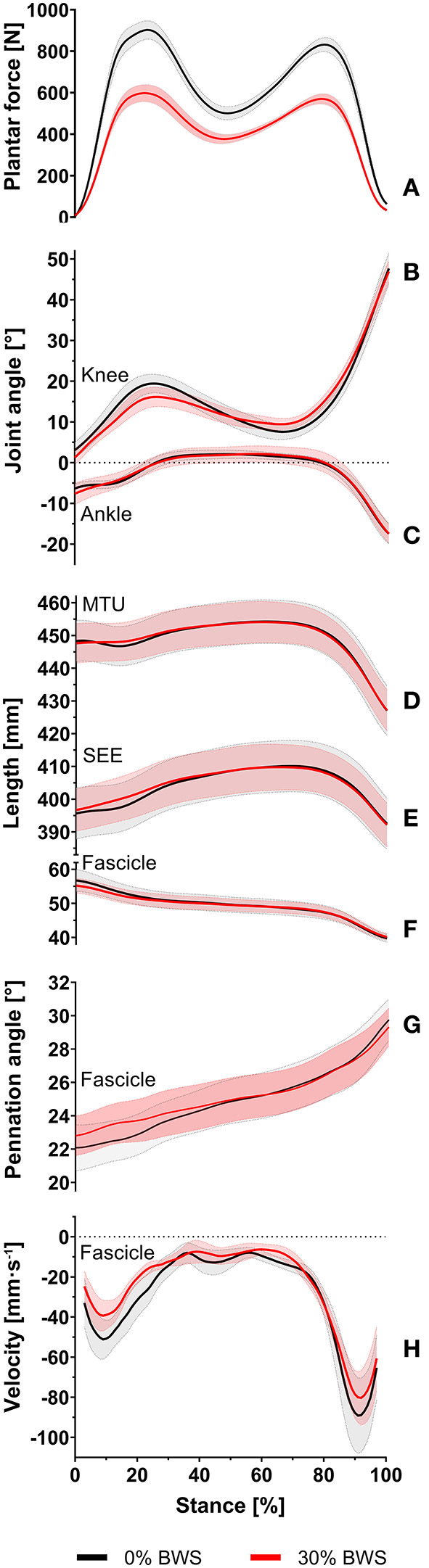
Rehabilitative body weight supported gait training aims at restoring walking function as a key element in activities of daily living. Studies demonstrated reductions in muscle and joint forces, while kinematic gait patterns appear to be preserved with up to 30% weight support. However, the influence of body weight support on muscle architecture, with respect to fascicle and series elastic element behavior is unknown, despite this having potential clinical implications for gait retraining. Eight males (31.9 ± 4.7 years) walked at 75% of the speed at which they typically transition to running, with 0% and 30% body weight support on a lower-body positive pressure treadmill. Gastrocnemius medialis fascicle lengths and pennation angles were measured via ultrasonography. Additionally, joint kinematics were analyzed to determine gastrocnemius medialis muscle-tendon unit lengths, consisting of the muscle's contractile and series elastic elements. Series elastic element length was assessed using a muscle-tendon unit model. Depending on whether data were normally distributed, a paired -test or Wilcoxon signed rank test was performed to determine if body weight supported walking had any effects on joint kinematics and fascicle-series elastic element behavior. Walking with 30% body weight support had no statistically significant effect on joint kinematics and peak series elastic element length. Furthermore, at the time when peak series elastic element length was achieved, and on average across the entire stance phase, muscle-tendon unit length, fascicle length, pennation angle, and fascicle velocity were unchanged with respect to body weight support. In accordance with unchanged gait kinematics, preservation of fascicle-series elastic element behavior was observed during walking with 30% body weight support, which suggests transferability of gait patterns to subsequent unsupported walking.
康复性体重支撑步态训练旨在恢复步行功能,这是日常生活活动中的关键要素。研究表明,肌肉和关节受力会减少,而在高达30%的体重支撑下,运动步态模式似乎得以保留。然而,尽管体重支撑对肌肉结构(就肌束和串联弹性元件行为而言)的影响可能对步态再训练具有临床意义,但其影响尚不清楚。八名男性(31.9±4.7岁)在下肢正压跑步机上以其通常过渡到跑步速度的75%行走,体重支撑分别为0%和30%。通过超声测量腓肠肌内侧肌束长度和羽状角。此外,分析关节运动学以确定腓肠肌内侧肌腱单元长度,该长度由肌肉的收缩元件和串联弹性元件组成。使用肌腱单元模型评估串联弹性元件长度。根据数据是否呈正态分布,进行配对t检验或Wilcoxon符号秩检验,以确定体重支撑行走是否对关节运动学和肌束-串联弹性元件行为有任何影响。30%体重支撑下行走对关节运动学和串联弹性元件峰值长度没有统计学显著影响。此外,在达到串联弹性元件峰值长度时以及在整个站立期的平均水平上,肌腱单元长度、肌束长度、羽状角和肌束速度在体重支撑方面没有变化。与不变的步态运动学一致,在30%体重支撑下行走期间观察到肌束-串联弹性元件行为得以保留,这表明步态模式可转移至随后的无支撑行走。