Instituto de Parasitología y Biomedicina López-Neyra, Consejo Superior de Investigaciones Científicas; Granada, Spain.
Unidad Regional de Medicina Tropical, Hospital Virgen de la Arrixaca; El Palmar, Murcia, Spain.
PLoS Negl Trop Dis. 2021 Feb 4;15(2):e0009059. doi: 10.1371/journal.pntd.0009059. eCollection 2021 Feb.
Signs of senescence and the late stages of differentiation associated with the more severe forms of Chagas disease have been described in the Trypanosoma cruzi antigen-specific CD4+ T-cell population. However, the mechanisms involved in these functions are not fully known. To date, little is known about the possible impact of benznidazole treatment on the T. cruzi-specific functional response of CD4+ T cells.
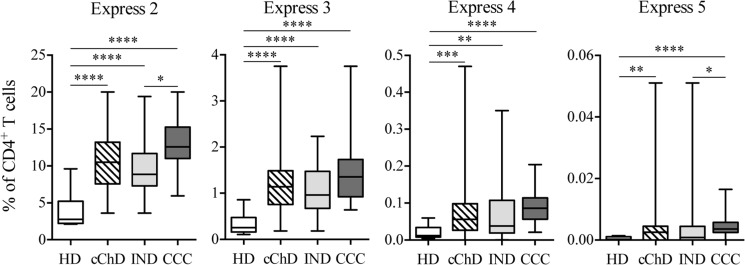
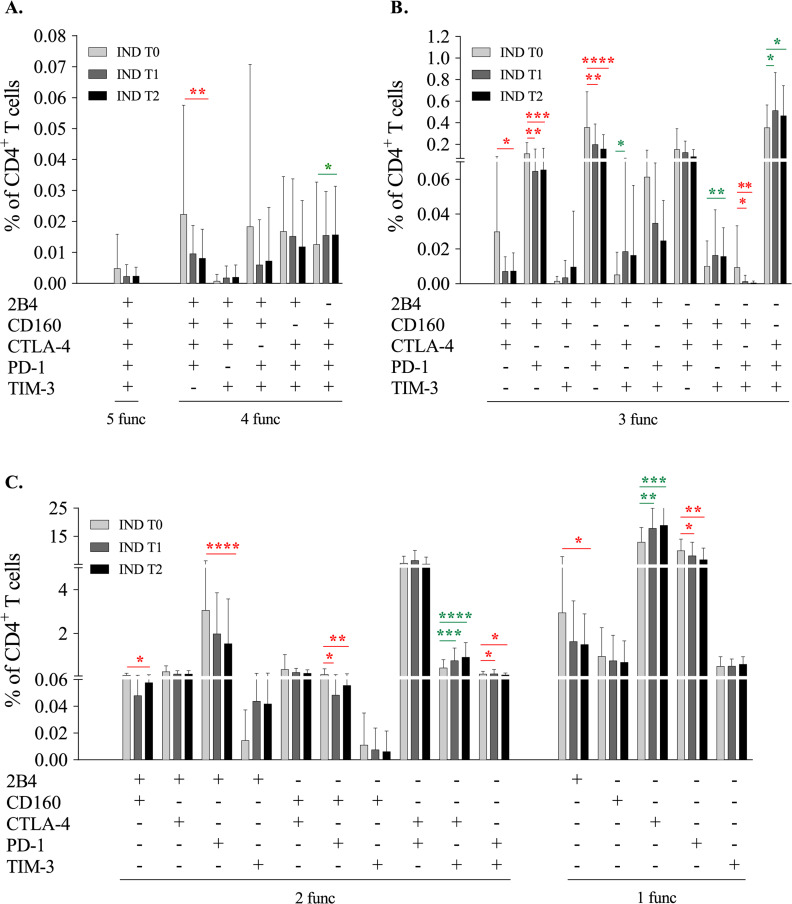
METHODOLOGY/PRINCIPAL FINDINGS: The functional capacity of CD4+ T cells was analyzed by cytometric assays in chronic Chagas disease patients, with indeterminate form (IND) and cardiac alterations (CCC) (25 and 15, respectively) before and after benznidazole treatment. An increase in the multifunctional capacity (expression of IFN-γ, IL-2, TNF-α, perforin and/or granzyme B) of the antigen-specific CD4+ T cells was observed in indeterminate versus cardiac patients, which was associated with the reduced coexpression of inhibitory receptors (2B4, CD160, CTLA-4, PD-1 and/or TIM-3). The functional profile of these cells shows statistically significant differences between IND and CCC (p<0.001), with a higher proportion of CD4+ T cells coexpressing 2 and 3 molecules in IND (54.4% versus 23.1% and 4.1% versus 2.4%, respectively). A significant decrease in the frequencies of CD4+ T cells that coexpress 2, 3 and 4 inhibitory receptors was observed in IND after 24-48 months of treatment (p<0.05, p<0.01 and p<0.05, respectively), which was associated with an increase in antigen-specific multifunctional activity. The IND group showed, at 9-12 months after treatment, an increase in the CD4+ T cell subset coproducing three molecules, which were mainly granzyme B+, perforin+ and IFN-γ+ (1.4% versus 4.5%).
CONCLUSIONS/SIGNIFICANCE: A CD4+ T cell dysfunctional process was detected in chronic Chagas disease patients, being more exacerbated in those patients with cardiac symptoms. After short-term benznidazole treatment (9-12 months), indeterminate patients showed a significant increase in the frequency of multifunctional antigen-specific CD4+ T cells.
与恰加斯病更严重形式相关的衰老迹象和晚期分化已在克氏锥虫抗原特异性 CD4+T 细胞群中描述。然而,这些功能所涉及的机制尚未完全清楚。迄今为止,人们对本芴醇治疗对 CD4+T 细胞的克氏锥虫特异性功能反应的可能影响知之甚少。
方法/主要发现:对慢性恰加斯病患者(分别为 25 例和 15 例,表现为不确定型(IND)和心脏改变(CCC))进行了细胞仪检测,分析 CD4+T 细胞的功能能力。在未治疗和治疗后,观察到抗原特异性 CD4+T 细胞的多功能能力(IFN-γ、IL-2、TNF-α、穿孔素和/或颗粒酶 B 的表达)增加,这与抑制性受体(2B4、CD160、CTLA-4、PD-1 和/或 TIM-3)的共表达减少有关。这些细胞的功能谱在 IND 和 CCC 之间存在统计学上的显著差异(p<0.001),在 IND 中,共表达 2 和 3 种分子的 CD4+T 细胞比例更高(分别为 54.4%、23.1%和 4.1%、2.4%)。在 IND 中,治疗 24-48 个月后,观察到共表达 2、3 和 4 种抑制性受体的 CD4+T 细胞频率显著降低(p<0.05、p<0.01 和 p<0.05),这与抗原特异性多功能活性增加有关。在治疗后 9-12 个月,IND 组显示共产生三种分子的 CD4+T 细胞亚群增加,主要为颗粒酶 B+、穿孔素+和 IFN-γ+(1.4%、4.5%)。
结论/意义:在慢性恰加斯病患者中检测到 CD4+T 细胞功能障碍过程,在有心脏症状的患者中更为严重。在短期本芴醇治疗(9-12 个月)后,不确定型患者显示抗原特异性多功能 CD4+T 细胞的频率显著增加。