De Charrière Amandine, Assouline Benjamin, Scheen Marc, Mentha Nathalie, Banfi Carlo, Bendjelid Karim, Giraud Raphaël
Intensive Care Unit, Geneva University Hospitals, 1205 Geneva, Switzerland.
Faculty of Medicine, University of Geneva, 1205 Geneva, Switzerland.
J Clin Med. 2021 Feb 2;10(3):534. doi: 10.3390/jcm10030534.
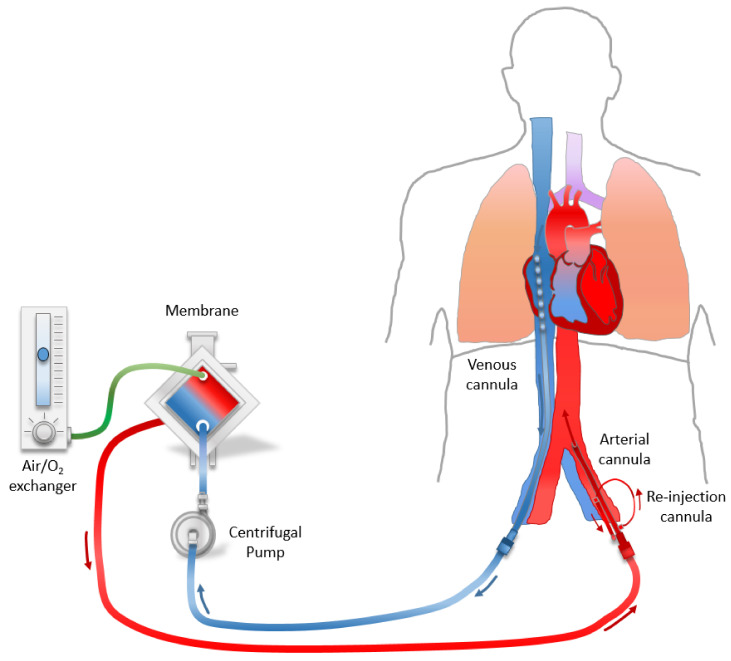
Cardiac arrest (CA) is a frequent cause of death and a major public health issue. To date, conventional cardiopulmonary resuscitation (CPR) is the only efficient method of resuscitation available that positively impacts prognosis. Extracorporeal membrane oxygenation (ECMO) is a complex and costly technique that requires technical expertise. It is not considered standard of care in all hospitals and should be applied only in high-volume facilities. ECMO combined with CPR is known as ECPR (extracorporeal cardiopulmonary resuscitation) and permits hemodynamic and respiratory stabilization of patients with CA refractory to conventional CPR. This technique allows the parallel treatment of the underlying etiology of CA while maintaining organ perfusion. However, current evidence does not support the routine use of ECPR in all patients with refractory CA. Therefore, an appropriate selection of patients who may benefit from this procedure is key. Reducing the duration of low blood flow by means of performing high-quality CPR and promoting access to ECPR, may improve the survival rate of the patients presenting with refractory CA. Indeed, patients who benefit from ECPR seem to carry better neurological outcomes. The aim of this present narrative review is to present the most recent literature available on ECPR and to clarify its potential therapeutic role, as well as to provide an in-depth explanation of equipment and its set up, the patient selection process, and the patient management post-ECPR.
心脏骤停(CA)是常见的死亡原因和主要的公共卫生问题。迄今为止,传统的心肺复苏术(CPR)是唯一可用的有效复苏方法,对预后有积极影响。体外膜肺氧合(ECMO)是一项复杂且昂贵的技术,需要专业技术知识。它并非所有医院的标准治疗方法,仅应在大型医疗机构中应用。ECMO与CPR联合使用被称为体外心肺复苏(ECPR),可使对传统CPR无效的CA患者实现血流动力学和呼吸稳定。该技术能在维持器官灌注的同时对CA的潜在病因进行并行治疗。然而,目前的证据并不支持对所有难治性CA患者常规使用ECPR。因此,恰当选择可能从该治疗中获益的患者是关键。通过实施高质量CPR并促进获得ECPR来缩短低血流持续时间,可能提高难治性CA患者的生存率。事实上,从ECPR中获益的患者似乎神经功能预后更好。本叙述性综述的目的是呈现关于ECPR的最新文献,阐明其潜在治疗作用,并深入解释设备及其设置、患者选择过程以及ECPR后的患者管理。