National Clinical Research Center for Metabolic Diseases, Key Laboratory of Diabetes Immunology of Ministry of Education, Department of Metabolism and Endocrinology, The Second Xiangya Hospital, Central South University, Changsha, China.
Department of Endocrinology, Changsha Central Hospital, Changsha, China.
JMIR Mhealth Uhealth. 2021 Feb 5;9(2):e25122. doi: 10.2196/25122.
Diabetes is a major health concern worldwide. Family member engagement in diabetes self-management education programs can improve patients' diabetes management. However, there is limited evidence that the family portal on diabetes management apps is effective in the glycemic control of patients with diabetes.
We aimed to evaluate the effectiveness of family support through the family portal function on Lilly Connected Care Program (LCCP) platform.
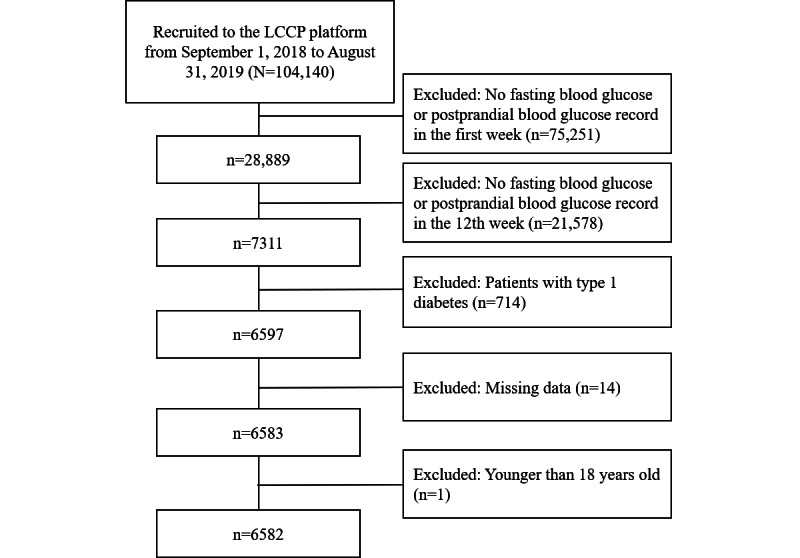
This retrospective cohort study included patients with type 2 diabetes recruited to the LCCP platform from September 1, 2018, to August 31, 2019. Propensity score matching was used to match family (group A) and non-family (group B) portal use groups with similar baseline characteristics. The patients were followed up with for 12 weeks. The main objectives were differences in mean fasting blood glucose, proportion of patients achieving fasting blood glucose target <7mmol/L, mean postprandial blood glucose, proportion of patients achieving postprandial blood glucose target <10mmol/L, proportion of patients achieving both fasting blood glucose <7mmol/L and postprandial blood glucose <10mmol/L, self-monitoring of blood glucose frequency at week 12 and the number of diabetes education courses patients completed during the 12 weeks. Moreover, logistic regression analysis was used to explore the baseline factors which may be associated with the use of family portal, and odds ratios with 95% confidence intervals were calculated.
A total of 6582 adult patients (aged ≥18 years) with type 2 diabetes who were receiving insulin therapy were enrolled in the study. Overall, 6.1% (402/6582) of the patients chose to engage their family members to use the family portal. Two groups of 394 patients were well-matched regarding baseline characteristics. After matching, mean fasting blood glucose and postprandial blood glucose at week 12 were significantly lower in group A than in group B (fasting blood glucose: 7.12 mmol/L, SD 1.70 vs 7.42 mmol/L, SD 1.88, respectively, P=.02; postprandial blood glucose: 8.56 mmol/L, SD 2.51 vs 9.10 mmol/L, SD 2.69, respectively, P=.002). When comparing group A to group B, the proportion of patients achieving both fasting blood glucose <7mmol and postprandial blood glucose <10mmol/L at week 12 (46.8% vs 39.4%, respectively, P=.04), self-monitoring of blood glucose frequency at week 12 (8.92 times per week, SD 6.77 vs 8.02 times per week, SD 5.97, respectively, P=.05) and number of diabetes education courses completed in 12 weeks (23.00, IQR9.00-38.00 vs 15.00, IQR 4.00-36.00, respectively, P<.001) was higher. Additionally, multivariate logistic regression analysis showed that higher age (OR=0.987, 95% CI 0.978-0.996, P=.006) and higher baseline fasting blood glucose (OR=0.914, 95% CI 0.859-0.972, P=.004) were correlated with less use of the family portal function, while increased baseline self-monitoring of blood glucose frequency (OR=1.022, 95% CI 1.012-1.032], P<.001) as well as increased education courses (OR=1.026, 95% CI 1.015-1.036, P<.001) were associated with more use of the family portal function.
Family support through the LCCP family portal is effective for glycemic control and self-management behavior improvement in type 2 diabetes patients.
糖尿病是全球主要的健康关注点。家庭成员参与糖尿病自我管理教育计划可以改善患者的糖尿病管理。然而,有限的证据表明,糖尿病管理应用程序的家庭门户在糖尿病患者的血糖控制方面是有效的。
我们旨在评估通过 Lilly Connected Care 计划(LCCP)平台的家庭支持功能的效果。
这是一项回顾性队列研究,纳入了 2018 年 9 月 1 日至 2019 年 8 月 31 日期间从 LCCP 平台招募的 2 型糖尿病患者。使用倾向评分匹配将有家庭(A 组)和无家庭(B 组)门户使用组与基线特征相似的患者进行匹配。对患者进行了 12 周的随访。主要目标是比较空腹血糖的平均值、空腹血糖目标<7mmol/L 的患者比例、餐后血糖的平均值、餐后血糖目标<10mmol/L 的患者比例、空腹血糖<7mmol/L 和餐后血糖<10mmol/L 的患者比例、第 12 周自我监测血糖的频率以及 12 周内完成的糖尿病教育课程数量。此外,还使用逻辑回归分析探讨了与家庭门户使用相关的基线因素,并计算了 95%置信区间的优势比。
共有 6582 名接受胰岛素治疗的成年 2 型糖尿病患者(年龄≥18 岁)参与了研究。总体而言,6.1%(402/6582)的患者选择让家庭成员使用家庭门户。两组各有 394 名患者的基线特征匹配良好。匹配后,A 组患者第 12 周的空腹血糖和餐后血糖明显低于 B 组(空腹血糖:7.12mmol/L,SD 1.70 与 7.42mmol/L,SD 1.88,P=.02;餐后血糖:8.56mmol/L,SD 2.51 与 9.10mmol/L,SD 2.69,P=.002)。与 B 组相比,A 组患者第 12 周同时达到空腹血糖<7mmol 和餐后血糖<10mmol/L 的比例更高(46.8%与 39.4%,P=.04),第 12 周自我监测血糖的频率更高(8.92 次/周,SD 6.77 与 8.02 次/周,SD 5.97,P=.05),12 周内完成的糖尿病教育课程更多(23.00,IQR9.00-38.00 与 15.00,IQR 4.00-36.00,P<.001)。此外,多变量逻辑回归分析显示,较高的年龄(OR=0.987,95%CI 0.978-0.996,P=.006)和较高的基线空腹血糖(OR=0.914,95%CI 0.859-0.972,P=.004)与家庭门户功能的使用减少相关,而较高的基线自我监测血糖频率(OR=1.022,95%CI 1.012-1.032,P<.001)和更多的教育课程(OR=1.026,95%CI 1.015-1.036,P<.001)与家庭门户功能的使用增加相关。
通过 Lilly Connected Care 计划的家庭支持,对 2 型糖尿病患者的血糖控制和自我管理行为改善有效。