Division of Nephrology, Department of Medicine I, University Hospital Würzburg, Oberduerrbacher Str. 6, 97080, Wuerzburg, Germany.
Department of Internal Medicine B, University Medicine Greifswald, Greifswald, Germany.
Int J Cardiovasc Imaging. 2021 Jun;37(6):1927-1936. doi: 10.1007/s10554-021-02176-5. Epub 2021 Feb 5.
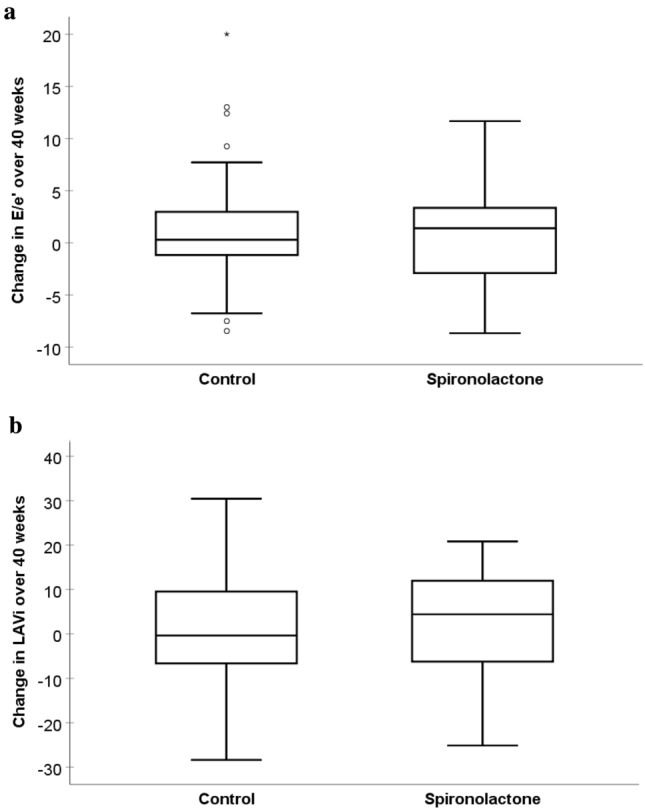
Heart failure with preserved ejection fraction (HFpEF) is highly prevalent in patients on maintenance haemodialysis (HD) and lacks effective treatment. We investigated the effect of spironolactone on cardiac structure and function with a specific focus on diastolic function parameters. The MiREnDa trial examined the effect of 50 mg spironolactone once daily versus placebo on left ventricular mass index (LVMi) among 97 HD patients during 40 weeks of treatment. In this echocardiographic substudy, diastolic function was assessed using predefined structural and functional parameters including E/e'. Changes in the frequency of HFpEF were analysed using the comprehensive 'HFA-PEFF score'. Complete echocardiographic assessment was available in 65 individuals (59.5 ± 13.0 years, 21.5% female) with preserved left ventricular ejection fraction (LVEF > 50%). At baseline, mean E/e' was 15.2 ± 7.8 and 37 (56.9%) patients fulfilled the criteria of HFpEF according to the HFA-PEFF score. There was no significant difference in mean change of E/e' between the spironolactone group and the placebo group (+ 0.93 ± 5.39 vs. + 1.52 ± 5.94, p = 0.68) or in mean change of left atrial volume index (LAVi) (1.9 ± 12.3 ml/m vs. 1.7 ± 14.1 ml/m, p = 0.89). Furthermore, spironolactone had no significant effect on mean change in LVMi (+ 0.8 ± 14.2 g/m vs. + 2.7 ± 15.9 g/m; p = 0.72) or NT-proBNP (p = 0.96). Treatment with spironolactone did not alter HFA-PEFF score class compared with placebo (p = 0.63). Treatment with 50 mg of spironolactone for 40 weeks had no significant effect on diastolic function parameters in HD patients.The trial has been registered at clinicaltrials.gov (NCT01691053; first posted Sep. 24, 2012).
射血分数保留的心力衰竭(HFpEF)在维持性血液透析(HD)患者中非常普遍,且缺乏有效治疗方法。我们研究了螺内酯对心脏结构和功能的影响,特别关注舒张功能参数。MiREnDa 试验在 40 周的治疗期间,检查了 97 名 HD 患者每天服用 50mg 螺内酯与安慰剂相比对左心室质量指数(LVMi)的影响。在这项超声心动图子研究中,使用包括 E/e'在内的预先确定的结构和功能参数评估舒张功能。HFpEF 频率的变化使用综合的“HFPEFF 评分”进行分析。在 65 名个体(59.5±13.0 岁,21.5%为女性)中进行了完整的超声心动图评估,这些个体的左心室射血分数(LVEF>50%)保留。在基线时,平均 E/e'为 15.2±7.8,根据 HFPEFF 评分,37 名(56.9%)患者符合 HFpEF 的标准。螺内酯组和安慰剂组的 E/e'平均变化无显著差异(+0.93±5.39 对+1.52±5.94,p=0.68)或左心房容积指数(LAVi)的平均变化(1.9±12.3ml/m 对 1.7±14.1ml/m,p=0.89)。此外,螺内酯对平均 LVMi 变化(+0.8±14.2g/m 对+2.7±15.9g/m;p=0.72)或 NT-proBNP(p=0.96)无显著影响。与安慰剂相比,螺内酯治疗并未改变 HFA-PEFF 评分类别(p=0.63)。40 周 50mg 螺内酯治疗对 HD 患者舒张功能参数无显著影响。该试验已在 clinicaltrials.gov 注册(NCT01691053;首次发布于 2012 年 9 月 24 日)。