Department of Cardiology (CBF), Charité Universitätsmedizin Berlin, Berlin, Germany.
Berlin Institute of Health Center for Regenerative Therapies (BCRT), Berlin, Germany.
Eur J Heart Fail. 2021 Nov;23(11):1891-1902. doi: 10.1002/ejhf.2210. Epub 2021 Jul 12.
Viral-induced cardiac inflammation can induce heart failure with preserved ejection fraction (HFpEF)-like syndromes. COVID-19 can lead to myocardial damage and vascular injury. We hypothesised that COVID-19 patients frequently develop a HFpEF-like syndrome, and designed this study to explore this.
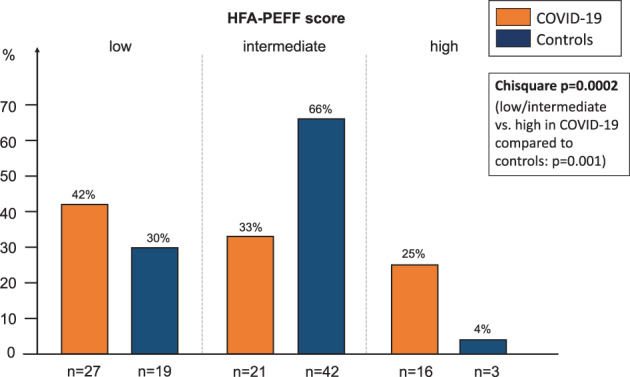
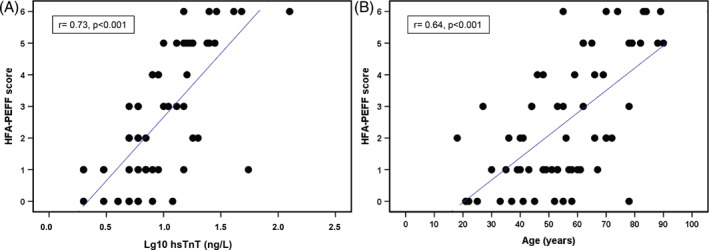
Cardiac function was assessed in 64 consecutive, hospitalized, and clinically stable COVID-19 patients from April-November 2020 with left ventricular ejection fraction (LVEF) ≥50% (age 56 ± 19 years, females: 31%, severe COVID-19 disease: 69%). To investigate likelihood of HFpEF presence, we used the HFA-PEFF score. A low (0-1 points), intermediate (2-4 points), and high (5-6 points) HFA-PEFF score was observed in 42%, 33%, and 25% of patients, respectively. In comparison, 64 subjects of similar age, sex, and comorbidity status without COVID-19 showed these scores in 30%, 66%, and 4%, respectively (between groups: P = 0.0002). High HFA-PEFF scores were more frequent in COVID-19 patients than controls (25% vs. 4%, P = 0.001). In COVID-19 patients, the HFA-PEFF score significantly correlated with age, estimated glomerular filtration rate, high-sensitivity troponin T (hsTnT), haemoglobin, QTc interval, LVEF, mitral E/A ratio, and H FPEF score (all P < 0.05). In multivariate, ordinal regression analyses, higher age and hsTnT were significant predictors of increased HFA-PEFF scores. Patients with myocardial injury (hsTnT ≥14 ng/L: 31%) vs. patients without myocardial injury, showed higher HFA-PEFF scores [median 5 (interquartile range 3-6) vs. 1 (0-3), P < 0.001] and more often showed left ventricular diastolic dysfunction (75% vs. 27%, P < 0.001).
Hospitalized COVID-19 patients frequently show high likelihood of presence of HFpEF that is associated with cardiac structural and functional alterations, and myocardial injury. Detailed cardiac assessments including echocardiographic determination of left ventricular diastolic function and biomarkers should become routine in the care of hospitalized COVID-19 patients.
病毒引起的心脏炎症可导致射血分数保留的心力衰竭(HFpEF)样综合征。COVID-19 可导致心肌损伤和血管损伤。我们假设 COVID-19 患者经常出现 HFpEF 样综合征,并设计本研究对此进行探讨。
2020 年 4 月至 11 月,我们连续评估了 64 例住院且临床稳定的 COVID-19 患者的心脏功能,这些患者的左心室射血分数(LVEF)≥50%(年龄 56±19 岁,女性占 31%,重症 COVID-19 疾病占 69%)。为了探讨 HFpEF 存在的可能性,我们使用了 HFA-PEFF 评分。42%、33%和 25%的患者的 HFA-PEFF 评分分别为低(0-1 分)、中(2-4 分)和高(5-6 分)。相比之下,64 名年龄、性别和合并症状况相似但没有 COVID-19 的患者的这些评分分别为 30%、66%和 4%(组间:P=0.0002)。COVID-19 患者的高 HFA-PEFF 评分比对照组更常见(25% vs. 4%,P=0.001)。在 COVID-19 患者中,HFA-PEFF 评分与年龄、估算肾小球滤过率、高敏肌钙蛋白 T(hsTnT)、血红蛋白、QTc 间期、LVEF、二尖瓣 E/A 比值和 H FPEF 评分显著相关(均 P<0.05)。在多变量有序回归分析中,较高的年龄和 hsTnT 是 HFA-PEFF 评分升高的显著预测因子。与无心肌损伤的患者相比,有心肌损伤(hsTnT≥14ng/L:31%)的患者 HFA-PEFF 评分更高[中位数 5(四分位距 3-6)比 1(0-3),P<0.001],且更常出现左心室舒张功能障碍(75% vs. 27%,P<0.001)。
住院 COVID-19 患者常出现 HFpEF 的高发生率,HFpEF 与心脏结构和功能改变以及心肌损伤有关。详细的心脏评估,包括左心室舒张功能的超声心动图测定和生物标志物,应成为住院 COVID-19 患者常规治疗的一部分。