Institute of Biological and Chemical Systems, Karlsruhe Institute of Technology, Eggenstein-Leopoldshafen, Germany.
School of Life Sciences, Lanzhou University, Lanzhou, PR China.
PLoS Genet. 2021 Feb 5;17(2):e1009356. doi: 10.1371/journal.pgen.1009356. eCollection 2021 Feb.
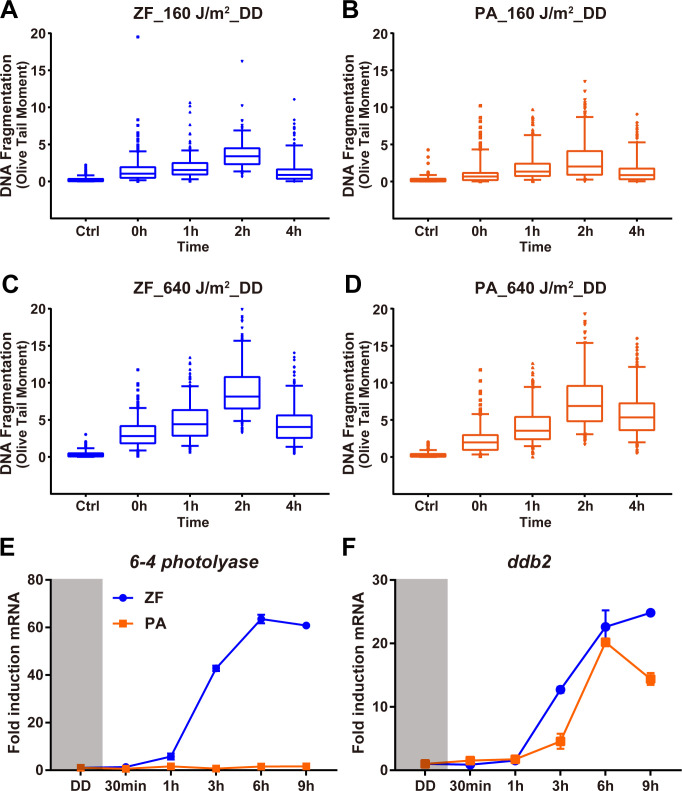
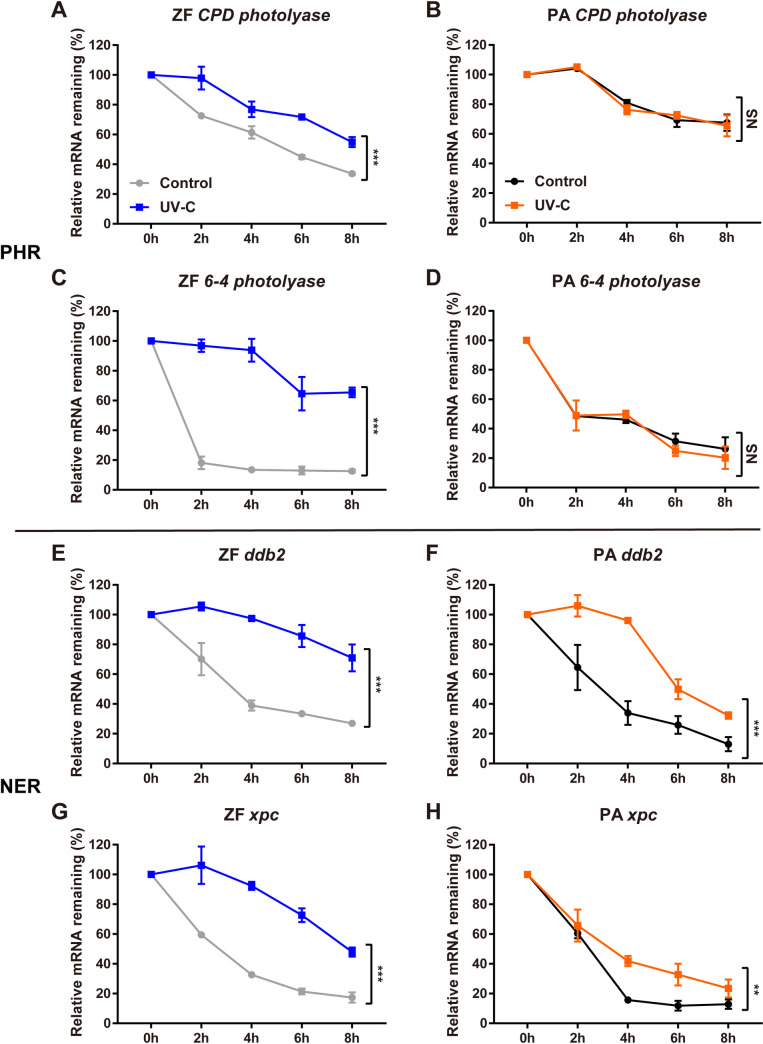
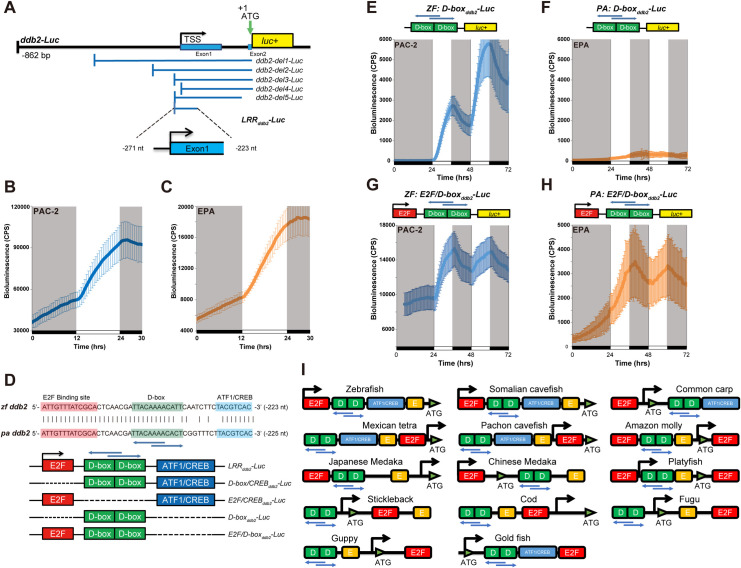
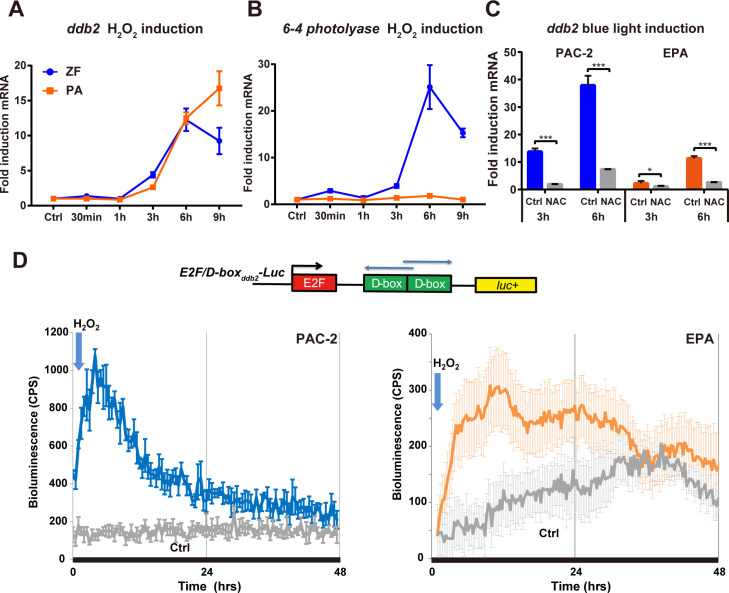
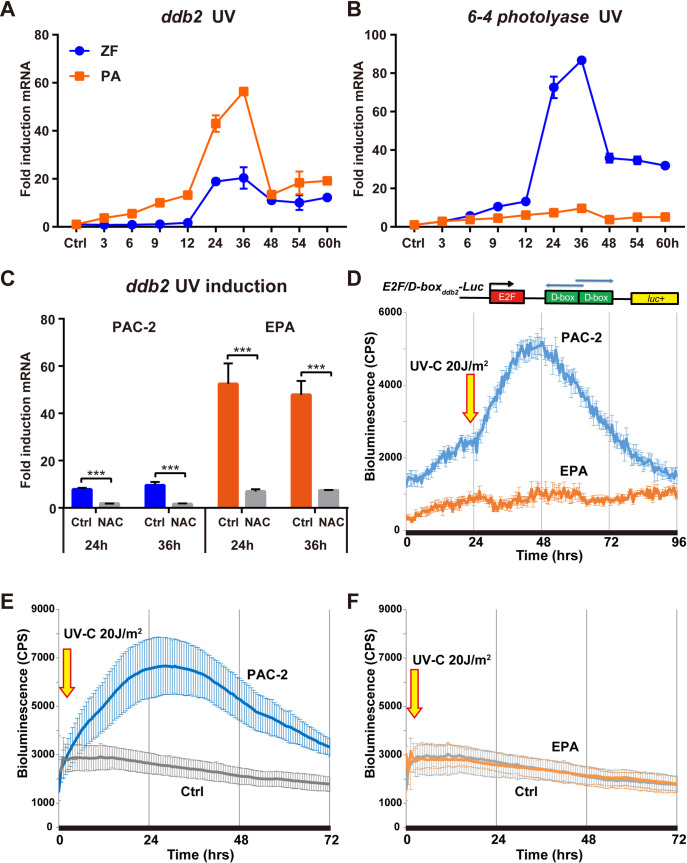
We have gained considerable insight into the mechanisms which recognize and repair DNA damage, but how they adapt to extreme environmental challenges remains poorly understood. Cavefish have proven to be fascinating models for exploring the evolution of DNA repair in the complete absence of UV-induced DNA damage and light. We have previously revealed that the Somalian cavefish Phreatichthys andruzzii, lacks photoreactivation repair via the loss of light, UV and ROS-induced photolyase gene transcription mediated by D-box enhancer elements. Here, we explore whether other systems repairing UV-induced DNA damage have been similarly affected in this cavefish model. By performing a comparative study using P. andruzzii and the surface-dwelling zebrafish, we provide evidence for a conservation of sunlight-regulated Nucleotide Excision Repair (NER). Specifically, the expression of the ddb2 gene which encodes a key NER recognition factor is robustly induced following exposure to light, UV and oxidative stress in both species. As in the case of the photolyase genes, D-boxes in the ddb2 promoter are sufficient to induce transcription in zebrafish. Interestingly, despite the loss of D-box-regulated photolyase gene expression in P. andruzzii, the D-box is required for ddb2 induction by visible light and oxidative stress in cavefish. However, in the cavefish ddb2 gene this D-box-mediated induction requires cooperation with an adjacent, highly conserved E2F element. Furthermore, while in zebrafish UV-induced ddb2 expression results from transcriptional activation accompanied by stabilization of the ddb2 mRNA, in P. andruzzii UV induces ddb2 expression exclusively via an increase in mRNA stability. Thus, we reveal plasticity in the transcriptional and post transcriptional mechanisms regulating the repair of sunlight-induced DNA damage under long-term environmental challenges.
我们已经深入了解了识别和修复 DNA 损伤的机制,但它们如何适应极端环境挑战仍知之甚少。洞穴鱼已被证明是探索在完全缺乏 UV 诱导的 DNA 损伤和光照的情况下 DNA 修复进化的迷人模型。我们之前已经揭示,索马里洞穴鱼 Phreatichthys andruzzii 通过失去光、UV 和 ROS 诱导的光解酶基因转录来修复光解修复,这种转录是由 D 盒增强子元件介导的。在这里,我们探讨了在这种洞穴鱼模型中,其他修复 UV 诱导的 DNA 损伤的系统是否也受到类似的影响。通过对 P. andruzzii 和表面生活的斑马鱼进行比较研究,我们为阳光调节的核苷酸切除修复(NER)提供了证据。具体来说,在两种物种中,暴露于光、UV 和氧化应激后,编码关键 NER 识别因子的 ddb2 基因的表达被强烈诱导。与光解酶基因的情况一样,ddb2 启动子中的 D 盒足以在斑马鱼中诱导转录。有趣的是,尽管 P. andruzzii 中 D 盒调节的光解酶基因表达丧失,但 D 盒是洞穴鱼可见光和氧化应激诱导 ddb2 所必需的。然而,在洞穴鱼的 ddb2 基因中,这种 D 盒介导的诱导需要与相邻的高度保守的 E2F 元件合作。此外,虽然在斑马鱼中,UV 诱导的 ddb2 表达是由于转录激活伴随着 ddb2 mRNA 的稳定化,但在 P. andruzzii 中,UV 仅通过增加 mRNA 稳定性来诱导 ddb2 表达。因此,我们揭示了在长期环境挑战下,调节阳光诱导的 DNA 损伤修复的转录和转录后机制的可塑性。