Department of Ophthalmology, Department of Morphofunctional Sciences I - Histology, Faculty of Medicine, Grigore T. Popa University of Medicine and Pharmacy, Iaşi, Romania;
Rom J Morphol Embryol. 2020 Apr-Jun;61(2):477-483. doi: 10.47162/RJME.61.2.17.
The definition of fetal growth restriction (FGR) refers to the incapability of a fetus to achieve the appropriate estimated growth, with expected fetal weight below the 10th percentile calculated for its gestational age. Placental factors and hypoxemia are considered to be essential elements with influence on intrauterine growth restriction (IUGR) and fetal death. The purpose of the present study was to investigate the macroscopic and microscopic pathological findings regarding the placentas in pregnancies complicated by influence on IUGR.
PATIENTS, MATERIALS AND METHODS: Our study included 42 third-trimester pregnant patients admitted to the Cuza Vodă Hospital of Obstetrics and Gynecology, Iaşi, Romania, in the last three years. Soon after delivery, the 42 placentas were collected and analyzed; 32 placentas came from cases previously diagnosed with influence on IUGR and were included in our study group. Ten other placentas included in the control group were selected from uncomplicated pregnancies. Standard Hematoxylin-Eosin (HE) staining method, as well as Periodic Acid-Schiff (PAS) staining, and immunohistochemical techniques for cluster of differentiation 31 (CD31) and collagen IV were used in order to highlight the morphological features of the studied placentas.
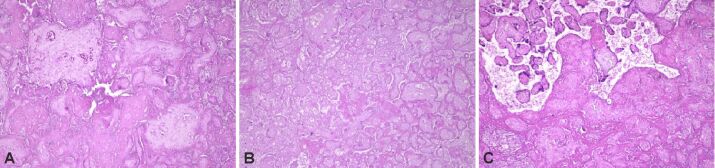
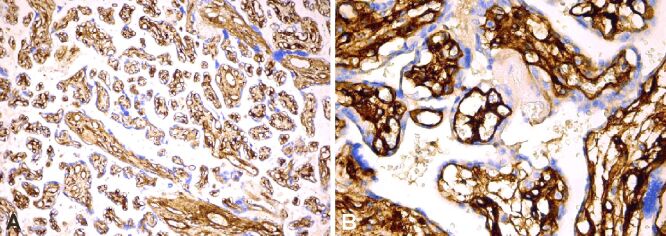
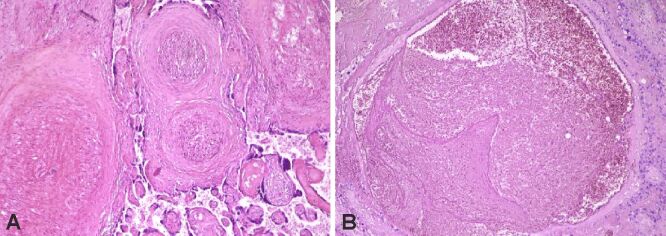
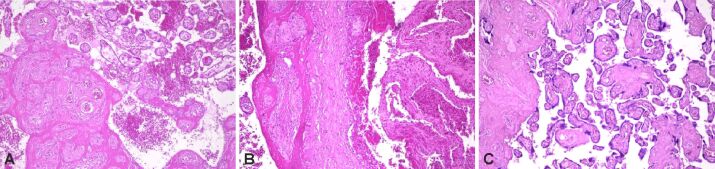
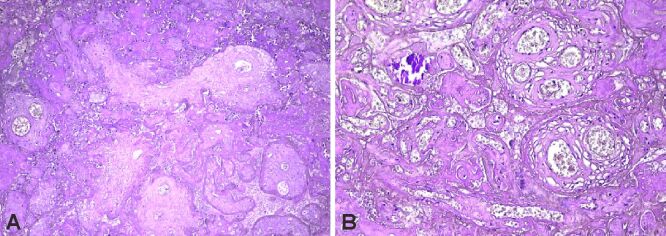
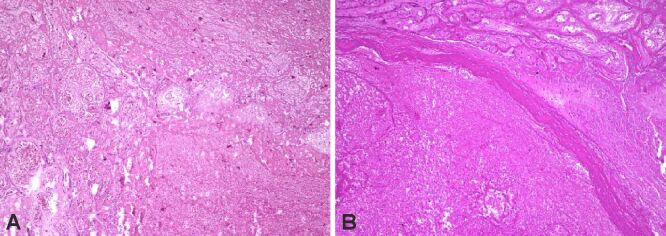
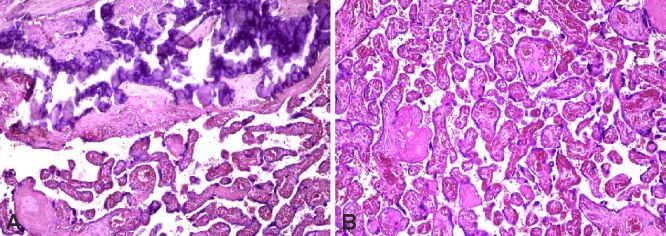
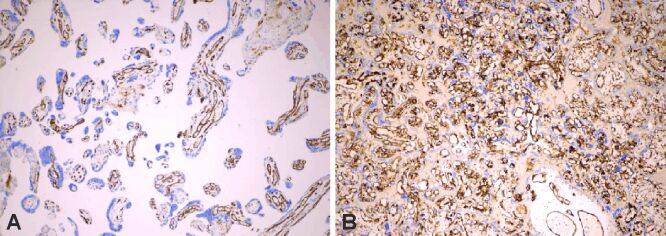
Our study revealed that reduced placental dimensions and eccentric umbilical cord insertion are correlated with the birthweight of the fetuses with IUGR (p<0.05). The most common histological finding in our study group was placental infarction later correlated with IUGR, but a certain causality could not be demonstrated, as this finding was also present in normal pregnancies. Other histopathological findings were also present in the influence on IUGR group, such as fibrin deposits, diffuse calcification, chronic villitis, avascular chronical villi, with no significant statistical correlations. CD31 was strongly immunoexpressed in the villous endothelial cells. Collagen IV presented a strong immunoreaction in the basement membrane and mesenchyme of the placental villi.
Our study revealed a correlation between the dimensions of the diameters and volume of the maternal placenta and the presence of influence on IUGR. Moreover, it confirms the available data suggesting that the place of insertion of the umbilical cord is correlated with the weight of the fetus. Further studies with extended panel antibodies are needed in order to determine and complete the role of these morphological changes in the development of influence on IUGR.
胎儿生长受限(FGR)的定义是指胎儿无法达到适当的预期生长,其预期体重低于其胎龄计算的第 10 个百分位数。胎盘因素和缺氧被认为是对宫内生长受限(IUGR)和胎儿死亡有影响的基本要素。本研究旨在探讨影响 IUGR 的妊娠中胎盘的大体和微观病理发现。
患者、材料和方法:我们的研究包括罗马尼亚雅西库扎沃达妇产科医院在过去三年中收治的 42 名孕晚期患者。分娩后不久,采集并分析了 42 个胎盘;32 个胎盘来自先前诊断为 IUGR 的病例,并纳入我们的研究组。对照组中还选择了 10 个来自无并发症妊娠的其他胎盘。使用标准苏木精-伊红(HE)染色法、过碘酸希夫(PAS)染色法以及 CD31 和 IV 型胶原的免疫组织化学技术,突出研究胎盘的形态特征。
我们的研究表明,胎盘尺寸减小和脐带偏心插入与 IUGR 胎儿的出生体重相关(p<0.05)。在我们的研究组中,最常见的组织学发现是胎盘梗死,随后与 IUGR 相关,但不能证明这种相关性存在因果关系,因为这种发现也存在于正常妊娠中。在影响 IUGR 组中还存在其他组织病理学发现,如纤维蛋白沉积、弥漫性钙化、慢性绒毛炎、无血管慢性绒毛,没有显著的统计学相关性。CD31 在绒毛内皮细胞中强烈免疫表达。IV 型胶原在胎盘绒毛的基膜和间质中呈现强烈的免疫反应。
我们的研究表明,母体胎盘的直径和体积与 IUGR 的存在之间存在相关性。此外,它证实了现有的数据表明,脐带的插入位置与胎儿的体重相关。需要进一步进行具有扩展面板抗体的研究,以确定和完善这些形态变化在 IUGR 发展中的作用。