Brouillet Sophie, Dufour Anaïs, Prot Fabien, Feige Jean-Jacques, Equy Véronique, Alfaidy Nadia, Gillois Pierre, Hoffmann Pascale
Gynaecology, Obstetric and Reproductive Medicine Department, Grenoble University Hospital, BP 217, 38043 Grenoble Cedex, France ; Commissariat à l'Energie Atomique (CEA), DSV-iRTSV, 38043 Grenoble Cedex, France ; Université Grenoble-Alpes, 38041 Grenoble, France ; Institut National de la Santé et de la Recherche Médicale U1036 (INSERM U1036), Laboratoire Biologie du Cancer et de l'Infection (BCI), Laboratoire BCI-iRTSV, CEA Grenoble, 17 rue des Martyrs, 38054 Grenoble Cedex 9, France.
Gynaecology, Obstetric and Reproductive Medicine Department, Grenoble University Hospital, BP 217, 38043 Grenoble Cedex, France.
Biomed Res Int. 2014;2014:341251. doi: 10.1155/2014/341251. Epub 2014 May 25.
To determine whether the umbilical cord insertion site of singleton pregnancies could be linked to the newborn birth weight at term and its individual growth potential achievement.
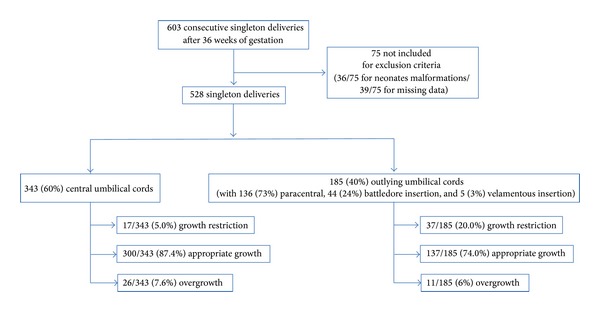
A cohort study including 528 records of term neonates was performed. Each neonate was assessed for growth adjusted for gestational age according to the infant's growth potential using the AUDIPOG module. We considered two categories of umbilical cord insertions: central and peripheral. Intrauterine growth restriction was defined as birth weight below the 10th percentile. Statistical analysis was performed using Chi-square, Student's t test, Wilcoxon test, ANOVA, and logistic regression.
We observed a total of 343 centrally inserted cords versus 185 peripheral cords. There were twice as many smokers in the mothers of the peripheral category compared to the centrally inserted ones. More importantly, we demonstrated that only 17/343 (5.0%) of infants with central cord insertion were growth restricted, compared to 37/185 (20.0%) of the infants born with a peripheral insertion. Neonates with centrally inserted cord were significantly heavier.
The umbilical cord insertion site of singleton pregnancies is associated with the newborn's birth weight at term and its individual growth potential achievement.
确定单胎妊娠的脐带插入部位是否与足月新生儿出生体重及其个体生长潜能的实现有关。
进行了一项队列研究,纳入了528例足月新生儿的记录。根据婴儿的生长潜能,使用AUDIPOG模块对每个新生儿进行了根据胎龄调整的生长评估。我们考虑了两类脐带插入:中央型和周围型。宫内生长受限定义为出生体重低于第10百分位数。使用卡方检验、学生t检验、威尔科克森检验、方差分析和逻辑回归进行统计分析。
我们共观察到343例中央型插入脐带的新生儿和185例周围型插入脐带的新生儿。周围型插入脐带新生儿的母亲中吸烟者的数量是中央型插入脐带新生儿母亲的两倍。更重要的是,我们发现,中央型插入脐带的婴儿中只有17/343(5.0%)生长受限,而周围型插入脐带出生的婴儿中这一比例为37/185(20.0%)。中央型插入脐带的新生儿体重明显更重。
单胎妊娠的脐带插入部位与足月新生儿出生体重及其个体生长潜能的实现有关。