Department of Biomedical and Biotechnological Sciences, University of Catania, Via Santa Sofia 97, 95123 Catania, Italy.
Department of Neurology and Stroke Unit, San Camillo de' Lellis General Hospital, Viale Kennedy 1, 02100 Rieti, Italy.
Int J Environ Res Public Health. 2021 Feb 3;18(4):1415. doi: 10.3390/ijerph18041415.
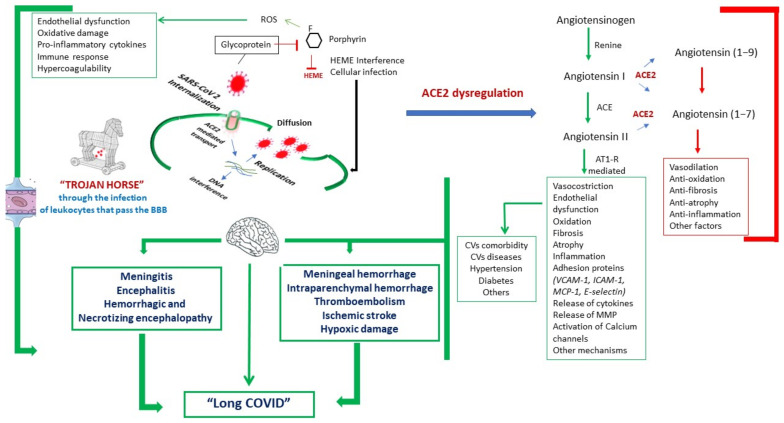
Neuroinvasive properties of SARS-CoV-2 have allowed the hypothesis of several pathogenic mechanisms related to acute and chronic neurological sequelae. However, neuropathological correlates have been poorly systematically investigated, being retrieved from reports of single case or limited case series still.
A PubMed search was carried out to review all publications on autopsy in subjects with "COronaVIrus Disease-19" (COVID-19). Among them, we focused on histological findings of the brain, which were compared with those from the authors' autoptic studies performed in some COVID-19 patients.
Only seven studies reported histological evidence of brain pathology in patients deceased for COVID-19, including three with reverse transcription-quantitative polymerase chain reaction evidence of viral infection. All these studies, in line with our experience, showed vascular-related and infection-related secondary inflammatory tissue damage due to an abnormal immune response. It is still unclear, however, whether these findings are the effect of a direct viral pathology or rather reflect a non-specific consequence of cardiovascular and pulmonary disease on the brain.
Notwithstanding the limited evidence available and the heterogeneity of the studies, we provide a preliminary description of the relationship between SARS-CoV-2 and brain sequelae. Systematic autoptic investigations are needed for accurate detection and adequate management of these patients.
SARS-CoV-2 的神经侵袭特性使得人们提出了几种与急性和慢性神经系统后遗症相关的发病机制假说。然而,神经病理学相关性尚未得到系统的深入研究,目前的研究结果仅来自于单一病例或有限的病例系列报告。
我们对 PubMed 数据库进行了检索,以查阅所有关于“COVID-19”尸检的出版物。在这些出版物中,我们重点关注大脑的组织学发现,并将其与作者在一些 COVID-19 患者尸检中获得的发现进行比较。
仅有七项研究报告了 COVID-19 死亡患者的大脑病理学组织学证据,其中三项研究通过逆转录-定量聚合酶链反应(RT-qPCR)检测到了病毒感染。所有这些研究与我们的经验一致,均显示了血管相关和感染相关的继发性炎症组织损伤,这是由于异常的免疫反应所致。然而,目前尚不清楚这些发现是直接的病毒病理学作用的结果,还是心血管和肺部疾病对大脑的非特异性影响的结果。
尽管目前的证据有限且研究存在异质性,但我们对 SARS-CoV-2 与大脑后遗症之间的关系进行了初步描述。需要进行系统的尸检调查,以准确检测和妥善管理这些患者。