BGI Genomics, BGI-Shenzhen, Shenzhen, 518083, China.
Tianjin Medical Laboratory, BGI-Tianjin, BGI-Shenzhen, Tianjin, 300308, China.
Genome Med. 2021 Feb 5;13(1):18. doi: 10.1186/s13073-021-00836-8.
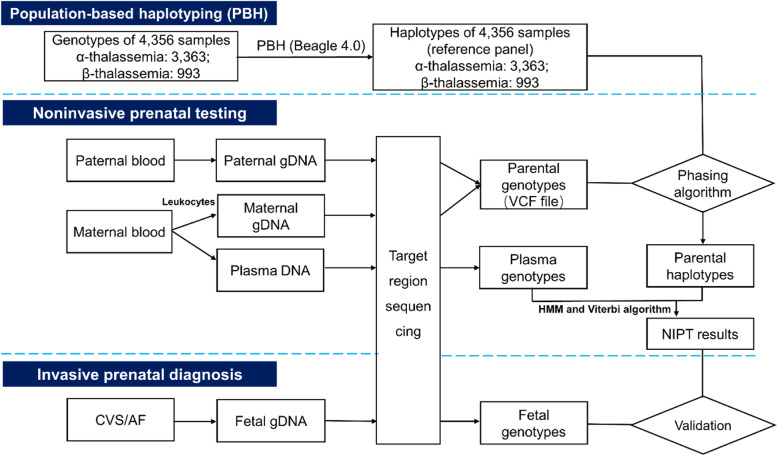
Noninvasive prenatal testing (NIPT) of recessive monogenic diseases depends heavily on knowing the correct parental haplotypes. However, the currently used family-based haplotyping method requires pedigrees, and molecular haplotyping is highly challenging due to its high cost, long turnaround time, and complexity. Here, we proposed a new two-step approach, population-based haplotyping-NIPT (PBH-NIPT), using α-thalassemia and β-thalassemia as prototypes.
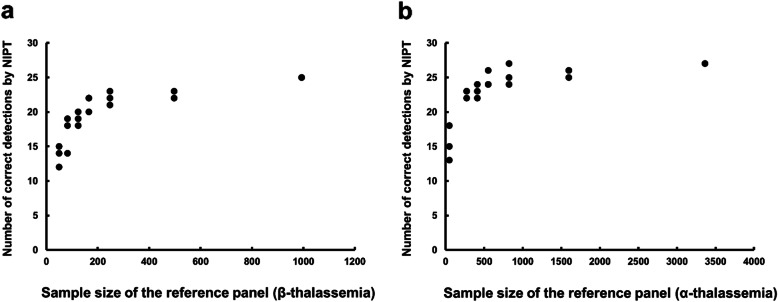
First, we deduced parental haplotypes with Beagle 4.0 with training on a large retrospective carrier screening dataset (4356 thalassemia carrier screening-positive cases). Second, we inferred fetal haplotypes using a parental haplotype-assisted hidden Markov model (HMM) and the Viterbi algorithm.
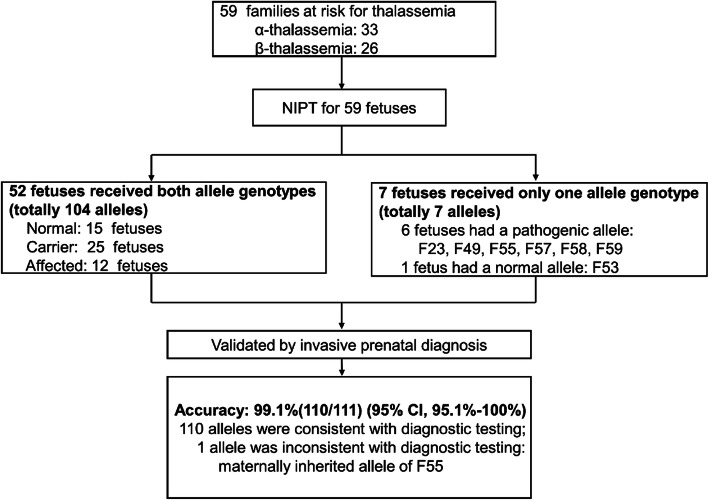
With this approach, we enrolled 59 couples at risk of having a fetus with thalassemia and successfully inferred 94.1% (111/118) of fetal alleles. We confirmed these alleles by invasive prenatal diagnosis, with 99.1% (110/111) accuracy (95% CI, 95.1-100%).
These results demonstrate that PBH-NIPT is a sensitive, fast, and inexpensive strategy for NIPT of thalassemia.
隐性单基因疾病的无创性产前检测(NIPT)严重依赖于正确的父母单体型。然而,目前使用的基于家系的单体型分析方法需要系谱,而由于其成本高、周转时间长且复杂,分子单体型分析极具挑战性。在这里,我们提出了一种新的两步法,即基于人群的单体型分析-NIPT(PBH-NIPT),以α-地中海贫血和β-地中海贫血为原型。
首先,我们使用 Beagle 4.0 进行推断,该软件在一个大型回顾性携带者筛查数据集(4356 例地中海贫血携带者筛查阳性病例)上进行了训练。其次,我们使用父单体型辅助隐马尔可夫模型(HMM)和维特比算法推断胎儿单体型。
使用这种方法,我们招募了 59 对有生育地中海贫血胎儿风险的夫妇,并成功推断了 94.1%(111/118)的胎儿等位基因。我们通过侵入性产前诊断来确认这些等位基因,准确率为 99.1%(110/111)(95%置信区间,95.1-100%)。
这些结果表明,PBH-NIPT 是一种敏感、快速且廉价的地中海贫血 NIPT 策略。