School of Automation Science & Engineering, South China University of Technology, Guangzhou, 510641, China.
Shenzhen Jingke Gene Technology Co. Ltd, Shenzhen, 518052, China.
Sci Rep. 2021 Mar 11;11(1):5714. doi: 10.1038/s41598-021-85128-2.
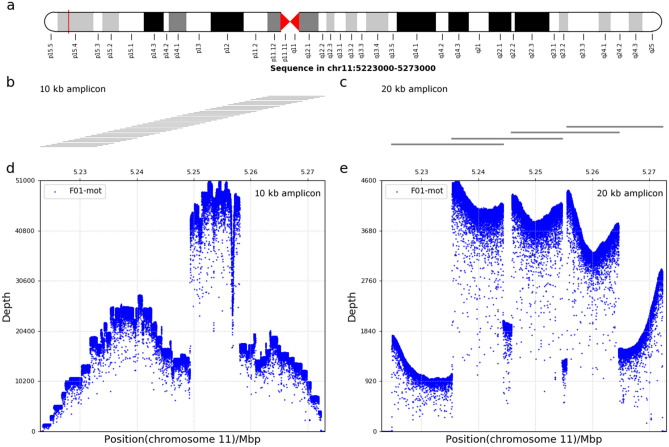
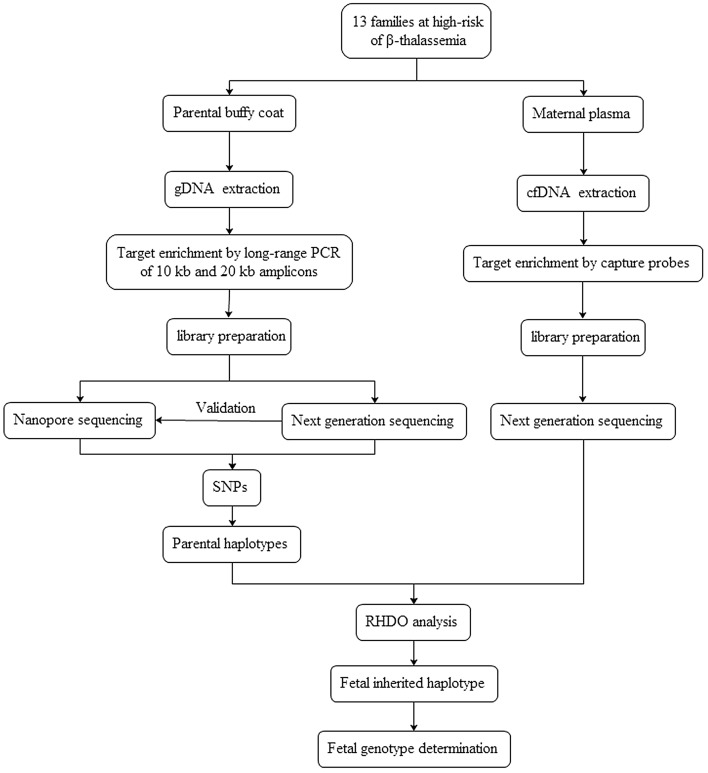
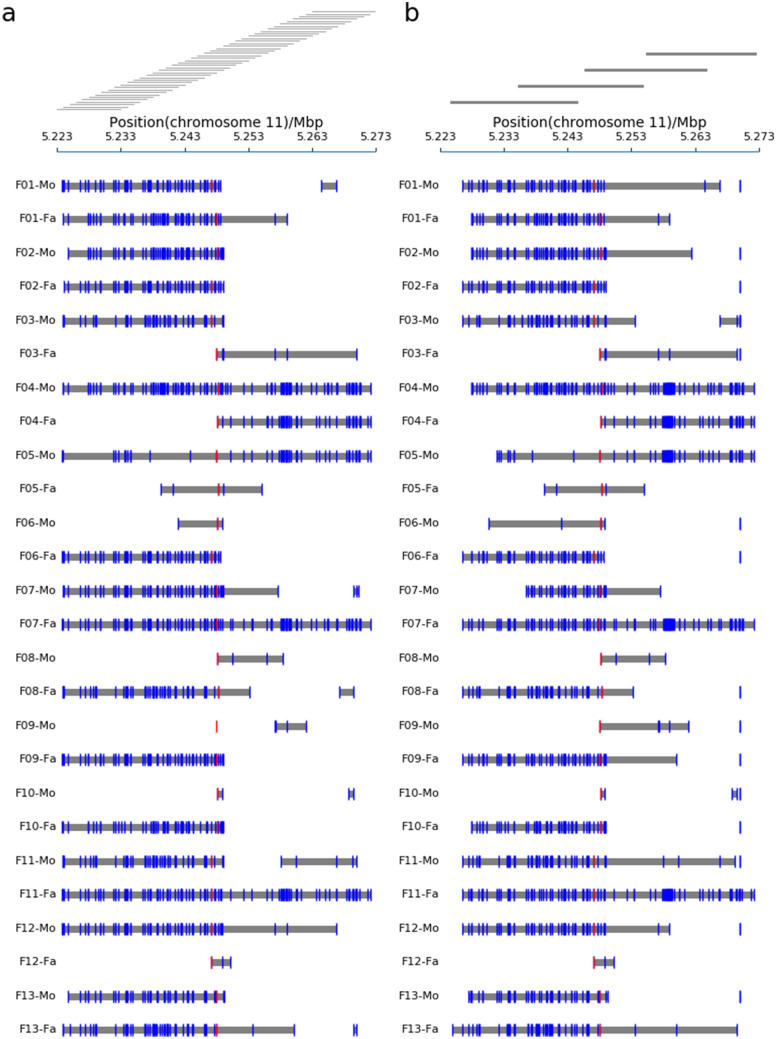
Noninvasive prenatal testing (NIPT) for single gene disorders remains challenging. One approach that allows for accurate detection of the slight increase of the maternally inherited allele is the relative haplotype dosage (RHDO) analysis, which requires the construction of parental haplotypes. Recently, the nanopore sequencing technologies have become available and may be an ideal tool for direct construction of haplotypes. Here, we explored the feasibility of combining nanopore sequencing with the RHDO analysis in NIPT of β-thalassemia. Thirteen families at risk for β-thalassemia were recruited. Targeted region of parental genomic DNA was amplified by long-range PCR of 10 kb and 20 kb amplicons. Parental haplotypes were constructed using nanopore sequencing and next generation sequencing data. Fetal inheritance of parental haplotypes was classified by the RHDO analysis using data from maternal plasma DNA sequencing. Haplotype phasing was achieved in 12 families using data from 10 kb library. While data from the 20 kb library gave a better performance that haplotype phasing was achieved in all 13 families. Fetal status was correctly classified in 12 out of 13 families. Thus, targeted nanopore sequencing combined with the RHDO analysis is feasible to NIPT for β-thalassemia.
单基因疾病的无创性产前检测 (NIPT) 仍然具有挑战性。一种能够准确检测母体遗传等位基因轻微增加的方法是相对单体型剂量 (RHDO) 分析,该方法需要构建亲本单体型。最近,纳米孔测序技术已经问世,可能成为直接构建单体型的理想工具。在这里,我们探讨了将纳米孔测序与 RHDO 分析结合用于β-地中海贫血 NIPT 的可行性。招募了 13 个有β-地中海贫血风险的家庭。通过长距离 PCR 将 10 kb 和 20 kb 扩增子扩增目标区域的父母基因组 DNA。使用纳米孔测序和下一代测序数据构建亲本单体型。使用来自母体血浆 DNA 测序的数据通过 RHDO 分析对胎儿从父母获得的单体型进行分类。使用 10 kb 文库数据实现了 12 个家庭的单体型定相。虽然来自 20 kb 文库的数据表现更好,但所有 13 个家庭都实现了单体型定相。13 个家庭中的 12 个正确分类了胎儿状态。因此,靶向纳米孔测序结合 RHDO 分析可用于β-地中海贫血的 NIPT。