Harris E, Diaz-Pines E, Stoll E, Schloter M, Schulz S, Duffner C, Li K, Moore K L, Ingrisch J, Reinthaler D, Zechmeister-Boltenstern S, Glatzel S, Brüggemann N, Bahn M
Plant, Soil and Ecosystem Processes Research Group, Department of Ecology, University of Innsbruck, Sternwartestrasse 15, 6020 Innsbruck, Austria.
Institute of Soil Research, University of Natural Resources and Life Sciences, Vienna, Peter-Jordan-Straße 82, 1190 Vienna, Austria.
Sci Adv. 2021 Feb 5;7(6). doi: 10.1126/sciadv.abb7118. Print 2021 Feb.
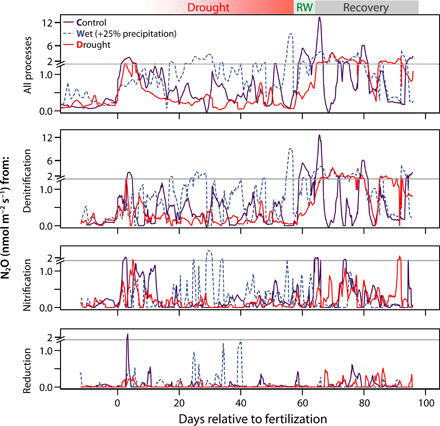
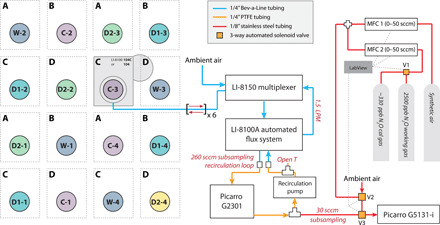
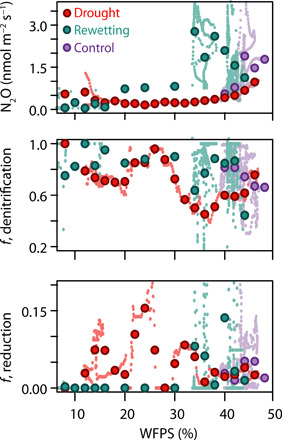
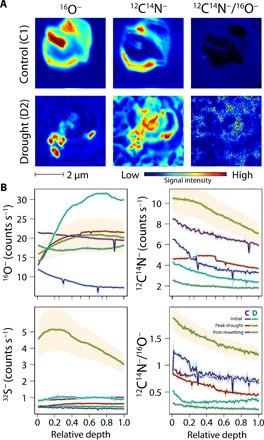
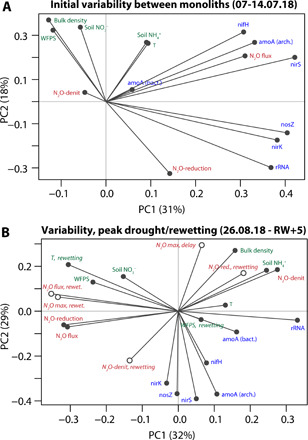
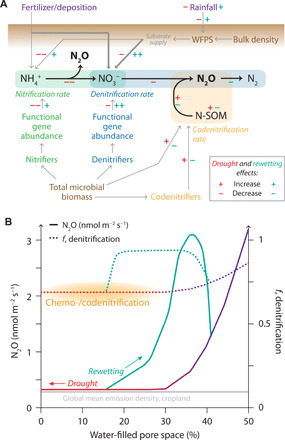
Nitrous oxide is a powerful greenhouse gas whose atmospheric growth rate has accelerated over the past decade. Most anthropogenic NO emissions result from soil N fertilization, which is converted to NO via oxic nitrification and anoxic denitrification pathways. Drought-affected soils are expected to be well oxygenated; however, using high-resolution isotopic measurements, we found that denitrifying pathways dominated NO emissions during a severe drought applied to managed grassland. This was due to a reversible, drought-induced enrichment in nitrogen-bearing organic matter on soil microaggregates and suggested a strong role for chemo- or codenitrification. Throughout rewetting, denitrification dominated emissions, despite high variability in fluxes. Total NO flux and denitrification contribution were significantly higher during rewetting than for control plots at the same soil moisture range. The observed feedbacks between precipitation changes induced by climate change and NO emission pathways are sufficient to account for the accelerating NO growth rate observed over the past decade.
一氧化二氮是一种强大的温室气体,在过去十年中其在大气中的增长速度加快。大多数人为排放的一氧化二氮源于土壤氮肥施用,通过有氧硝化作用和缺氧反硝化作用途径转化为一氧化二氮。预计受干旱影响的土壤含氧量充足;然而,通过高分辨率同位素测量,我们发现,在对管理草地施加严重干旱期间,反硝化作用途径主导了一氧化二氮排放。这是由于土壤微团聚体上含氮有机物出现了可逆的、干旱诱导的富集现象,这表明化学反硝化作用或共反硝化作用发挥了重要作用。在整个再湿润过程中,尽管通量变化很大,但反硝化作用主导了排放。在相同土壤湿度范围内,再湿润期间的一氧化二氮总通量和反硝化作用贡献显著高于对照地块。气候变化引起的降水变化与一氧化二氮排放途径之间观察到的反馈足以解释过去十年中观察到的一氧化二氮加速增长速度。