Leeds Institute of Rheumatic and Musculoskeletal Medicine, University of Leeds, Leeds, UK.
National Institute for Health Research (NIHR), Leeds Biomedical Research Centre (BRC), Leeds Teaching Hospitals, Leeds, UK.
Nat Rev Rheumatol. 2021 Mar;17(3):145-157. doi: 10.1038/s41584-020-00571-1. Epub 2021 Feb 5.
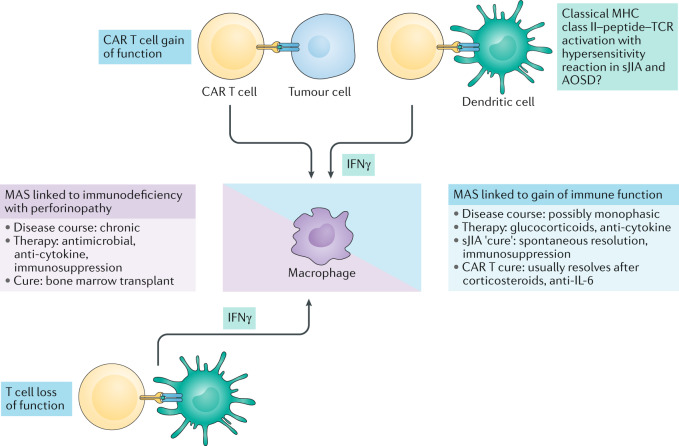
A hyperinflammatory 'cytokine storm' state termed macrophage activation syndrome (MAS), culminating from a complex interplay of genetics, immunodeficiency, infectious triggers and dominant innate immune effector responses, can develop across disparate entities including systemic juvenile idiopathic arthritis (sJIA) and its counterpart adult-onset Still disease (AOSD), connective tissue diseases, sepsis, infection, cancers and cancer immunotherapy. Classifying MAS using the immunological disease continuum model, with strict boundaries that define the limits of innate and adaptive immunity, at one boundary is MAS with loss of immune function, as occurs in the 'perforinopathies' and some cases of sJIA-AOSD. Conversely, at the other boundary, immune hypersensitivity with gain of immune function in MHC class II-associated sJIA-AOSD and with chimeric antigen receptor (CAR) T cell therapy also triggers MAS. This provides a benchmark for evaluating severe inflammation in some patients with COVID-19 pneumonia, which cripples primary type I interferon immunity and usually culminates in a lung-centric 'second wave' cytokine-driven alveolitis with associated immunothrombosis; this phenomenon is generally distinct from MAS but can share features with the proposed 'loss of immune function' MAS variant. This loss and gain of function MAS model offers immune cartography for a novel mechanistic classification of MAS with therapeutic implications.
一种称为巨噬细胞活化综合征(MAS)的超炎症“细胞因子风暴”状态,是由遗传、免疫缺陷、感染触发因素和主要先天免疫效应反应的复杂相互作用引起的,可发生在包括全身幼年特发性关节炎(sJIA)及其成人发病Still 病(AOSD)、结缔组织疾病、败血症、感染、癌症和癌症免疫治疗在内的不同实体中。使用免疫学疾病连续体模型对 MAS 进行分类,其边界严格定义了先天免疫和适应性免疫的界限,在一个边界是免疫功能丧失的 MAS,如“穿孔素病”和一些 sJIA-AOSD 病例中发生的情况。相反,在另一个边界,MHC 类 II 相关的 sJIA-AOSD 和嵌合抗原受体(CAR)T 细胞治疗中的免疫过敏,即免疫功能获得,也会引发 MAS。这为评估一些 COVID-19 肺炎患者的严重炎症提供了一个基准,这些患者的先天 I 型干扰素免疫功能受损,通常最终导致以肺为中心的“第二波”细胞因子驱动的肺泡炎,伴有免疫性血栓形成;这种现象通常与 MAS 不同,但可能与所提出的“免疫功能丧失”MAS 变体具有共同特征。这种功能丧失和获得的 MAS 模型为 MAS 的新型机制分类提供了免疫图谱,并具有治疗意义。