Rochester Regional Health, Rochester, NY; University of Rochester, Rochester, NY.
Mercy Hospital, Springfield, Mo.
J Allergy Clin Immunol Pract. 2021 May;9(5):1858-1863. doi: 10.1016/j.jaip.2021.01.036. Epub 2021 Feb 3.
The SarsCoV2, novel coronavirus (COVID-19) pandemic necessitated a rapid transition from in-person evaluations to remote delivery of care, including both video and telephone visits, in allergy/immunology practices.
To evaluate patient satisfaction, patient and physician impression of encounter completeness, and reimbursement between in-person, video, and telephone encounters. This study also assessed factors influencing patient satisfaction, perception of completeness, and choice of future evaluation type.
This was a prospective study of all encounters at a health care-system owned practice. Encounter type, encounter modality, patient demographics, primary diagnoses, reimbursement data, and physician assessment of encounter completeness were tracked. Patient satisfaction was assessed via standardized questions.
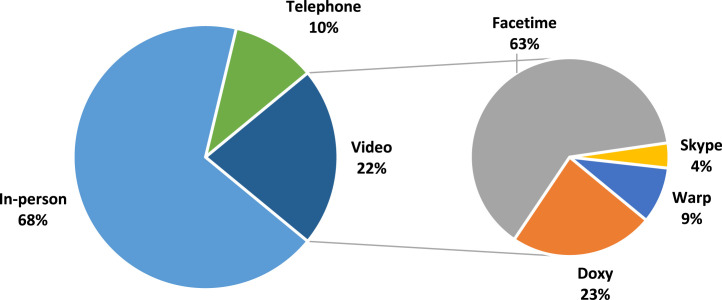
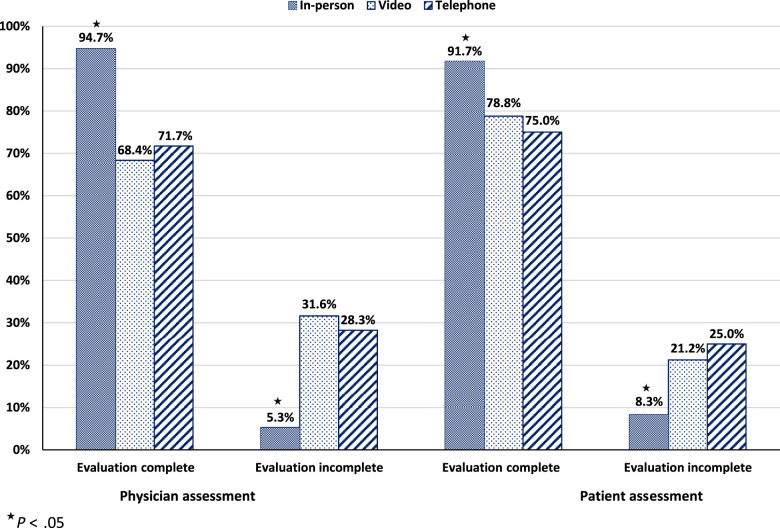
There were 447 encounters, with 303 in-person (67.8%), 98 video (21.9%), and 46 telephone (10.3%). Patient satisfaction data was obtained from 251 patients. There was similar patient satisfaction among all encounter modalities. Both patients and physicians were more likely to deem an in-person encounter as complete. Physicians were more likely to report an in-person encounter to be complete for food allergy (P < .001) and chronic rhinitis (P = .001) compared with video or telephone, whereas patients reported in-person encounters for food allergy to be complete compared with other modalities (P = .002). Patients reported that future encounter types should depend on the clinical situation.
There was similar patient satisfaction with in-person, video, and telephone encounters in an allergy/immunology practice during the COVID-19 pandemic. Chronic rhinitis and food allergy are more likely to call for an in-person evaluation. New patient visits are likely to be the highest yield to focus on for in-person evaluations.
SarsCoV2,新型冠状病毒(COVID-19)大流行需要迅速将面对面评估转变为远程医疗服务,包括视频和电话就诊,这在过敏/免疫学实践中尤为重要。
评估患者满意度、患者和医生对就诊完整性的印象,以及面对面、视频和电话就诊的报销情况。本研究还评估了影响患者满意度、对完整性的感知以及未来就诊类型选择的因素。
这是一项对医疗系统所有就诊的前瞻性研究。记录就诊类型、就诊方式、患者人口统计学资料、主要诊断、报销数据以及医生对就诊完整性的评估。通过标准化问题评估患者满意度。
共有 447 次就诊,其中 303 次为面对面(67.8%)、98 次为视频(21.9%)、46 次为电话(10.3%)。从 251 名患者处获得了患者满意度数据。所有就诊方式的患者满意度相似。患者和医生都更倾向于认为面对面就诊更为完整。与视频或电话相比,医生更倾向于报告面对面就诊对食物过敏(P<.001)和慢性鼻炎(P=0.001)更为完整,而患者报告食物过敏的面对面就诊更为完整,而其他就诊方式则不完整(P=0.002)。患者报告说,未来的就诊类型应取决于临床情况。
在 COVID-19 大流行期间,过敏/免疫学实践中,患者对面对面、视频和电话就诊的满意度相似。慢性鼻炎和食物过敏更可能需要进行面对面评估。新患者就诊可能是进行面对面评估的最高收益。