Zolopa Camille, Hoj Stine, Bruneau Julie, Meeson Julie-Soleil, Minoyan Nanor, Raynault Marie-France, Makarenko Iuliia, Larney Sarah
Centre de Recherche du Centre Hospitalier de l'Université de Montréal (CR-CHUM), 900 rue Saint-Denis, Montréal, QC H2X 0A9, Canada.
Centre de Recherche du Centre Hospitalier de l'Université de Montréal (CR-CHUM), 900 rue Saint-Denis, Montréal, QC H2X 0A9, Canada; Department of Family Medicine and Emergency Medicine, Université de Montréal, 2900 boulevard d'Edouard Montpetit, Montreal, QC H3T 1J4, Canada.
Int J Drug Policy. 2021 Jun;92:103127. doi: 10.1016/j.drugpo.2021.103127. Epub 2021 Jan 20.
"Big Events" are major disruptions to physical, political, and economic environments that can influence vulnerability to drug-related harms. We reviewed the impacts of Big Events with relevance to the COVID-19 pandemic on drug-related risk and harms and access to drug treatment and harm reduction services.
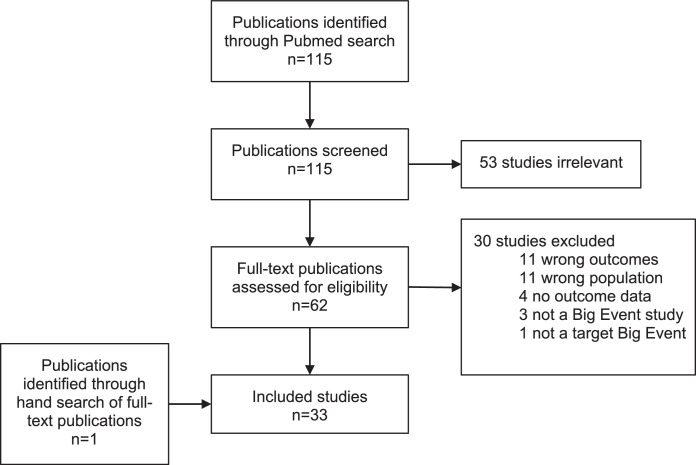
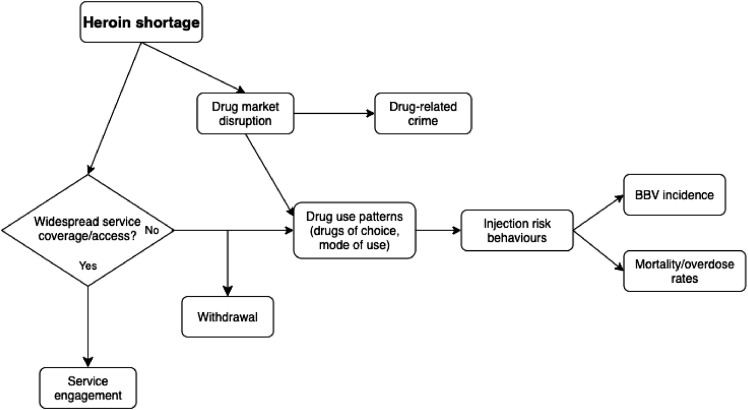
We conducted a rapid review of quantitative, qualitative, and mixed methods literature relating to the following Big Events: respiratory infection pandemics, natural disasters, financial crises, and heroin shortages. Included studies reported data on changes to risks, harms, and/or service provisioning for people who use illicit drugs (other than cannabis) in the context of these Big Events. Searches were conducted in PubMed in May 2020, and two reviewers screened studies for inclusion. Peer-reviewed studies published in English or French were included. We used a narrative synthesis approach and mapped risk pathways identified in the literature.
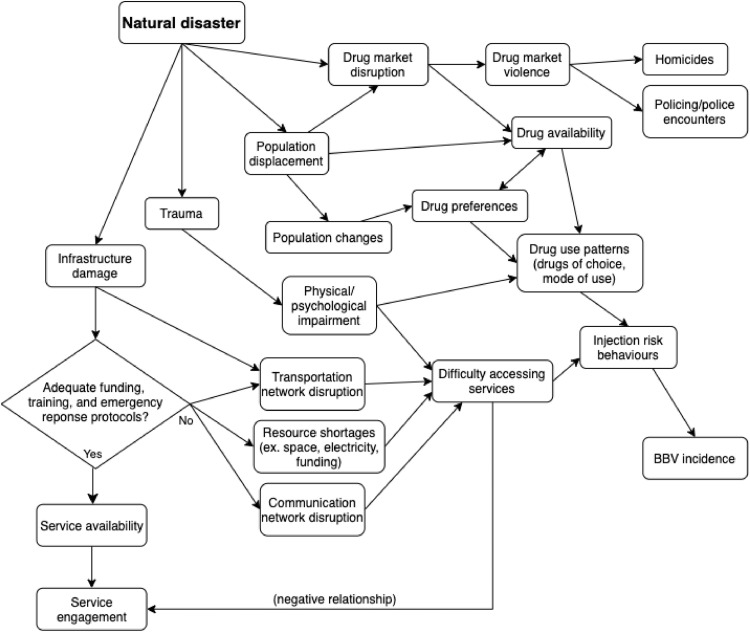
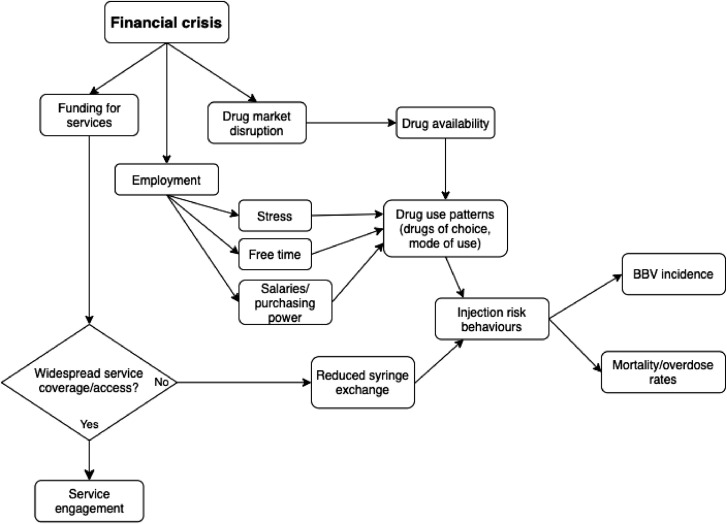
No studies reporting on respiratory infection pandemics were identified. Twelve studies reporting on natural disaster outcomes noted marked disruption to drug markets, increased violence and risk of drug-related harm, and significant barriers to service provision caused by infrastructure damage. Five studies of the 2008 global financial crisis indicated increases in the frequency of drug use and associated harms as incomes and service funding declined. Finally, 17 studies of heroin shortages noted increases in heroin price and adulteration, potentiating drug substitutions and risk behaviors, as well as growing demand for drug treatment.
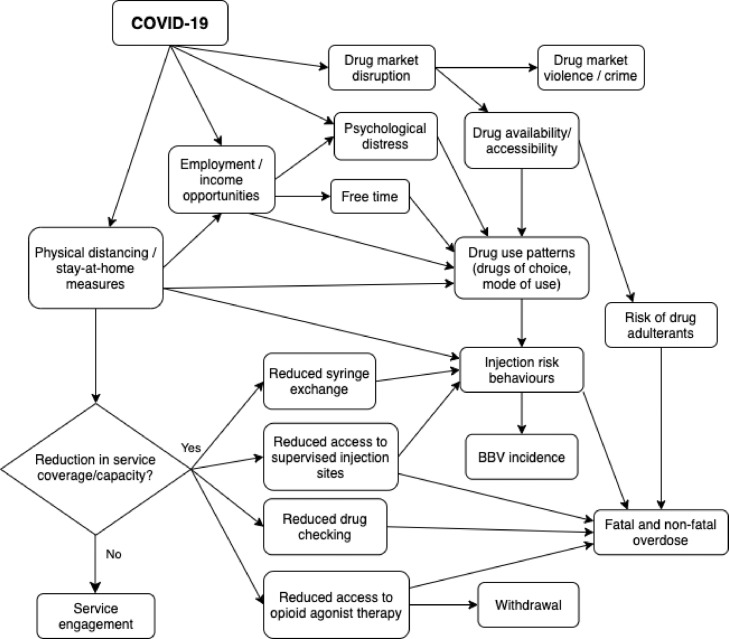
Current evidence reveals numerous risk pathways and service impacts emanating from Big Events. Risk pathway maps derived from this literature provide groundwork for future research and policy analyses, including in the context of the COVID-19 pandemic. In light of the findings, we recommend responding to the pandemic with legislative and financial support for the flexible delivery of harm reduction services, opioid agonist treatment, and mental health care.
“重大事件”是对自然、政治和经济环境的重大破坏,可能影响人们对药物相关危害的易感性。我们回顾了与新冠疫情相关的重大事件对药物相关风险、危害以及药物治疗和减少伤害服务可及性的影响。
我们对与以下重大事件相关的定量、定性和混合方法的文献进行了快速回顾:呼吸道感染大流行、自然灾害、金融危机和海洛因短缺。纳入的研究报告了在这些重大事件背景下,使用非法药物(大麻除外)的人群的风险、危害和/或服务提供变化的数据。2020年5月在PubMed上进行了检索,两名评审员筛选纳入研究。纳入了以英文或法文发表的同行评审研究。我们采用叙述性综合方法,并绘制了文献中确定的风险途径。
未检索到关于呼吸道感染大流行的研究。12项报告自然灾害结果的研究指出,药物市场受到显著干扰,暴力事件增加以及药物相关危害风险上升,基础设施受损导致服务提供面临重大障碍。5项关于2008年全球金融危机的研究表明,随着收入和服务资金减少,药物使用频率及相关危害增加。最后,17项关于海洛因短缺的研究指出,海洛因价格上涨和掺假现象增多,促使药物替代和风险行为增加,以及对药物治疗的需求不断增长。
目前的证据揭示了重大事件引发的众多风险途径和服务影响。从这些文献得出的风险途径图为未来研究和政策分析奠定了基础,包括在新冠疫情背景下。鉴于研究结果,我们建议通过立法和财政支持来应对疫情,以灵活提供减少伤害服务、阿片类激动剂治疗和精神卫生保健。