Chen Shuying, Zhang Jingjun, Chen Qiudan, Cheng Juan, Chen Xiaotong, Mao Yinqi, Chen Wei, Liu Chenbin, Wu Han, Lv Yuan, Lin Yong
Department of Laboratory Medicine, Huashan Hospital, Fudan University, Shanghai 200040, P.R. China.
Department of Rehabilitation, Huashan Hospital, Fudan University, Shanghai 200040, P.R. China.
Oncol Lett. 2021 Feb;21(2):137. doi: 10.3892/ol.2020.12398. Epub 2020 Dec 20.
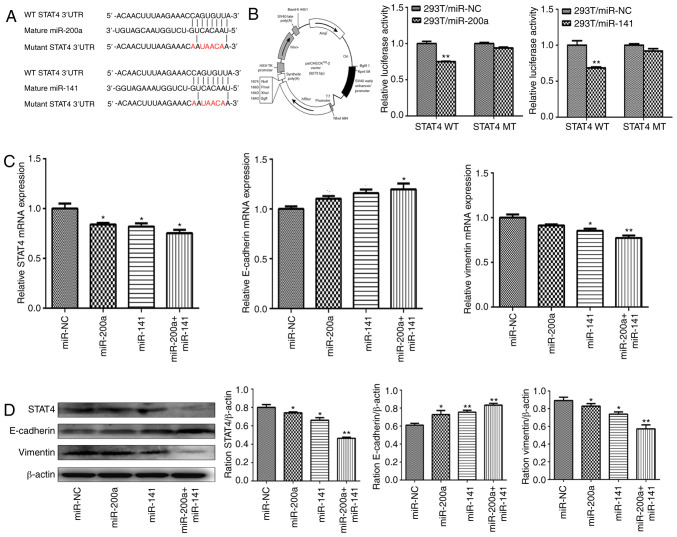
MicroRNAs (miRNAs or miRs) are non-coding small RNAs that target specific messenger RNAs to inhibit protein translation. miR-200a and miR-141 function as tumor suppressors by targeting STAT4. These two miRNAs belong to the same family, and their expression is often decreased in various cancer types, but are located on different chromosomes of the human genome. The present study showed that the expression levels of miR-141 and miR-200a in serum and cells of liver cancer are significantly downregulated. The expression levels of miR-141 and miR-200a are closely associated with clinicopathological features of liver cancer, especially metastasis and invasion. It is first reported that STAT4 is the new common target gene of miR-141 and miR-200a. In the present study, miR-141 and miR-200a were confirmed to inhibit the expression of E-cadherin and vimentin synergistically during epithelial-mesenchymal transition to regulate the proliferation, migration and invasion of liver cancer cells by targeting STAT4. Simultaneous overexpression of miR-200a and miR-141 resulted in stronger effects compared with each miRNA alone. In addition, overexpression of STAT4 significantly reversed the tumor suppressive roles of miR-200a and miR-141 in liver cancer cells. These findings enrich the tumor suppressor mechanisms of the miR-200 family, and may also provide new experimental and theoretical basis for the use of miRNAs for early diagnosis, prognosis and thorough treatment of liver cancer.
微小RNA(miRNA或miR)是一类非编码小RNA,可靶向特定信使RNA以抑制蛋白质翻译。miR-200a和miR-141通过靶向信号转导和转录激活因子4(STAT4)发挥肿瘤抑制作用。这两种miRNA属于同一家族,其表达在多种癌症类型中常降低,但位于人类基因组的不同染色体上。本研究表明,肝癌患者血清和细胞中miR-141和miR-200a的表达水平显著下调。miR-141和miR-200a的表达水平与肝癌的临床病理特征密切相关,尤其是转移和侵袭。首次报道STAT4是miR-141和miR-200a的新共同靶基因。在本研究中,证实miR-141和miR-200a在上皮-间质转化过程中协同抑制E-钙黏蛋白和波形蛋白的表达,通过靶向STAT4调节肝癌细胞的增殖、迁移和侵袭。与单独过表达每种miRNA相比,同时过表达miR-200a和miR-141产生的效果更强。此外,STAT4的过表达显著逆转了miR-200a和miR-141在肝癌细胞中的肿瘤抑制作用。这些发现丰富了miR-200家族的肿瘤抑制机制,也可能为利用miRNA进行肝癌的早期诊断、预后评估和彻底治疗提供新的实验和理论依据。