Zhao Qin-Yu, Liu Le-Ping, Luo Jing-Chao, Luo Yan-Wei, Wang Huan, Zhang Yi-Jie, Gui Rong, Tu Guo-Wei, Luo Zhe
Department of Blood Transfusion, The Third Xiangya Hospital of Central South University, Changsha, China.
College of Engineering and Computer Science, Australian National University, Canberra, ACT, Australia.
Front Med (Lausanne). 2021 Jan 21;7:637434. doi: 10.3389/fmed.2020.637434. eCollection 2020.
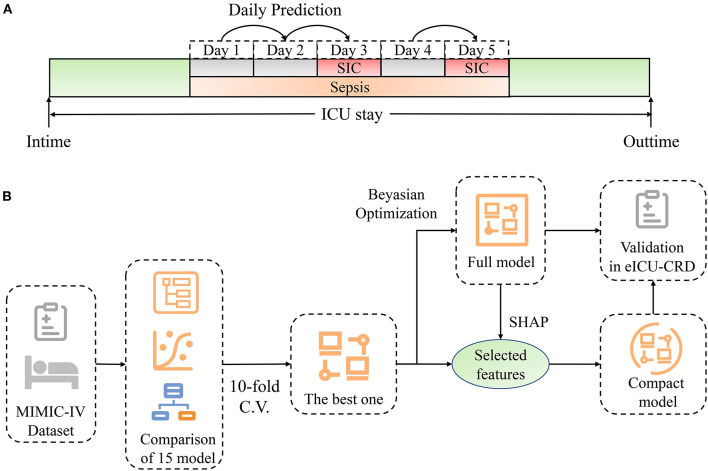
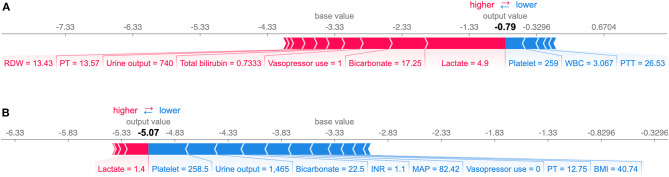
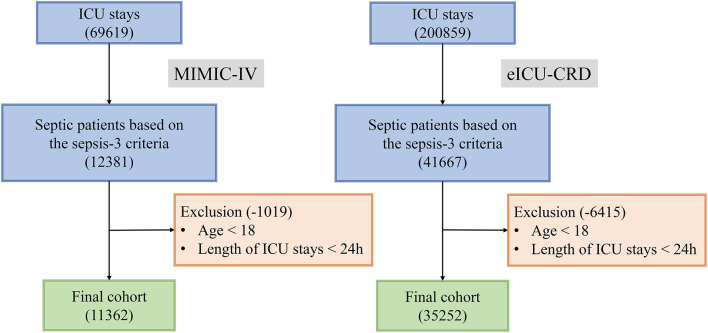
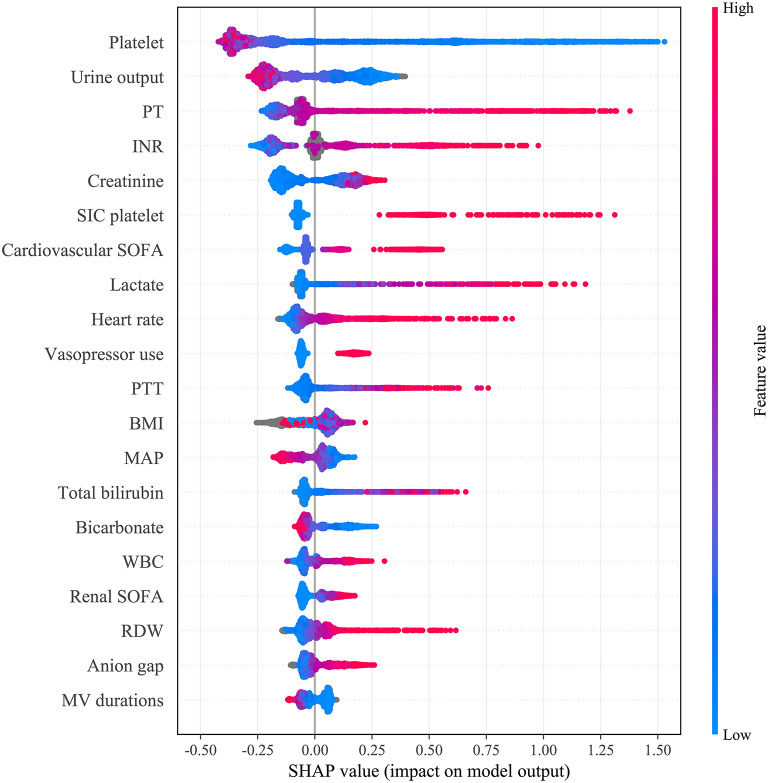
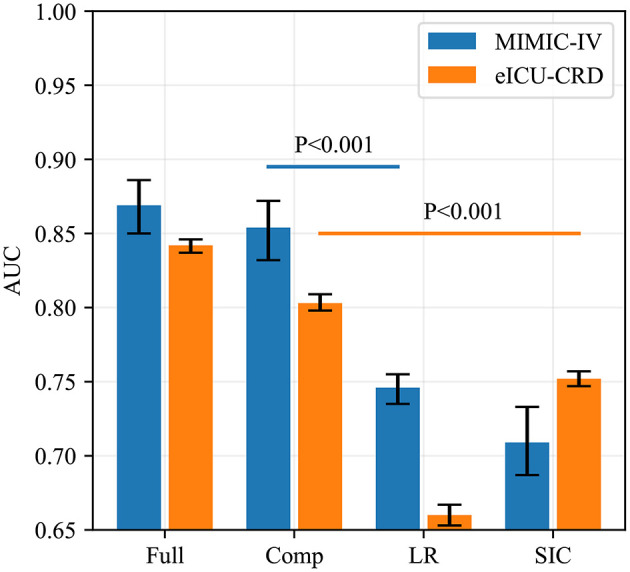
Sepsis-induced coagulopathy (SIC) denotes an increased mortality rate and poorer prognosis in septic patients. Our study aimed to develop and validate machine-learning models to dynamically predict the risk of SIC in critically ill patients with sepsis. Machine-learning models were developed and validated based on two public databases named Medical Information Mart for Intensive Care (MIMIC)-IV and the eICU Collaborative Research Database (eICU-CRD). Dynamic prediction of SIC involved an evaluation of the risk of SIC each day after the diagnosis of sepsis using 15 predictive models. The best model was selected based on its accuracy and area under the receiver operating characteristic curve (AUC), followed by fine-grained hyperparameter adjustment using the Bayesian Optimization Algorithm. A compact model was developed, based on 15 features selected according to their importance and clinical availability. These two models were compared with Logistic Regression and SIC scores in terms of SIC prediction. Of 11,362 patients in MIMIC-IV included in the final cohort, a total of 6,744 (59%) patients developed SIC during sepsis. The model named Categorical Boosting (CatBoost) had the greatest AUC in our study (0.869; 95% CI: 0.850-0.886). Coagulation profile and renal function indicators were the most important features for predicting SIC. A compact model was developed with an AUC of 0.854 (95% CI: 0.832-0.872), while the AUCs of Logistic Regression and SIC scores were 0.746 (95% CI: 0.735-0.755) and 0.709 (95% CI: 0.687-0.733), respectively. A cohort of 35,252 septic patients in eICU-CRD was analyzed. The AUCs of the full and the compact models in the external validation were 0.842 (95% CI: 0.837-0.846) and 0.803 (95% CI: 0.798-0.809), respectively, which were still larger than those of Logistic Regression (0.660; 95% CI: 0.653-0.667) and SIC scores (0.752; 95% CI: 0.747-0.757). Prediction results were illustrated by SHapley Additive exPlanations (SHAP) values, which made our models clinically interpretable. We developed two models which were able to dynamically predict the risk of SIC in septic patients better than conventional Logistic Regression and SIC scores.
脓毒症诱导的凝血病(SIC)意味着脓毒症患者的死亡率增加且预后较差。我们的研究旨在开发并验证机器学习模型,以动态预测脓毒症重症患者发生SIC的风险。基于两个名为重症监护医学信息集市(MIMIC)-IV和电子重症监护病房协作研究数据库(eICU-CRD)的公共数据库开发并验证了机器学习模型。SIC的动态预测涉及使用15种预测模型评估脓毒症诊断后每天发生SIC的风险。根据其准确性和受试者操作特征曲线(AUC)下的面积选择最佳模型,然后使用贝叶斯优化算法进行细粒度超参数调整。基于根据重要性和临床可用性选择的15个特征开发了一个精简模型。在SIC预测方面,将这两个模型与逻辑回归和SIC评分进行了比较。最终队列纳入的MIMIC-IV中的11362例患者中,共有6744例(59%)患者在脓毒症期间发生了SIC。在我们的研究中,名为分类提升(CatBoost)的模型具有最大的AUC(0.869;95%CI:0.850-0.886)。凝血指标和肾功能指标是预测SIC的最重要特征。开发了一个AUC为0.854(95%CI:0.832-0.872)的精简模型,而逻辑回归和SIC评分的AUC分别为0.746(95%CI:0.735-0.755)和0.709(95%CI:0.687-0.733)。分析了eICU-CRD中的35252例脓毒症患者队列。外部验证中完整模型和精简模型的AUC分别为0.842(95%CI:0.837-0.846)和0.803(95%CI:0.798-