Chen Xi, Yan Yuan-Liang, Zeng Shuang-Shuang, Gong Zhi-Cheng, Xu Zhi-Jie
Department of Pharmacy, Xiangya Hospital, Central South University, Changsha, China.
National Clinical Research Center for Geriatric Disorders, Xiangya Hospital, Central South University, Changsha, China.
Ann Transl Med. 2021 Jan;9(1):47. doi: 10.21037/atm-20-3293.
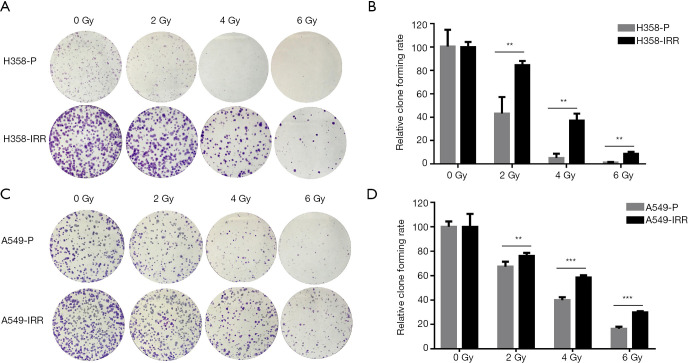
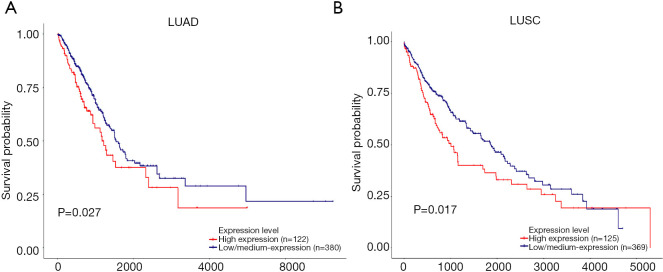
Radiotherapy is the standard therapeutic approach for non-small cell lung cancers (NSCLCs). However, radiotherapy resistance accounts for major treatment failures in NSCLC patients. Recently, targeting autophagy-related signaling has shown potential to improve radiotherapy. Furthermore, some studies have reported that caveolin-1 (Cav1), a primary scaffolding protein of caveolae, is positively associated with NSCLC progression and cell autophagy. However, the function of Cav1-mediated autophagy in NSCLC radioresistance remains largely unknown.
The NSCLC irradiation (IR)-resistant cell lines H358-IRR and A549-IRR were used for analysis. Real-time quantitative PCR (qPCR), western blot, cell counting kit-8 (CCK-8), colony formation and transmission electron microscopy analyses were performed to explore the relationship between Cav1 and immunity-related GTPase family M protein (IRGM)-regulated autophagy in the radiation resistance of lung cancers.
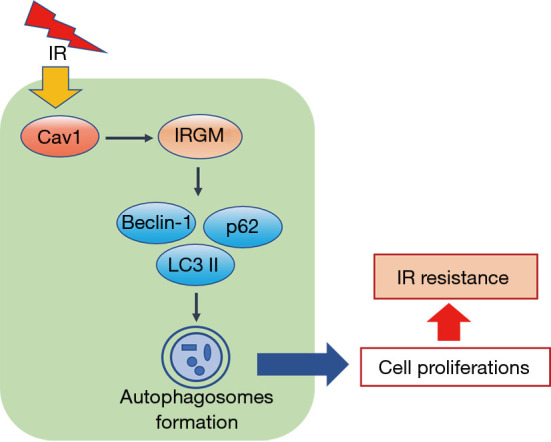
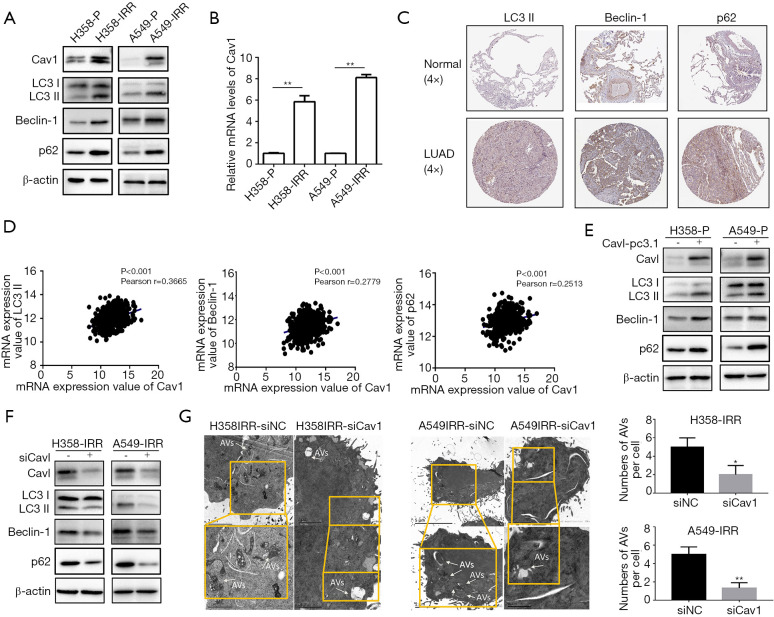
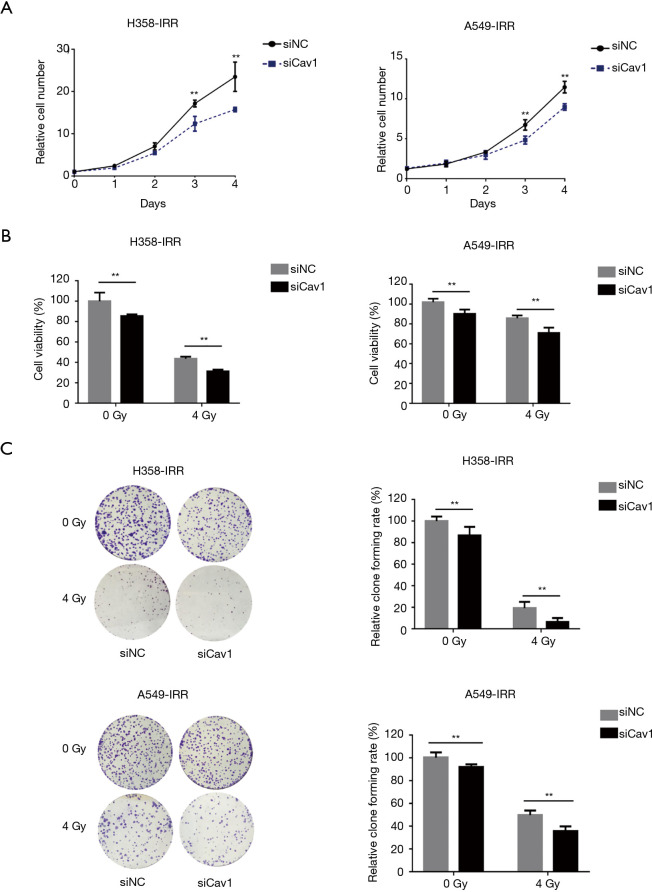
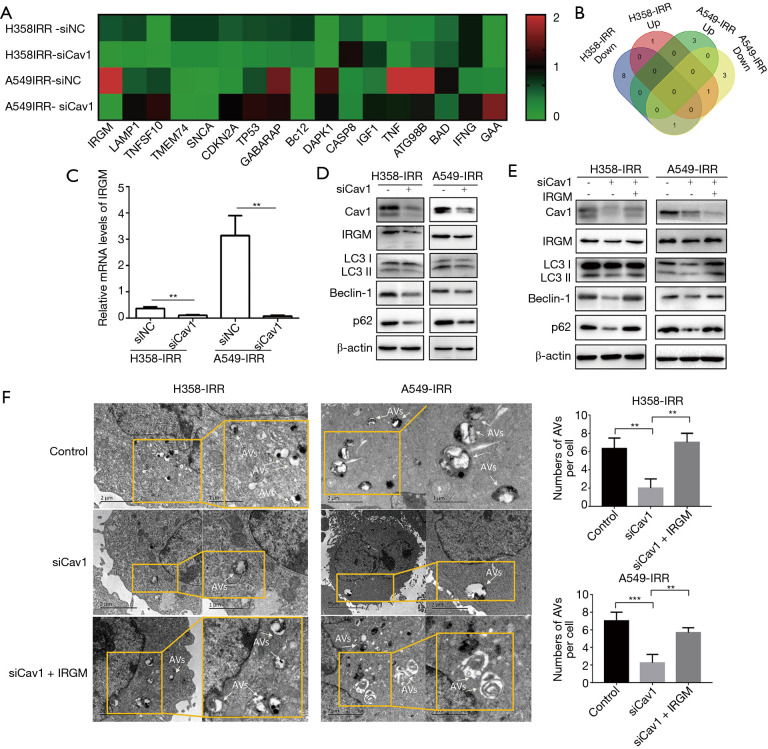
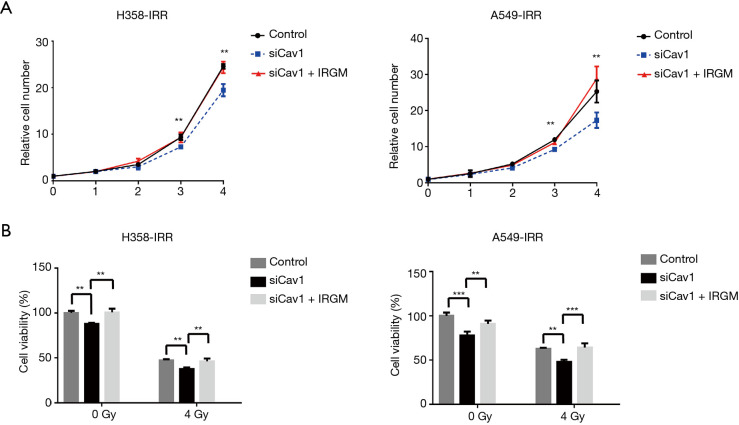
Cav1 was significantly overexpressed in H358-IRR and A549-IRR cells compared to their parental counterparts. Knockdown of Cav1 significantly decreased the proliferation of IR-resistant NSCLC cells. Combinational treatment of IR and siRNA of Cav1 showed enhanced inhibition of the cell viability and colony formation of IR-resistant NSCLC cells. In addition, Cav1 overexpression could upregulate the autophagic proteins microtubule associated protein 1 light chain 3 II (LC3 II), Beclin-1 and Sequestosome 1 (SQSTM1/p62) in parental NSCLC cells, while Cav1 downregulation by siRNA inhibited the expression of LC3 II, Beclin-1 and p62 and the formation of autophagosomes in IR-resistant NSCLC cells. Furthermore, we observed that IRGM was downregulated after knockdown of Cav1 in IR-resistant NSCLC cells. Thus, Cav1 was observed to promote autophagy and increase IR-resistant cell survival by targeting IRGM.
The results of our study showed that Cav1 is involved in the development of IR resistance in NSCLC through IRGM-regulated autophagy and can be considered as a potential therapeutic target for improving the radiosensitivity of NSCLC.
放射治疗是非小细胞肺癌(NSCLC)的标准治疗方法。然而,放疗抵抗是NSCLC患者治疗失败的主要原因。最近,靶向自噬相关信号通路显示出改善放疗效果的潜力。此外,一些研究报道,小窝蛋白-1(Cav1)作为小窝的主要支架蛋白,与NSCLC进展和细胞自噬呈正相关。然而,Cav1介导的自噬在NSCLC放疗抵抗中的作用仍 largely未知。
使用NSCLC放疗(IR)抗性细胞系H358-IRR和A549-IRR进行分析。进行实时定量PCR(qPCR)、蛋白质印迹、细胞计数试剂盒-8(CCK-8)、集落形成和透射电子显微镜分析,以探讨Cav1与免疫相关GTP酶家族M蛋白(IRGM)调节的自噬在肺癌放疗抵抗中的关系。
与亲本细胞相比,Cav1在H358-IRR和A549-IRR细胞中显著过表达。敲低Cav1显著降低了IR抗性NSCLC细胞的增殖。IR与Cav1的siRNA联合处理显示对IR抗性NSCLC细胞的细胞活力和集落形成有增强的抑制作用。此外,Cav1过表达可上调亲本NSCLC细胞中的自噬蛋白微管相关蛋白1轻链3 II(LC3 II)、Beclin-1和聚集体蛋白1(SQSTM1/p62),而通过siRNA下调Cav1可抑制IR抗性NSCLC细胞中LC3 II、Beclin-1和p62的表达以及自噬体的形成。此外,我们观察到在IR抗性NSCLC细胞中敲低Cav1后IRGM下调。因此,观察到Cav1通过靶向IRGM促进自噬并增加IR抗性细胞存活。
我们的研究结果表明,Cav1通过IRGM调节的自噬参与NSCLC的IR抗性发展,可被视为提高NSCLC放射敏感性的潜在治疗靶点。