Batomen Brice, Sweet Elizabeth, Nandi Arijit
Department of Epidemiology, Biostatistics, and Occupational Health, McGill University, Canada.
Department of Anthropology, University of Massachusetts Boston, USA.
SSM Popul Health. 2021 Jan 23;13:100736. doi: 10.1016/j.ssmph.2021.100736. eCollection 2021 Mar.
Household financial debt has more than tripled since the 1980s in the United States. The experience of indebtedness is socially structured and there is mounting evidence that debt is linked to decrements in health. However, it is unclear whether debt contributes to social disparities in health.
We examined whether household debt, measured by debt in excess of income and wealth, mediated education-based social inequalities in health, including cardiovascular risk factors (hypertension) and chronic conditions (diabetes, coronary heart disease, and psychiatric problems).
We used longitudinal data from a sample of over 10,500 adults aged 18 years and older surveyed biennially between 1999 and 2015 as part of the Panel Study of Income Dynamics (PSID). We estimated the total effect of education on our health outcomes. To assess mediation by levels of household debt, we then estimated the controlled direct effect of education through pathways not mediated by levels of household debt, after accounting for lagged time-varying confounders and loss to follow-up using marginal structural models.
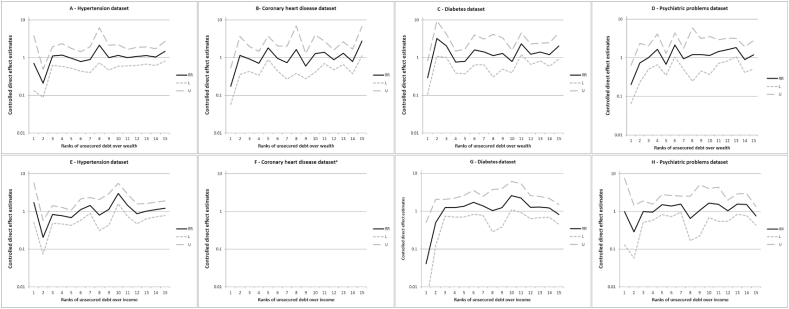
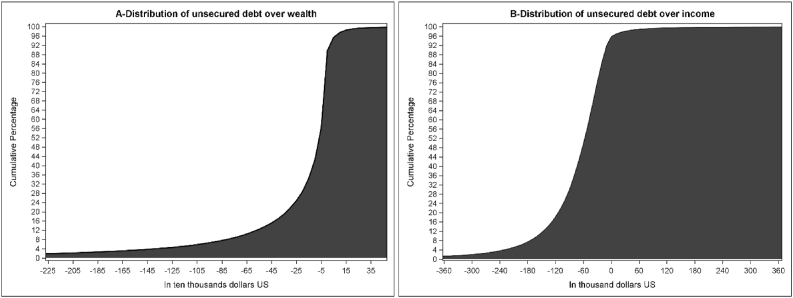
Compared to respondents with at least a high school education, respondents with less than a high school education reported higher household debts in excess of income and wealth; they also reported a higher incidence of hypertension [risk ratio (RR) = 1.25, 95%CI = 1.13, 1.39), coronary heart disease (RR = 1.42, 95%CI: 1.25, 1.62), diabetes (RR = 1.50, 95%CI: 1.34, 1.68), and psychiatric problems (RR = 1.39, 95%CI: 1.24, 1.56). Compared to the total effects, the controlled direct effects of education on health were attenuated, particularly for death or first onset of hypertension and coronary heart disease, after fixing levels of household debt-to-income and debt-to-wealth.
Our results provide early evidence that household debt in excess of wealth partly mediates education-based inequalities in hypertension and coronary heart disease in the United States, with less consistent evidence for other chronic conditions.
自20世纪80年代以来,美国家庭金融债务增长了两倍多。负债经历具有社会结构性,而且越来越多的证据表明债务与健康状况下降有关。然而,尚不清楚债务是否会导致健康方面的社会差异。
我们研究了以超出收入和财富的债务衡量的家庭债务是否介导了基于教育的健康方面的社会不平等,包括心血管危险因素(高血压)和慢性病(糖尿病、冠心病和精神问题)。
我们使用了来自收入动态面板研究(PSID)的纵向数据,该数据来自1999年至2015年期间每两年调查一次的10500多名18岁及以上成年人的样本。我们估计了教育对我们健康结果的总体影响。为了评估家庭债务水平的中介作用,我们随后在使用边际结构模型考虑了滞后的随时间变化的混杂因素和失访情况后,估计了教育通过不由家庭债务水平介导的途径产生的受控直接影响。
与至少受过高中教育的受访者相比,高中以下学历的受访者报告的超出收入和财富的家庭债务更高;他们还报告了更高的高血压发病率[风险比(RR)=1.25,95%置信区间(CI)=1.13,1.39]、冠心病(RR=1.42,95%CI:1.25,1.62)糖尿病(RR=1.50,95%CI:1.34,1.68)和精神问题(RR=1.39,95%CI:1.24,1.56)。与总体影响相比,在固定家庭债务与收入和债务与财富的水平后,教育对健康的受控直接影响减弱,尤其是对于高血压和冠心病的死亡或首次发病。
我们的结果提供了早期证据,表明超出财富的家庭债务部分介导了美国基于教育的高血压和冠心病方面的不平等,而对于其他慢性病的证据则不太一致。