Pike J Wesley, Lee Seong Min, Benkusky Nancy A, Meyer Mark B
Department of Biochemistry University of Wisconsin-Madison Madison WI USA.
JBMR Plus. 2020 Dec 5;5(1):e10433. doi: 10.1002/jbm4.10433. eCollection 2021 Jan.
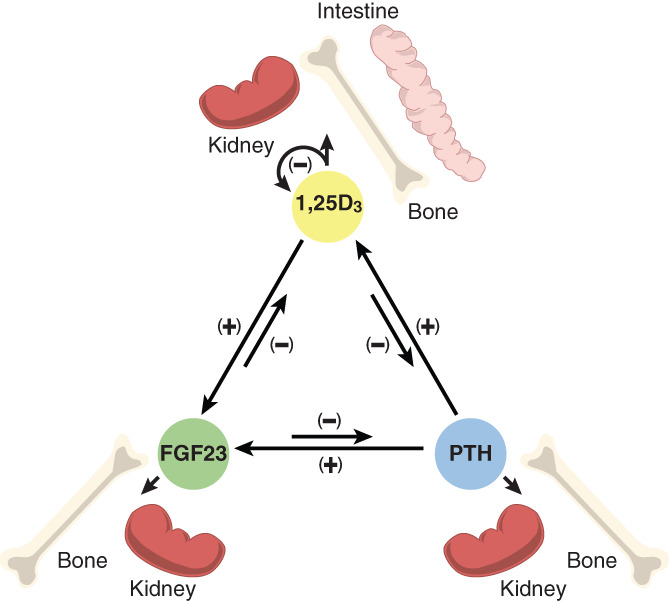
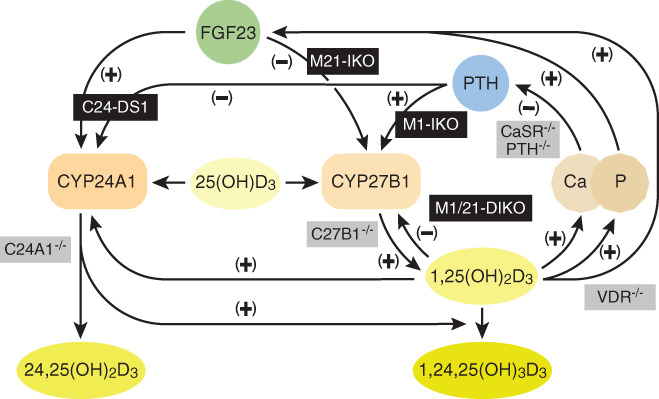
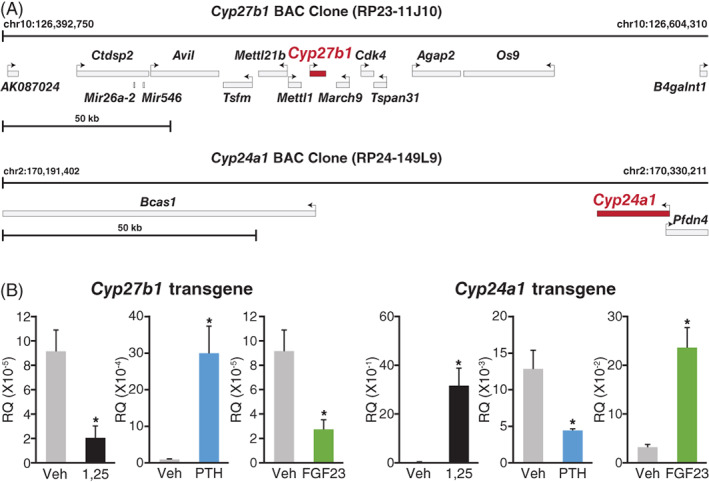
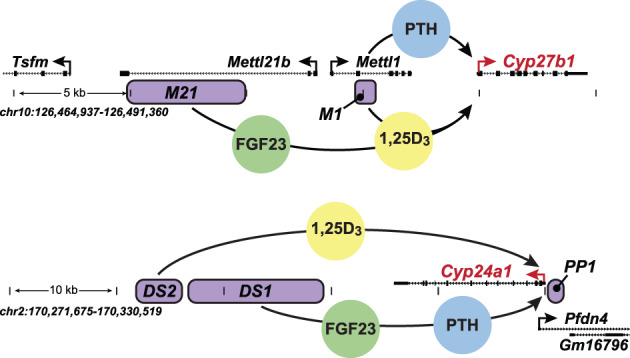
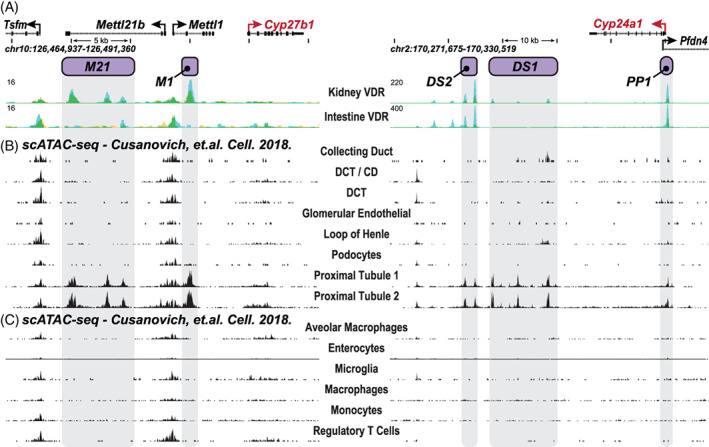
Our recent genomic studies identified a complex kidney-specific enhancer module located within the introns of adjacent (M1) and (M21) genes that mediate basal and PTH induction of , as well as suppression by FGF23 and 1,25-dihydroxyvitamin D [1,25(OH)D]. The tissue specificity for this regulatory module appears to be localized exclusively to renal proximal tubules. Gross deletion of these segments in mice has severe consequences on skeletal health, and directly affects expression in the kidney. Deletion of both the M1 and M21 submodules together almost completely eliminates basal expression in the kidney, creating a renal specific pseudo-null mouse, resulting in a systemic and skeletal phenotype similar to that of the -KO mouse caused by high levels of both 25-hydroxyvitamin D [25(OH)D] and PTH and depletion of 1,25(OH)D. levels in the double KO mouse also decrease because of compensatory downregulation of the gene by elevated PTH and reduced FGF23 that is mediated by an intergenic module located downstream of the gene. Outside of the kidney in nonrenal target cells (NRTCs), expression of in these mutant mice was unaffected. Dietary normalization of calcium, phosphate, PTH, and FGF23 rescues the aberrant phenotype of this mouse and normalizes the skeleton. In addition, both the high levels of 25(OH)D were reduced and the low levels of 1,25(OH)D were fully eliminated in these mutant mice as a result of the rescue-induced normalization of renal . Thus, these hormone-regulated enhancers for both and in the kidney are responsible for the circulating levels of 1,25(OH)D in the blood. The retention of and expression in NRTCs of these endocrine 1,25(OH)D-deficient mice suggests that this pseudo-null mouse will provide a model for the future exploration of the role of NRTC-produced 1,25(OH)D in the hormone's diverse noncalcemic actions in both health and disease. © 2020 The Authors. published by Wiley Periodicals LLC on behalf of American Society for Bone and Mineral Research.
我们最近的基因组研究发现了一个复杂的肾脏特异性增强子模块,它位于相邻的(M1)和(M21)基因的内含子中,介导了该基因的基础表达和甲状旁腺激素(PTH)诱导表达,以及成纤维细胞生长因子23(FGF23)和1,25-二羟基维生素D [1,25(OH)D]的抑制作用。这个调控模块的组织特异性似乎仅局限于肾近端小管。在小鼠中对这些片段进行大规模缺失会对骨骼健康产生严重影响,并直接影响该基因在肾脏中的表达。同时缺失M1和M21子模块几乎完全消除了肾脏中的基础表达,产生了一种肾脏特异性的假基因敲除小鼠,导致出现与因25-羟基维生素D [25(OH)D]和PTH水平升高以及1,25(OH)D耗竭所致的该基因敲除(-KO)小鼠相似的全身和骨骼表型。双敲除小鼠中的该基因水平也会降低,这是由于位于该基因下游的基因间模块介导的PTH升高和FGF23降低对该基因进行了代偿性下调。在非肾脏靶细胞(NRTCs)等非肾脏组织中,这些突变小鼠中的该基因表达未受影响。通过饮食使钙、磷、PTH和FGF23正常化可挽救该小鼠的异常表型并使骨骼正常化。此外,由于挽救诱导的肾脏该基因表达正常化,这些突变小鼠中高水平的25(OH)D降低,低水平的1,25(OH)D完全消除。因此,肾脏中这些受激素调节的该基因和另一基因的增强子决定了血液中1,25(OH)D的循环水平。这些内分泌1,25(OH)D缺乏小鼠的NRTCs中该基因和另一基因表达的保留表明,这种该基因假基因敲除小鼠将为未来探索NRTCs产生的1,25(OH)D在该激素在健康和疾病中的多种非钙调节作用中的作用提供一个模型。© 2020作者。由Wiley Periodicals LLC代表美国骨与矿物质研究学会出版。