Zhang Lu, Wu Lingeng, Chen Qiuying, Zhang Bin, Liu Jing, Liu Shuyi, Mo Xiaokai, Li Minmin, Chen Zhuozhi, Chen Luyan, You Jingjing, Jin Zhe, Chen Xudong, Zhou Zejian, Zhang Shuixing
Department of Radiology, The First Affiliated Hospital of Jinan University, Guangzhou, Guangdong, China.
Department of Interventional Therapy, Cancer Centre, Guangdong Provincial People's Hospital, Guangdong Academy of Medical Sciences, School of Medicine, South China University of Technology, Guangzhou, Guangdong, China.
EClinicalMedicine. 2020 Dec 13;31:100673. doi: 10.1016/j.eclinm.2020.100673. eCollection 2021 Jan.
Hyperprogressive disease (HPD) is a new progressive pattern in patients with advanced hepatocellular carcinoma (HCC) treated with programmed cell death 1 (PD-1) inhibitors. We aimed to investigate risk factors associated with HPD in advanced HCC patients undergoing anti-PD-1 therapy.
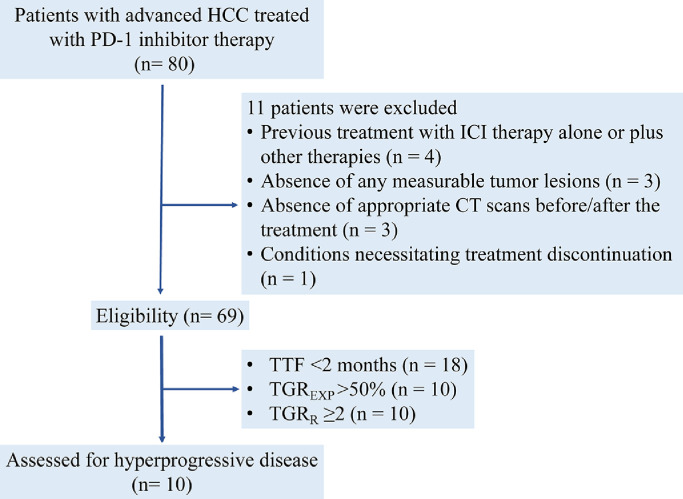
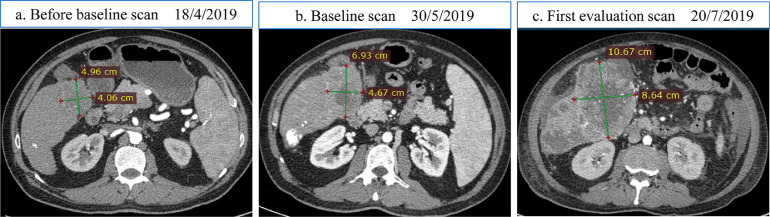
A total of 69 patients treated with anti-PD-1 therapy between March 2017 and January 2020 were included. HPD was determined according to the time to treatment failure, tumour growth rate, and tumour growth rate ratio. Univariate and multivariate analyses were performed to identify clinical variables significantly associated with HPD. A risk model was constructed based on clinical variables with prognostic significance for HPD.
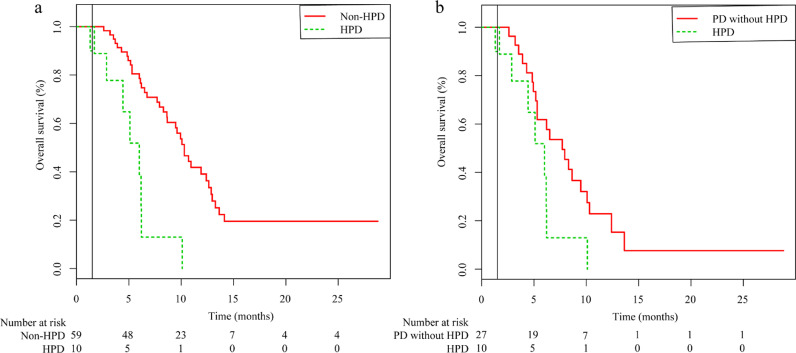
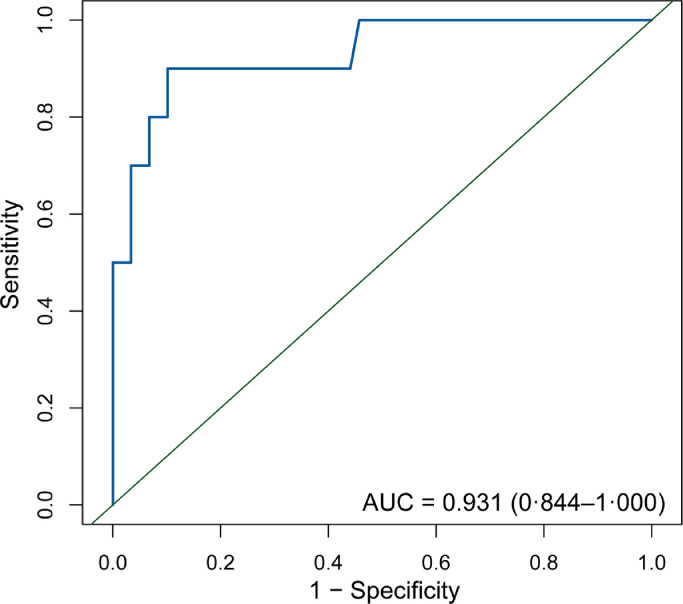
Overall, 10 (14·49%) had HPD. Haemoglobin level, portal vein tumour thrombus, and Child-Pugh score were significantly associated with HPD. The risk model had an area under the curve of 0·931 (95% confidence interval, 0·844-1·000). Patients with HPD had a significantly shorter overall survival (OS) than that of the patients with non-HPD ( < 0·001). However, there was no significant difference in OS between PD (progressive disease) patients with and without HPD ( = 0·05).
We identified three clinical variables as risk factors for HPD, providing an opportunity to aid the pre-treatment evaluation of the risk of HPD in patients treated with immunotherapy.
This study was funded by the National Natural Science Foundation of China (81571664, 81871323, and 81801665); National Natural Science Foundation of Guangdong Province (2018B030311024); Scientific Research General Project of Guangzhou Science Technology and Innovation Commission (201707010,328); and China Postdoctoral Science Foundation (2016M600145).
超进展性疾病(HPD)是晚期肝细胞癌(HCC)患者接受程序性细胞死亡蛋白1(PD-1)抑制剂治疗后的一种新的进展模式。我们旨在研究接受抗PD-1治疗的晚期HCC患者中与HPD相关的危险因素。
纳入2017年3月至2020年1月期间接受抗PD-1治疗的69例患者。根据治疗失败时间、肿瘤生长率和肿瘤生长率比来确定HPD。进行单因素和多因素分析以识别与HPD显著相关的临床变量。基于对HPD具有预后意义的临床变量构建风险模型。
总体而言,10例(14.49%)发生HPD。血红蛋白水平、门静脉肿瘤血栓和Child-Pugh评分与HPD显著相关。风险模型的曲线下面积为0.931(95%置信区间,0.844-1.000)。发生HPD的患者总生存期(OS)明显短于未发生HPD的患者(P<0.001)。然而,有进展性疾病(PD)的患者中发生HPD和未发生HPD的患者的OS无显著差异(P=0.05)。
我们确定了三个临床变量作为HPD的危险因素,为免疫治疗患者HPD风险的治疗前评估提供了帮助。
本研究由中国国家自然科学基金(81571664、81871323和81801665);广东省自然科学基金(2018B030311024);广州市科技创新委员会科研一般项目(201707010,328);以及中国博士后科学基金(2016M600145)资助。