Kushal Sayedul Ashraf, Amin Yahia Md, Reza Shusama, Shawon Md Shajedur Rahman
Lifespring, 14th floor, Union heights, 55/2, Panthapath, Dhaka 1205, Bangladesh.
Centre for Big Data Research in Health, UNSW Medicine, Level 2, AGSM Building (G27), UNSW Sydney, NSW 2052, Australia.
EClinicalMedicine. 2020 Dec 23;31:100691. doi: 10.1016/j.eclinm.2020.100691. eCollection 2021 Jan.
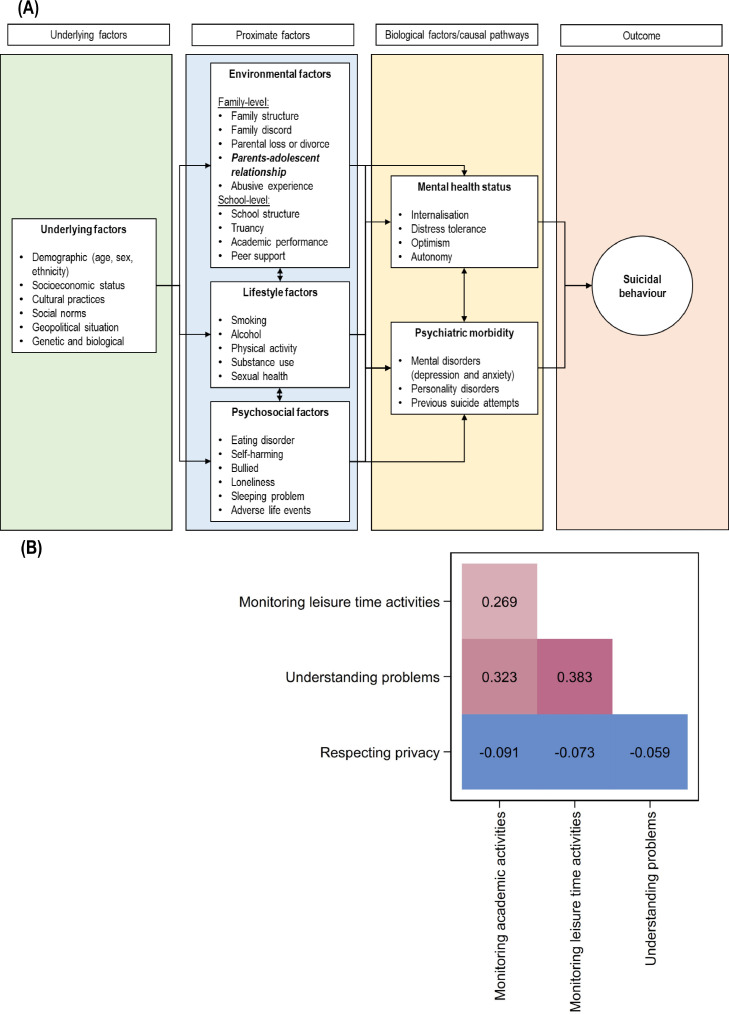
Despite the potential benefits of parents-adolescent relationships on suicidal behaviours among adolescents, research on these topics are importantly limited by lack of comprehensiveness, difficulties in cross-country comparisons, and limited generalisability, among others. We aimed to estimate the prevalence of various aspects of parents-adolescent relationships and suicidal behaviours by sex and region, and to investigate their associations.
We used data from the Global School-based Health Survey (GSHS) from 52 countries in 2009-2015 for 120 858 adolescents (53.9% girls) aged 12-15 years. Using meta-analysis with random effects, we estimated the prevalence of parents-adolescent relationships (i.e. understanding problems, monitoring academic and leisure time activities, and respecting privacy) and suicidal behaviours (i.e. suicidal ideation, suicide planning, and suicide attempt). Multi-level mixed-effect logistic regressions were used to investigate their associations.
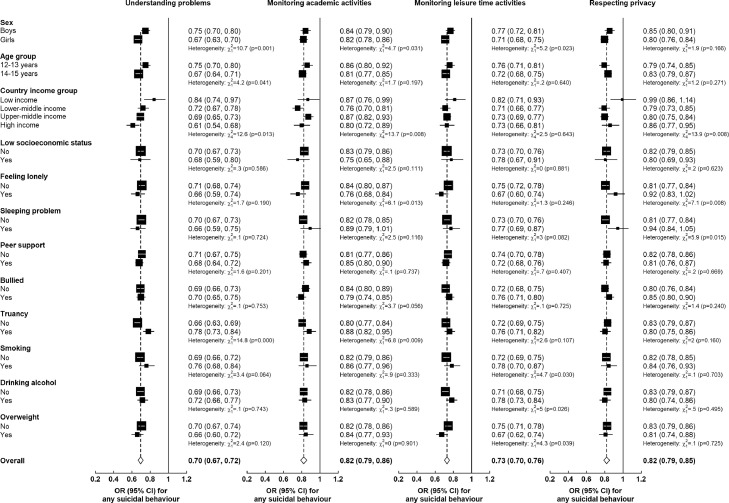
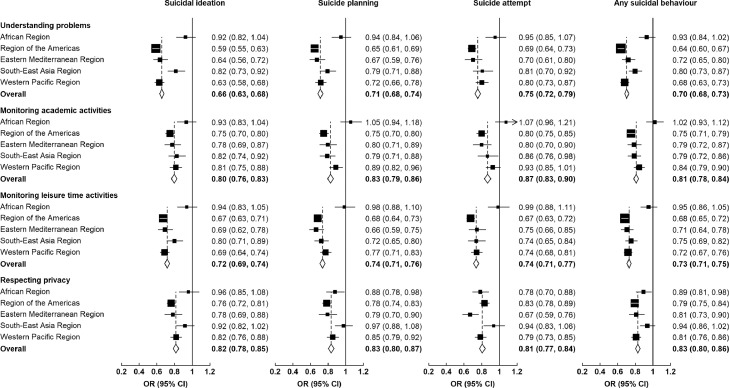
Overall, boys and girls reported similar levels of parental understanding of problems (35.8% vs. 36.8%), monitoring academic activities (41.8% vs. 41.1%), and respecting privacy (69.6% vs. 69.7%), whereas girls reported higher level of parental monitoring of leisure time activities than boys (44.9% vs. 40.0%). Adolescents in the Western Pacific region reported the lowest level of parental understanding of problems and monitoring activities, while those in South-East Asia region least reported that their parents respected their privacy. The overall prevalence of any suicidal behaviour was higher in girls than boys (26.2% vs. 23.0%). Suicidal behaviour was less likely in adolescents if their parents understood their problems (odds ratio, 95% confidence intervals: 0.70, 0.68-0.73), monitored their academic (0.81, 0.78-0.84) and leisure time activities (0.73, 0.71-0.75), and respected their privacy (0.83, 0.80-0.86). There was evidence of heterogeneity in those associations by sex and regions.
Although the prevalence of parents-adolescent relationships and adolescent suicidal behaviours varied particularly by sex and region, there were strong and independent associations among them.
尽管父母与青少年的关系对青少年自杀行为可能有潜在益处,但关于这些主题的研究因缺乏全面性、跨国比较困难以及普遍性有限等问题而受到重要限制。我们旨在按性别和地区估计父母与青少年关系及自杀行为各方面的患病率,并调查它们之间的关联。
我们使用了2009 - 2015年来自52个国家的全球学校健康调查(GSHS)数据,涉及120858名12 - 15岁的青少年(53.9%为女孩)。通过随机效应的荟萃分析,我们估计了父母与青少年关系(即理解问题、监督学业和休闲活动以及尊重隐私)和自杀行为(即自杀意念、自杀计划和自杀未遂)的患病率。使用多层次混合效应逻辑回归来调查它们之间的关联。
总体而言,男孩和女孩报告的父母对问题的理解程度(35.8%对36.8%)、对学业活动的监督(41.8%对41.1%)以及对隐私的尊重程度(69.6%对69.7%)相似,而女孩报告的父母对休闲活动的监督程度高于男孩(44.9%对40.0%)。西太平洋地区的青少年报告父母对问题的理解和监督活动水平最低,而东南亚地区的青少年最少报告父母尊重他们的隐私。任何自杀行为的总体患病率女孩高于男孩(26.2%对23.0%)。如果青少年的父母理解他们的问题(比值比,95%置信区间:0.70,0.68 - 0.73)、监督他们的学业(0.81,0.78 - 0.84)和休闲活动(0.73,0.71 - 0.75)以及尊重他们的隐私(0.83,0.80 - 0.86),他们自杀行为的可能性较小。有证据表明这些关联在性别和地区方面存在异质性。
尽管父母与青少年关系及青少年自杀行为的患病率因性别和地区而异,但它们之间存在强烈且独立的关联。