Bennett Charles L, Hoque Shamia, Olivieri Nancy, Taylor Matthew A, Aboulafia David, Lubaczewski Courtney, Bennett Andrew C, Vemula Jay, Schooley Benjamin, Witherspoon Bartlett J, Godwin Ashley C, Ray Paul S, Yarnold Paul R, Ausdenmoore Henry C, Fishman Marc, Herring Georgne, Ventrone Anne, Aldaco Juan, Hrushesky William J, Restaino John, Thomsen Henrik S, Yarnold Paul R, Marx Robert, Migliorati Cesar, Ruggiero Salvatore, Nabhan Chadi, Carson Kenneth R, McKoy June M, Yang Y Tony, Schoen Martin W, Knopf Kevin, Martin Linda, Sartor Oliver, Rosen Steven, Smith William K
City of Hope National Medical Center in Duarte, California, United States.
University of South Carolina College of Pharmacy in Columbia, South Carolina, United States.
EClinicalMedicine. 2020 Dec 23;31:100693. doi: 10.1016/j.eclinm.2020.100693. eCollection 2021 Jan.
Adverse drug/device reactions (ADRs) can result in severe patient harm. We define very serious ADRs as being associated with severe toxicity, as measured on the Common Toxicity Criteria Adverse Events (CTCAE)) scale, following use of drugs or devices with large sales, large financial settlements, and large numbers of injured persons. We report on impacts on patients, clinicians, and manufacturers following very serious ADR reporting.
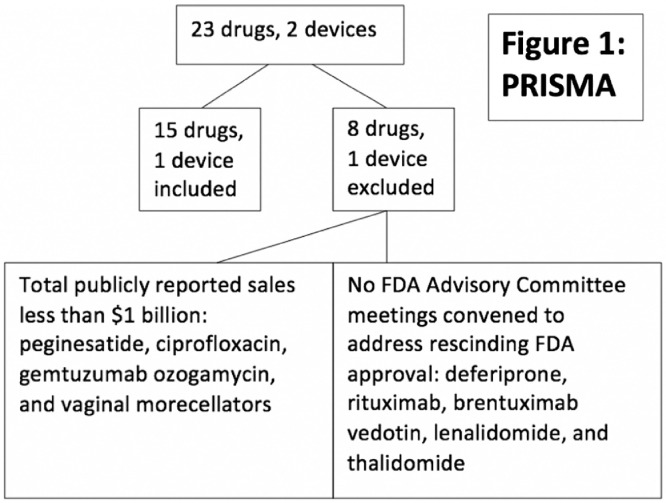
We reviewed clinician identified very serious ADRs published between 1997 and 2019. Drugs and devices associated with reports of very serious ADRs were identified. Included drugs or devices had market removal discussed at Food and Drug Advisory (FDA) Advisory Committee meetings, were published by clinicians, had sales > $1 billion, were associated with CTCAE Grade 4 or 5 toxicity effects, and had either >$1 billion in settlements or >1,000 injured patients. Data sources included journals, Congressional transcripts, and news reports. We reviewed data on: 1) timing of ADR reports, Boxed warnings, and product withdrawals, and 2) patient, clinician, and manufacturer impacts. Binomial analysis was used to compare sales pre- and post-FDA Advisory Committee meetings.
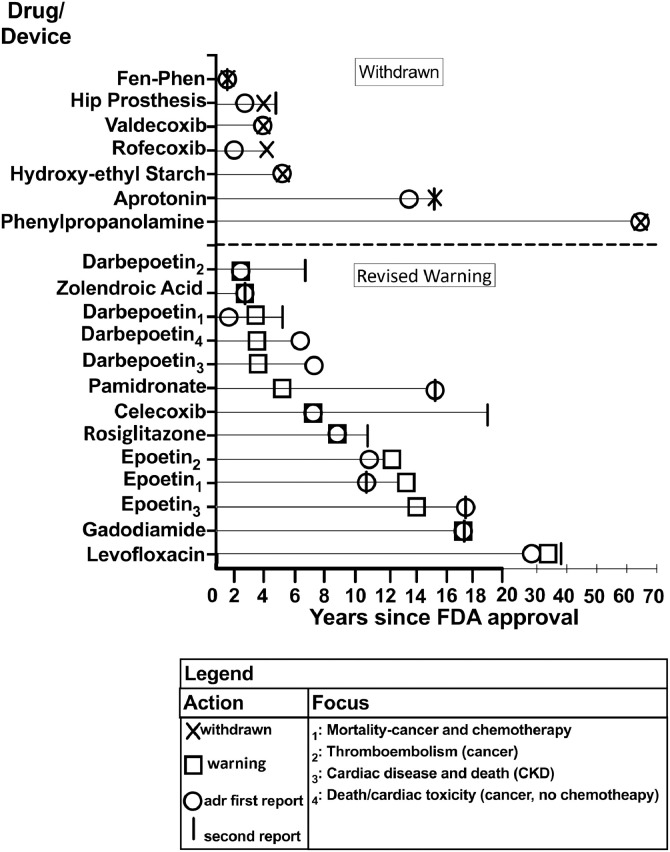
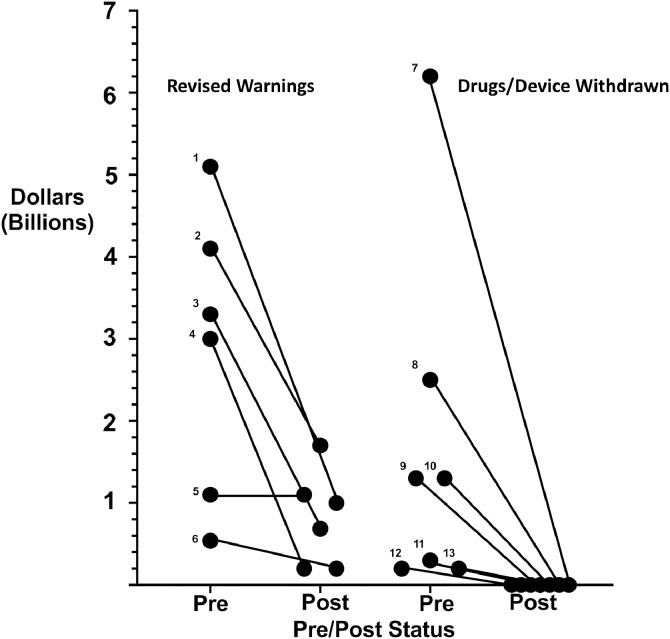
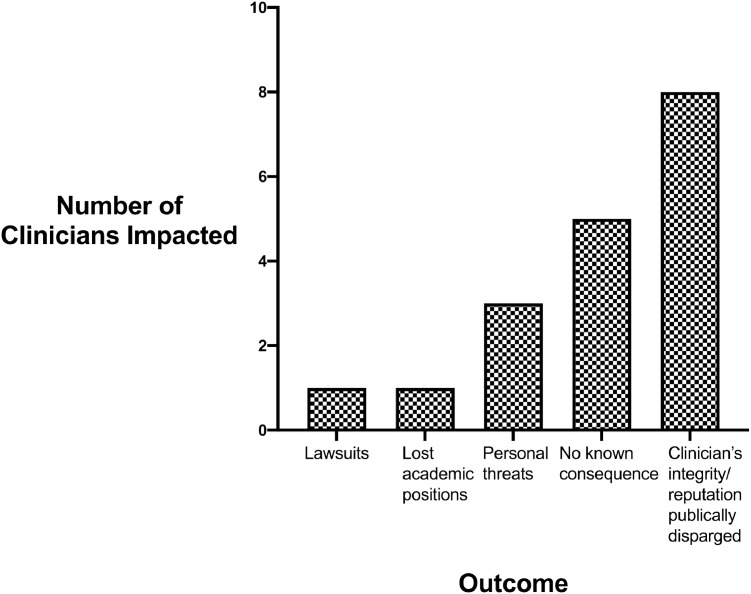
Twenty very serious ADRs involved fifteen drugs and one device. Legal settlements totaled $38.4 billion for 753,900 injured persons. Eleven of 18 clinicians (61%) reported harms, including verbal threats from manufacturer (five) and loss of a faculty position (one). Annual sales decreased 94% from $29.1 billion pre-FDA meeting to $4.9 billion afterwards (<0.0018). Manufacturers of four drugs paid $1.7 billion total in criminal fines for failing to inform the FDA and physicians about very serious ADRs. Following FDA approval, the median time to ADR reporting was 7.5 years (Interquartile range 3,13 years). Twelve drugs received Box warnings and one drug received a warning (median, 7.5 years following ADR reporting (IQR 5,11 years). Six drugs and 1 device were withdrawn from marketing (median, 5 years after ADR reporting (IQR 4,6 years)).
Because very serious ADRs impacts are so large, policy makers should consider developing independently funded pharmacovigilance centers of excellence to assist with clinician investigations.
This work received support from the National Cancer Institute (1R01 CA102713 (CLB), https://www.nih.gov/about-nih/what-we-do/nih-almanac/national-cancer-institute-nci; and two Pilot Project grants from the American Cancer Society's Institutional Grant Award to the University of South Carolina (IRG-13-043-01) https://www.cancer.org/ (SH; BS).
药物/器械不良反应(ADR)可导致患者严重伤害。我们将非常严重的ADR定义为在使用销量大、财务和解金额大且受伤人数多的药物或器械后,根据常见毒性标准不良事件(CTCAE)量表测量出的与严重毒性相关的反应。我们报告了非常严重的ADR报告对患者、临床医生和制造商的影响。
我们回顾了临床医生确定的1997年至2019年期间发表的非常严重的ADR。确定了与非常严重的ADR报告相关的药物和器械。纳入的药物或器械在食品药品咨询(FDA)咨询委员会会议上讨论过市场撤市情况,由临床医生发表,销售额超过10亿美元,与CTCAE 4级或5级毒性效应相关,和解金额超过10亿美元或受伤患者超过1000人。数据来源包括期刊、国会记录和新闻报道。我们审查了以下数据:1)ADR报告、黑框警告和产品撤市的时间,以及2)对患者、临床医生和制造商的影响。采用二项式分析比较FDA咨询委员会会议前后的销售额。
20起非常严重的ADR涉及15种药物和1种器械。753,900名受伤患者的法律和解总额为384亿美元。18名临床医生中有11名(61%)报告了伤害情况,包括来自制造商的言语威胁(5名)和失去教职(1名)。年度销售额从FDA会议前的291亿美元下降了94%,降至会后的49亿美元(<0.0018)。四种药物的制造商因未向FDA和医生通报非常严重的ADR而总共支付了17亿美元的刑事罚款。在FDA批准后,ADR报告的中位时间为7.5年(四分位间距3,13年)。12种药物收到了黑框警告,1种药物收到了警告(ADR报告后的中位时间为7.5年(IQR 5,11年))。6种药物和1种器械被撤市(ADR报告后的中位时间为5年(IQR 4,6年))。
由于非常严重ADR的影响如此之大,政策制定者应考虑建立独立资助的卓越药物警戒中心,以协助临床医生进行调查。
这项工作得到了美国国立癌症研究所(1R01 CA102713(CLB),https://www.nih.gov/about-nih/what-we-do/nih-almanac/national-cancer-institute-nci;以及美国癌症协会授予南卡罗来纳大学机构资助奖的两项试点项目资助(IRG-13-043-01)https://www.cancer.org/(SH;BS)。