Chuang Hao-Chun, Hong Chih-Kai, Hsu Kai-Lan, Kuan Fa-Chuan, Chiang Chen-Hao, Chen Yueh, Su Wei-Ren
Department of Orthopaedic Surgery, National Cheng Kung University Hospital, College of Medicine, National Cheng Kung University, Tainan, Taiwan.
Department of Biomedical Engineering, National Cheng Kung University, Tainan, Taiwan.
JSES Int. 2020 Nov 26;5(1):77-82. doi: 10.1016/j.jseint.2020.09.015. eCollection 2021 Jan.
Degenerative signs on shoulder radiographs, including spur formation and narrow acromiohumeral intervals (AHIs), have been recognized as indicative of atrophic and fat-infiltrated rotator cuff muscles. Past studies have demonstrated that patients with poor quality muscles are prone to retraction of the supraspinatus tendon and failure to repair. However, the association between radiographic signs and tendon retraction has never been elucidated in previous literature. The present study aimed to investigate the association between the degenerative signs on shoulder radiographs and the severity of supraspinatus retraction.
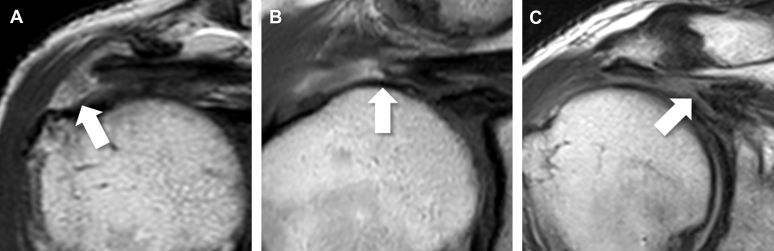
Images of 67 individuals, who had undergone an arthroscopic rotator cuff repair, were retrospectively reviewed. The greater tuberosity (GT) morphology, subacromial spur, AHI, and acromial thickness were evaluated on the radiographs, whereas the retraction of the supraspinatus tendon was assessed via an MRI in accordance with the Patte classification. Simple regression analyses between the radiographic signs and Patte stages were performed, and factors reaching statistical significance were then included in the multiple ordinal logistic regression. Statistically significant predictors from the multiple regression analysis were constructed into combinations, for which the sensitivity and specificity were calculated.
The GT morphology ( = .004), AHI ( = .083), subacromial spur ( = .008), and age ( = .004) were associated with supraspinatus retraction in the simple regression analyses. These four parameters were incorporated into the multiple ordinal logistic regression, where the GT spur (adjusted odds ratio 8.63, 95% confidence interval 2.16-34.53, = .002) and AHI (AOR 0.79, 95% CI 0.63-0.98, = .032) were demonstrated to be predictive of the Patte stage of supraspinatus retraction. The acromial spur implied a higher risk of severe retraction although this finding was not statistically significant (AOR 2.89, 95% CI 0.90-9.29, = .075). The presence of concurrent GT spur and narrow AHI was highly specific (sensitivity 27.3% / specificity 91.1%) for advanced supraspinatus retraction.
The presence of a radiographic GT spur, narrow AHI, and subacromial spur indicated advanced retraction of the supraspinatus tendon. When patients with clinical suspicion of rotator cuff tear present with combinations of these radiographic signs, a prompt MRI examination and a referral to a shoulder specialist are recommended.
肩部X线片上的退变征象,包括骨刺形成和肩峰下间隙(AHI)变窄,已被认为是肩袖肌肉萎缩和脂肪浸润的指征。既往研究表明,肌肉质量差的患者容易出现冈上肌腱回缩和修复失败。然而,影像学征象与肌腱回缩之间的关联在以往文献中从未得到阐明。本研究旨在探讨肩部X线片上的退变征象与冈上肌回缩严重程度之间的关联。
回顾性分析67例行关节镜下肩袖修复术患者的影像资料。在X线片上评估大结节(GT)形态、肩峰下骨刺、AHI和肩峰厚度,而通过MRI根据Patte分类评估冈上肌腱的回缩情况。对影像学征象与Patte分期进行简单回归分析,然后将具有统计学意义的因素纳入多元有序逻辑回归。将多元回归分析中有统计学意义的预测因素构建成组合,并计算其敏感性和特异性。
在简单回归分析中,GT形态(P = 0.004)、AHI(P = 0.083)、肩峰下骨刺(P = 0.008)和年龄(P = 0.004)与冈上肌回缩有关。这四个参数被纳入多元有序逻辑回归,其中GT骨刺(调整优势比8.63,95%置信区间2.16 - 34.53,P = 0.002)和AHI(AOR 0.79,95% CI 0.63 - 0.98,P = 0.032)被证明可预测冈上肌回缩的Patte分期。肩峰下骨刺提示严重回缩的风险较高,尽管这一发现无统计学意义(AOR 2.89,95% CI 0.90 - 9.29,P = 0.075)。同时存在GT骨刺和狭窄AHI对冈上肌严重回缩具有高度特异性(敏感性27.3% / 特异性91.1%)。
X线片上出现GT骨刺、狭窄AHI和肩峰下骨刺提示冈上肌腱严重回缩。当临床怀疑肩袖撕裂的患者出现这些影像学征象的组合时,建议及时进行MRI检查并转诊至肩部专科医生处。