Monov Simeon, Nestorova Rodina, Velkova Margarita, Boyanov Mihail, Jeleva Silvia, Petkova Renata, Petranova Tzvetanka
Medical Center "Academy", Sofia, Bulgaria.
Clinic of Rheumatology, Medical University, Sofia, Bulgaria.
Rheumatol Ther. 2021 Mar;8(1):443-455. doi: 10.1007/s40744-021-00282-3. Epub 2021 Feb 8.
Post-menopausal women with osteoporosis > 70 years of age at high risk of fracture urgently require treatment for fracture prevention. Moreover, persistence with osteoporosis therapy is critical for real-world effectiveness. We estimated persistence with denosumab in older women at high fracture risk in clinical practice in Bulgaria.
Eligible participants were post-menopausal women, > 70 years of age, diagnosed with osteoporosis (T-score ≤ - 2.5) and at high risk of fracture (≥ 3% for hip and ≥ 20% for major osteoporotic fracture) who received at least one denosumab injection before enrollment. Planned follow-up was 24 months. The primary endpoint was persistence to denosumab at 12, 18, and 24 months (defined as receiving all denosumab injections within 6 months ± 60 days of the previous injection).
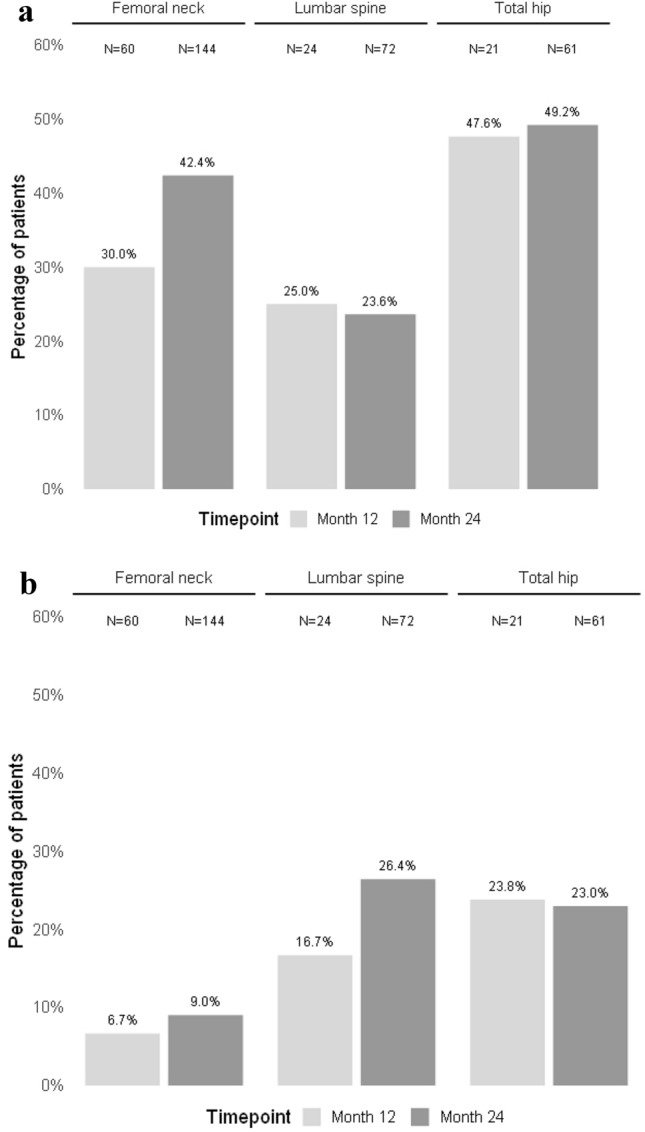
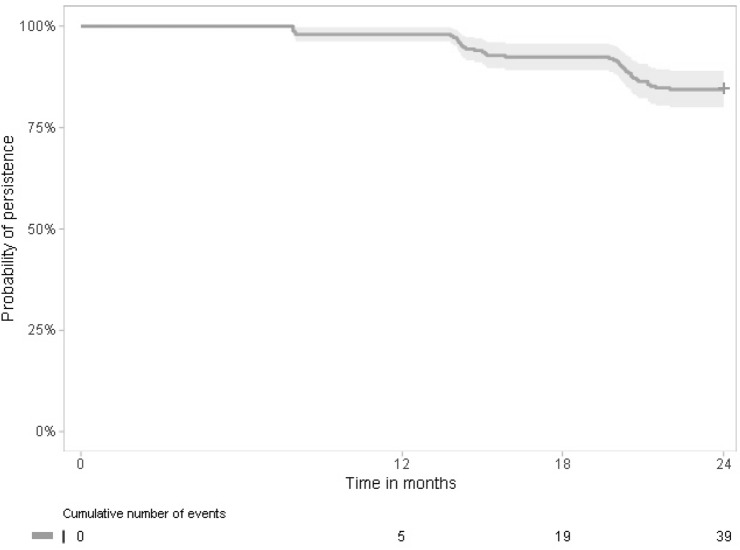
250 women were enrolled across 12 Bulgarian endocrinology/rheumatology practices; median follow up, 736 days. Mean (SD) age was 75.8 (4.2) years; mean (SD) FRAX was 13.1 (8.6) for hip and 26.1 (9.5) for major osteoporotic fracture; 47 (18.8%) women had prior osteoporosis therapy and 104 (41.6%) had prior fracture. Denosumab persistence was high: 98.0%, 92.4%, and 84.4% at 12, 18, and 24 months, respectively. A total of 42 (16.8%) women discontinued denosumab during follow-up, mostly for financial reasons [25/42 (59.5%)] or loss to follow-up [8/42 (19.0%)]. After 24 months of denosumab treatment, BMD T-score improvement to the range of osteopenia (- 2.5 ≤ T < - 1.5) was achieved by 42.4% at the femoral neck, 23.6% at the lumbar spine, and 49.2% at the total hip; complete recovery (T-score ≥ - 1.5) was observed in 9.0%, 26.4%, and 23.0% respectively. New fracture was reported in 5 patients (2%).
Even in an elderly population, persistence with denosumab was high despite the challenge imposed by the 50% co-pay in Bulgaria.
Bulgarian Drug Agency, №HИП-0009 (registered 28.06.2017); Central Ethics Commission: №КИ-41 (registered 16.05.2017).
70岁以上患有骨质疏松症且骨折风险高的绝经后女性迫切需要进行治疗以预防骨折。此外,坚持骨质疏松症治疗对于实际疗效至关重要。我们评估了在保加利亚临床实践中,骨折风险高的老年女性使用地诺单抗的持续性。
符合条件的参与者为70岁以上的绝经后女性,诊断为骨质疏松症(T值≤ -2.5)且骨折风险高(髋部骨折风险≥3%,主要骨质疏松性骨折风险≥20%),在入组前至少接受过一次地诺单抗注射。计划随访24个月。主要终点是在12、18和24个月时坚持使用地诺单抗(定义为在前一次注射的6个月±60天内接受所有地诺单抗注射)。
保加利亚12个内分泌科/风湿科诊所共纳入250名女性;中位随访时间为736天。平均(标准差)年龄为75.8(4.2)岁;髋部平均(标准差)FRAX为13.1(8.6),主要骨质疏松性骨折为26.1(9.5);47名(18.8%)女性曾接受过骨质疏松症治疗,104名(41.6%)曾发生过骨折。地诺单抗的持续性较高:在12、18和24个月时分别为98.0%、92.4%和84.4%。共有42名(16.8%)女性在随访期间停用了地诺单抗,主要原因是经济因素[25/42(59.5%)]或失访[8/42(19.0%)]。地诺单抗治疗24个月后,股骨颈骨密度T值改善至骨量减少范围(-2.5≤T<-1.5)的比例为42.4%,腰椎为23.6%,全髋为49.2%;完全恢复(T值≥ -1.5)的比例分别为9.0%、26.4%和23.0%。有5名患者(2%)报告发生了新的骨折。
即使在老年人群中,尽管保加利亚有50%的自付费用这一挑战,地诺单抗的持续性仍较高。
保加利亚药品管理局,编号HИП - 0009(2017年6月28日注册);中央伦理委员会:编号КИ - 41(2017年5月16日注册)。