Vall d'Hebron Institute of Oncology (VHIO), Medical Oncology Department, Barcelona, Spain.
Hospital Universitario Morales Meseguer, Murcia, Spain.
ESMO Open. 2021 Apr;6(2):100048. doi: 10.1016/j.esmoop.2021.100048. Epub 2021 Feb 6.
Women represent an increasing proportion of the oncology workforce; however, globally this does not translate into leadership roles, reflecting disparities in career opportunities between men and women. The Spanish Society of Medical Oncology (SEOM) undertook a survey to investigate gender disparity in the Spanish oncology context.
An online survey was made available to SEOM medical oncologists between February and May 2019. It included demographics, professional context and achievements, parenthood and family conciliation issues, workplace gender bias, and approaches to address disparities.
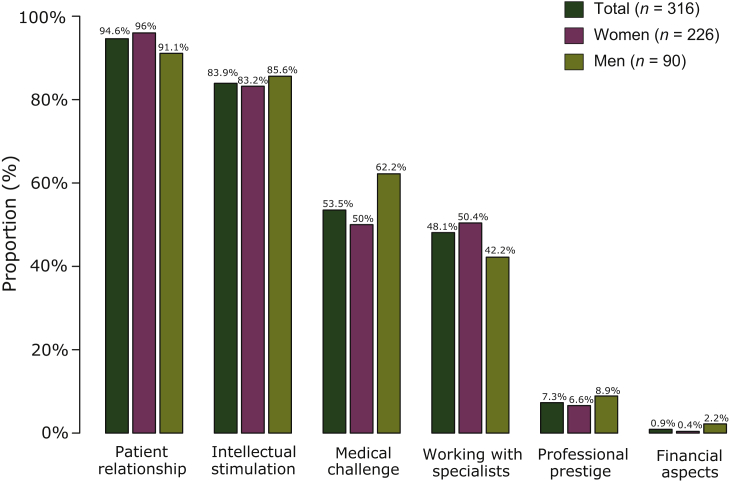
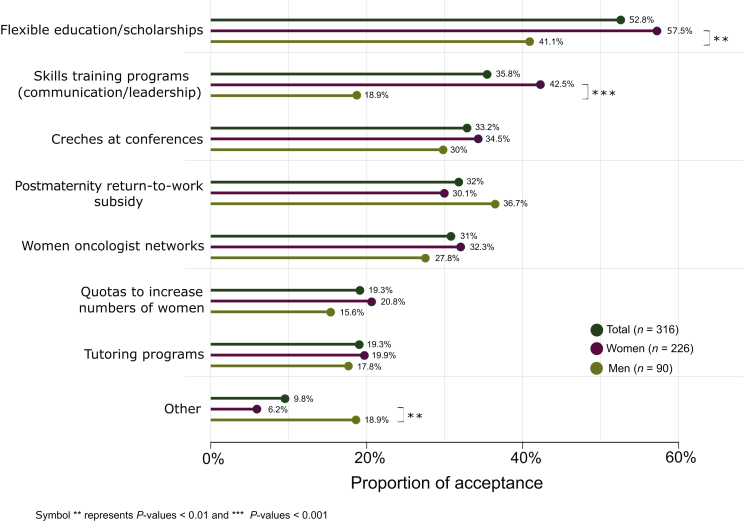
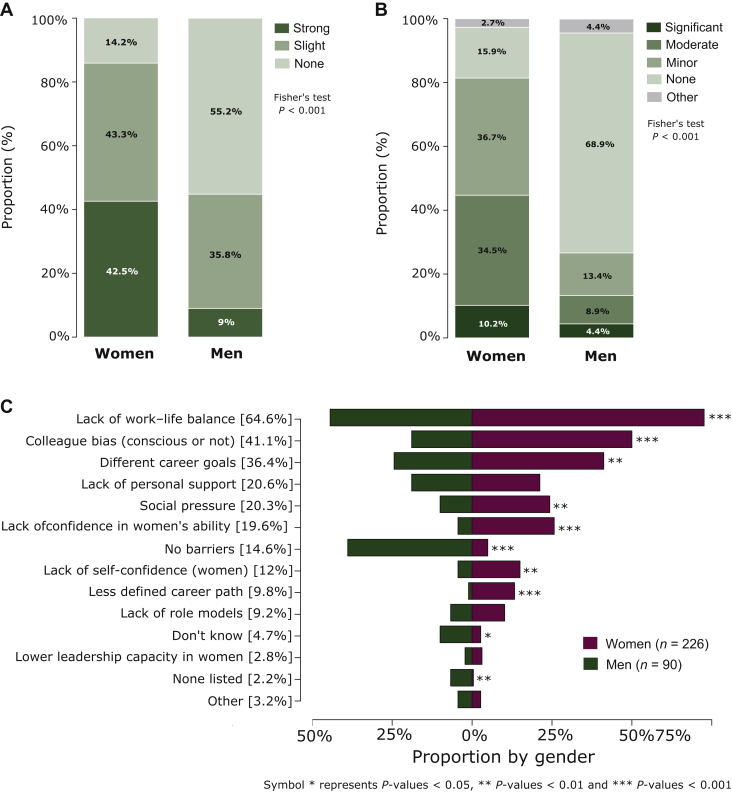
Of the 316 eligible respondents, 71.5% were women, 59.5% were aged 45 or younger, and 66.1% had children. Among women, 12.4% were division or unit heads, compared with 45.5% of men, with most women (74.3%) being attending medical oncologists, compared with 45.5% of men. More males were professors (34.4% versus 14.2% of females), had a PhD (46.7% versus 28.8%), and/or had led clinical research groups (41.1% versus 9.7%). Spending time overseas after completing a residency was also more common for men than women (34.4% versus 20.4%). Professional satisfaction was similar between genders, driven primarily by patient care and intellectual stimulation. More women (40.7%) considered parenthood to have a strong negative impact on their career, compared with men (9.0%). Main perceived barriers to gender equality included a lack of work-life balance (72.6% women, 44.4% men), bias of peers and superiors (50.0% women, 18.9% men), and different career goals (41.2% women, 24.4% men). Preferred solutions included educational programs and scholarships (52.9%), communication and leadership training (35.8%), childcare at conferences (33.2%), and postmaternity return-to-work incentives (32.0%).
There is a clear paucity of equal opportunities for female oncologists in Spain. This can be addressed by encouraging professional development and merit recognition particularly for younger female oncologists, and empowering women to be involved in management and leadership of institutions and professional societies.
女性在肿瘤学领域的劳动力中所占比例不断增加;然而,全球范围内,这并未转化为领导角色,反映出男女在职业机会方面的差距。西班牙肿瘤内科学会(SEOM)进行了一项调查,以研究西班牙肿瘤学领域的性别差距。
2019 年 2 月至 5 月,向 SEOM 肿瘤内科医生提供了一份在线调查。它包括人口统计学、专业背景和成就、育儿和家庭协调问题、工作场所性别偏见以及解决差距的方法。
在 316 名符合条件的受访者中,71.5%为女性,59.5%年龄在 45 岁或以下,66.1%有子女。在女性中,12.4%是分部或单位负责人,而男性为 45.5%,大多数女性(74.3%)为主治医生,而男性为 45.5%。男性中教授(34.4%对女性的 14.2%)、博士(46.7%对女性的 28.8%)和/或领导临床研究小组(41.1%对女性的 9.7%)的比例更高。在完成住院医师培训后,男性出国工作的比例也高于女性(34.4%对女性的 20.4%)。职业满意度在性别之间相似,主要受患者护理和智力刺激的驱动。更多的女性(40.7%)认为生育对她们的职业有很大的负面影响,而男性为 9.0%。性别平等的主要障碍包括工作与生活平衡不足(72.6%的女性,44.4%的男性)、同行和上级的偏见(50.0%的女性,18.9%的男性)和不同的职业目标(41.2%的女性,24.4%的男性)。首选的解决方案包括教育计划和奖学金(52.9%)、沟通和领导力培训(35.8%)、会议期间的儿童保育(33.2%)和产后重返工作的激励措施(32.0%)。
西班牙女性肿瘤学家的机会明显不平等。这可以通过鼓励职业发展和认可功绩来解决,特别是对于年轻的女性肿瘤学家,并赋予女性参与机构和专业协会的管理和领导的权力。