Nikolova Tanja, Bossart Michaela, Kacperczyk-Bartnik Joanna, Razumova Zoia, Strojna Alexandra, Bizzarri Nicolò, Pletnev Andrei, Gómez-Hidalgo Natalia R, Theofanakis Charalampos, Lanner Maximilian, Selcuk Ilker, Shushkevich Alexander, Anca Chelariu-Raicu, Nikolova Natasha, Concin Nicole, Zalewski Kamil
Klinikum Mittelbaden, Academic Teaching Hospital of Heidelberg University, Baden-Baden, Germany.
Department of Obstetrics and Gynecology, St. Josefskrankenhaus, Freiburg, Germany.
Front Oncol. 2022 Dec 7;12:1005130. doi: 10.3389/fonc.2022.1005130. eCollection 2022.
Gender-related differences in career development are well known issues in various professions. An international survey on gender-related differences was performed among young gynecologic oncology surgeons in Europe to identify potential gender inequalities in career development.
A survey on demographics, clinical and academic working environment, family/parenting, career development, salary and leadership was sent to all members of the European Network of Young Gynecologic Oncologists (ENYGO), which is a network within the European Society of Gynecologic Oncology (ESGO). Gynecologic oncology surgeons and obstetricians/gynecologists who actively work in this field in Europe were included in the study.
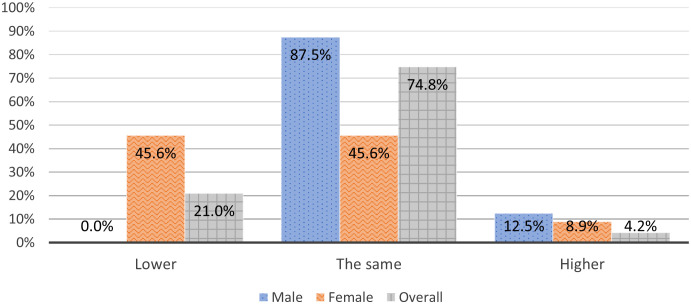
Responses were analyzed from 192 gynecologic oncology surgeons of whom 65.1% (125/192) were female (median age 37, IQR: 34 - 42) and 34.9% (67/192) were male (median age 38, IQR: 36 - 41). Male reported to perform a median of 15 and female a median of 10 operations per month 007). Among female, 24.8% had a leadership position vs. 44.8% among male, crude = 2.46, 95% 1.31-4.62, .01. When stratifying for age under 41 and having children, 36.7% of male and 5.6% of female had a leadership position, adjusted 10.8, 95% 3.28-35.64, <.001. A significantly higher proportion of female compared to male believed they earned less than their gender counterparts at the same clinical position and with same qualifications (30.4% vs. 2.5%, .001). There was not a statistically significant gender difference in the academic qualification PhD degree or professorship ( = .92 and = .64, respectively). In the previous year, male published more peer-reviewed articles than female (median 3 vs. median 2; = .017).
This first comprehensive survey on gender-differences in gynecologic oncology in Europe revealed that there are gender gaps concerning several aspects during the critical time of career development in the young generation of gynecologic oncology surgeons. These gender gaps are particularly reflected by a lower rate of female leadership positions. ENYGO and ESGO are dedicated to work on solution to overcome the identified obstacles and to support closing gender gaps.
职业发展中的性别差异是各个行业中众所周知的问题。在欧洲年轻妇科肿瘤外科医生中进行了一项关于性别差异的国际调查,以确定职业发展中潜在的性别不平等问题。
向欧洲年轻妇科肿瘤学家网络(ENYGO)的所有成员发送了一份关于人口统计学、临床和学术工作环境、家庭/育儿、职业发展、薪资和领导力的调查问卷,ENYGO是欧洲妇科肿瘤学会(ESGO)旗下的一个网络。纳入研究的是在欧洲该领域积极工作的妇科肿瘤外科医生和妇产科医生。
对192名妇科肿瘤外科医生的回复进行了分析,其中65.1%(125/192)为女性(中位年龄37岁,四分位间距:34 - 42岁),34.9%(67/192)为男性(中位年龄38岁,四分位间距:36 - 41岁)。男性报告每月进行手术的中位数为15例,女性为10例(P = 0.007)。女性中有24.8%担任领导职务,男性中这一比例为44.8%,粗比值比 = 2.46,95%置信区间为1.31 - 4.62,P = 0.01。在按41岁以下且有子女进行分层时,36.7%的男性和5.6%的女性担任领导职务,调整后的比值比为10.8,95%置信区间为3.28 - 35.64,P < 0.001。与男性相比,认为自己在相同临床职位且具备相同资质的情况下收入低于同性别同行的女性比例显著更高(30.4%对2.5%,P = 0.001)。在博士学位或教授职位的学术资格方面,没有统计学上显著的性别差异(分别为P = 0.92和P = 0.64)。在前一年,男性发表的同行评审文章比女性更多(中位数分别为3篇对2篇;P = 0.017)。
这项关于欧洲妇科肿瘤性别差异的首次全面调查显示,在年轻一代妇科肿瘤外科医生职业发展的关键时期,在几个方面存在性别差距。这些性别差距尤其体现在女性担任领导职务的比例较低。ENYGO和ESGO致力于研究解决方案,以克服已发现的障碍并支持缩小性别差距。