Ryantono Fiko, Sethi Raman, Kalim Alvin Santoso, Imelda Priscillia, Melati Devy, Simanjaya Susan, Widitjiarso William, Pitaka Ririd Tri, Arfian Nur, Iskandar Kristy, Makhmudi Akhmad, Lai Poh San
Pediatric Surgery Division, Department of Surgery/Genetics Working Group, Faculty of Medicine, Public Health and Nursing, Universitas Gadjah Mada/Dr. Sardjito Hospital, Yogyakarta, Indonesia.
Department of Pediatrics, National University of Singapore, Singapore and The Khoo Teck Puat-National University Children's Medical Institute, National University Hospital, Singapore.
J Int Med Res. 2021 Feb;49(2):300060520987789. doi: 10.1177/0300060520987789.
Cluster genes, specifically the class 3 semaphorins () including , have been associated with the development of Hirschsprung disease (HSCR) in Caucasian populations. We aimed to screen for rare and common variants in in Indonesian patients with HSCR.
In this prospective clinical study, we analyzed gene variants in 55 patients with HSCR through DNA sequencing and bioinformatics analyses.
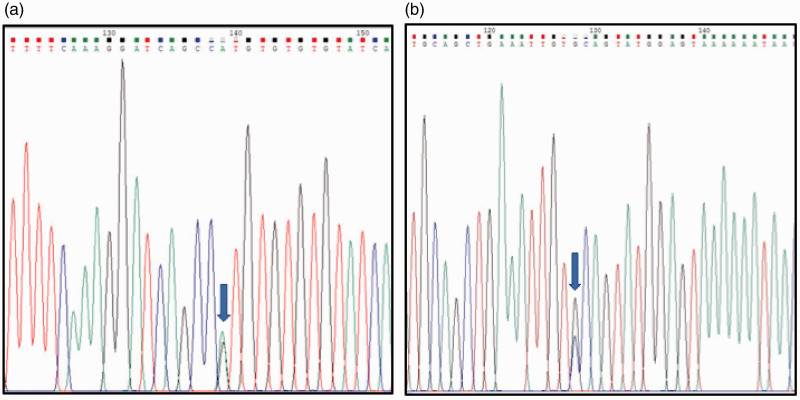
Two variants in were found: p.Val337Met (rs1527482) and p.Val579 = (rs2272351). The rare variant rs1527482 (A) was significantly overrepresented in our HSCR patients (9.1%) compared with South Asian controls in the 1000 Genomes (4.7%) and Exome Aggregation Consortium (ExAC; 3.5%) databases. Our analysis using bioinformatics tools predicted this variant to be evolutionarily conserved and damaging to SEMA3C protein function. Although the frequency of the other variant, rs2272351 (G), also differed significantly in Indonesian patients with HSCR (27.3%) from that in South Asian controls in 1000 Genomes (6.2%) and ExAC (4.6%), it is a synonymous variant and not likely to affect protein function.
This is the first comprehensive report of screening in patients of Asian ancestry with HSCR and identifies rs1527482 as a possible disease risk allele in this population.
包括SEMA3C在内的成簇基因,特别是3类信号素,已被证明与白种人群中先天性巨结肠(HSCR)的发生有关。我们旨在筛查印度尼西亚HSCR患者中SEMA3C的罕见和常见变异。
在这项前瞻性临床研究中,我们通过DNA测序和生物信息学分析,对55例HSCR患者的SEMA3C基因变异进行了分析。
在SEMA3C中发现了两个变异:p.Val337Met(rs1527482)和p.Val579=(rs2272351)。与千人基因组计划(4.7%)和外显子聚合联盟(ExAC;3.5%)数据库中的南亚对照相比,罕见变异rs1527482(A)在我们的HSCR患者中显著富集(9.1%)。我们使用生物信息学工具进行的分析预测该变异在进化上保守且对SEMA3C蛋白功能有损害。尽管另一个变异rs2(G)在印度尼西亚HSCR患者中的频率(27.3%)也与千人基因组计划中的南亚对照(6.2%)和ExAC(4.6%)有显著差异,但它是一个同义变异,不太可能影响蛋白功能。
这是首份对亚洲血统HSCR患者进行SEMA3C筛查的综合报告,并将rs1527482鉴定为该人群中可能的疾病风险等位基因。