Hospital Sírio-Libanês, Rehabilitation Centre, Dona Adma Jafet Street, 91 - Bela Vista, São Paulo, SP, 01308-050, Brazil.
Hospital Sírio-Libanês, Haemodialysis Centre, Dona Adma Jafet, 91 - Bela Vista, São Paulo, SP, 01308-050, Brazil.
BMC Nephrol. 2021 Feb 8;22(1):56. doi: 10.1186/s12882-021-02256-7.
Chronic kidney disease is a systemic disease affecting not only renal function, but also endocrine, cardiovascular, and skeletal muscle systems, with broad impact on functionality. Therefore, the assessment of body composition, peripheral muscle function, and exercise tolerance is also of great importance in this population. In addition, the development of reliable strategies that use feasible tools in clinical practice is of great importance in the functional diagnosis, clinical management and prescription of physical activity.
To assess the relationship between phase angle and peak torque of knee extensors with the performance in six-minute step test of patients with chronic kidney disease undergoing haemodialysis.
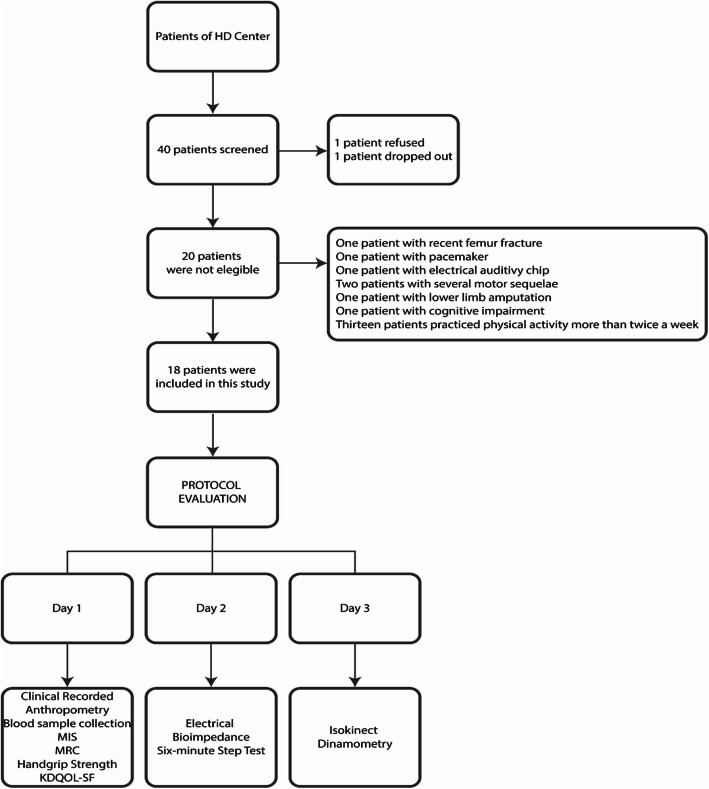
Observational and cross-sectional study at Haemodialysis Centre of Sírio-Libanês Hospital. The evaluations took place 3 days before the haemodialysis sessions. On the first day, patients underwent anthropometric evaluation and biochemical tests (lactate, urea, creatinine, albumin, ferritin and growth factor similar to insulin type 1 [IGF1]). On the second day, performed electrical bioimpedance and exercise tolerance assessed using the six-minute step test. On the last day, the evaluation of knee extensor muscles strength using isokinetic dynamometry was performed.
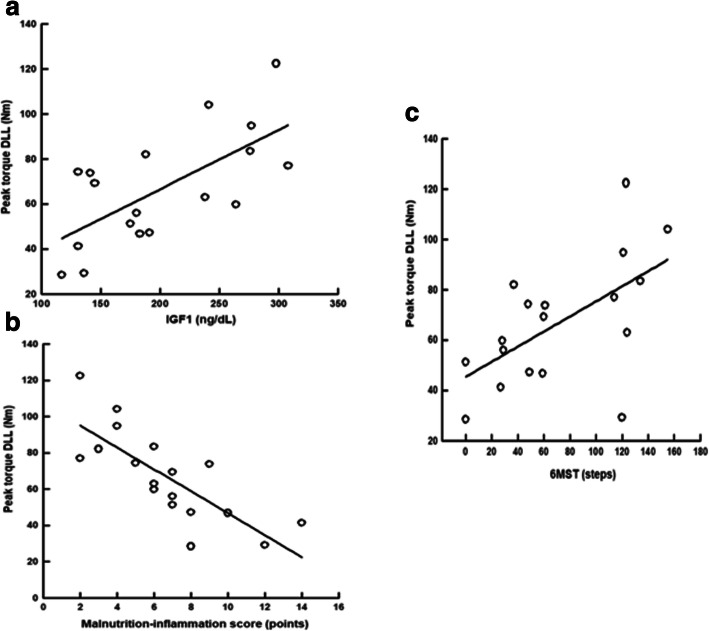
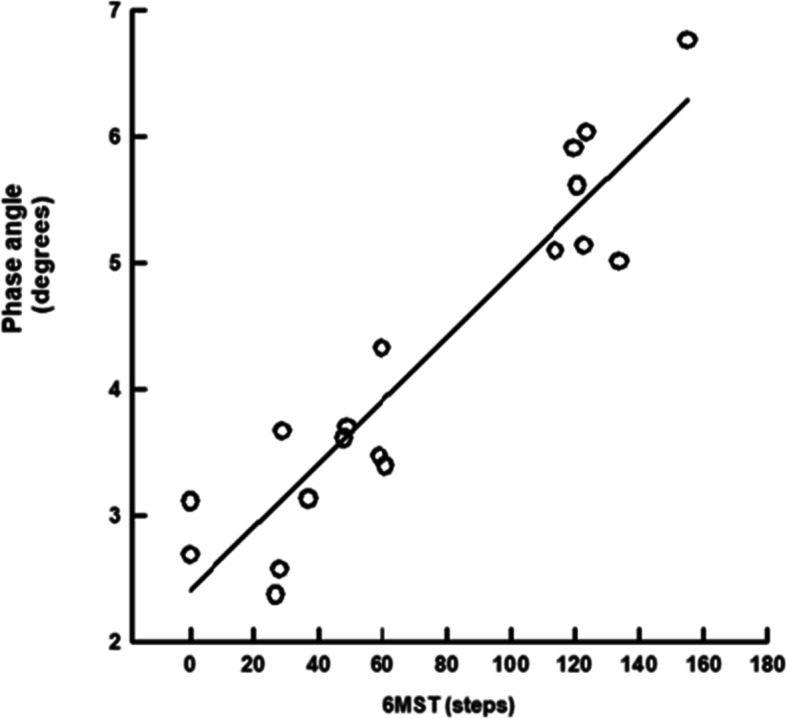
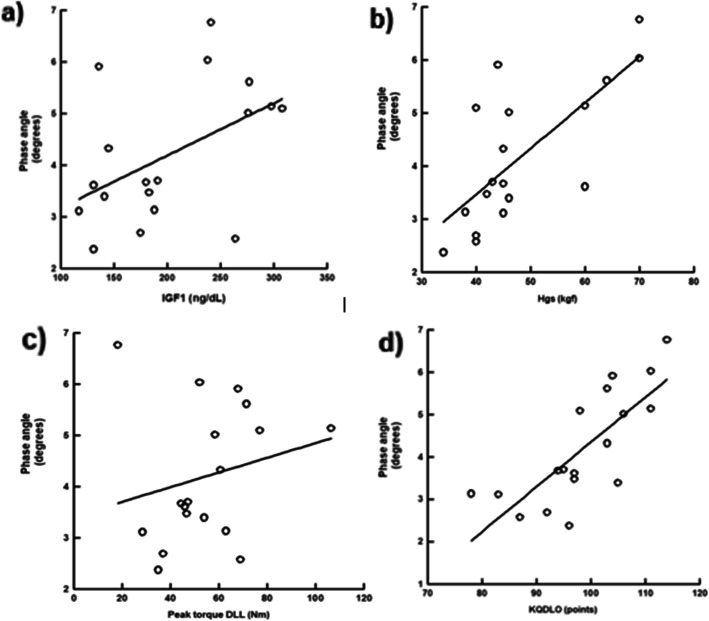
Eighteen subjects were included, with a mean age of 62.3 ± 17.6 years. A positive linear correlation was observed between the phase angle, derived from the electrical bioimpedance, and the performance in six-minute step test in these patients. It was also possible to observe a linear correlation between phase angle and IGF1, handgrip strength, peak torque of knee extensors and quality of life questionnaire. The peak torque of knee extensors also presented a linear correlation with IGF1, the performance in six-minute step test and mal-nutrition and inflammation score.
Phase angle and peak torque of knee extensors were correlated with the performance in six-minute step test. Therefore, the phase angle seems to be an important marker of reduced peripheral muscle function and exercise tolerance in haemodialysis patients.
慢性肾脏病是一种全身性疾病,不仅影响肾功能,还影响内分泌、心血管和骨骼肌系统,对功能有广泛影响。因此,评估身体成分、周围肌肉功能和运动耐量对该人群也非常重要。此外,开发使用临床实践中可行工具的可靠策略对于功能诊断、临床管理和体力活动处方非常重要。
评估相位角和膝关节伸肌峰值扭矩与血液透析慢性肾脏病患者六分钟台阶试验表现之间的关系。
在希里奥-利班内斯医院血液透析中心进行观察性和横断面研究。评估在血液透析治疗前 3 天进行。第一天,患者进行人体测量评估和生化测试(乳酸、尿素、肌酐、白蛋白、铁蛋白和胰岛素样生长因子 1 [IGF1])。第二天,进行电生物阻抗测量和使用六分钟台阶试验评估运动耐量。最后一天,使用等速动力学测力仪评估膝关节伸肌肌力。
纳入了 18 名受试者,平均年龄为 62.3±17.6 岁。在这些患者中,从电生物阻抗得出的相位角与六分钟台阶试验的表现呈正线性相关。还可以观察到相位角与 IGF1、手握力、膝关节伸肌峰值扭矩和生活质量问卷之间的线性相关。膝关节伸肌峰值扭矩也与 IGF1、六分钟台阶试验表现以及营养不良和炎症评分呈线性相关。
相位角和膝关节伸肌峰值扭矩与六分钟台阶试验表现相关。因此,相位角似乎是血液透析患者周围肌肉功能和运动耐量降低的重要标志物。