Klont Frank, Kieneker Lyanne M, Gomes-Neto Antonio W, Stam Suzanne P, Ten Hacken Nick H T, Kema Ido P, van Beek André P, van den Berg Else, Horvatovich Péter, Bischoff Rainer, Bakker Stephan J L
Department of Analytical Biochemistry, Groningen Research Institute of Pharmacy, University of Groningen, 9713 AV Groningen, The Netherlands.
Department of Internal Medicine, Division of Nephrology, University Medical Center Groningen, University of Groningen, 9700 RB Groningen, The Netherlands.
J Clin Med. 2020 Jan 21;9(2):293. doi: 10.3390/jcm9020293.
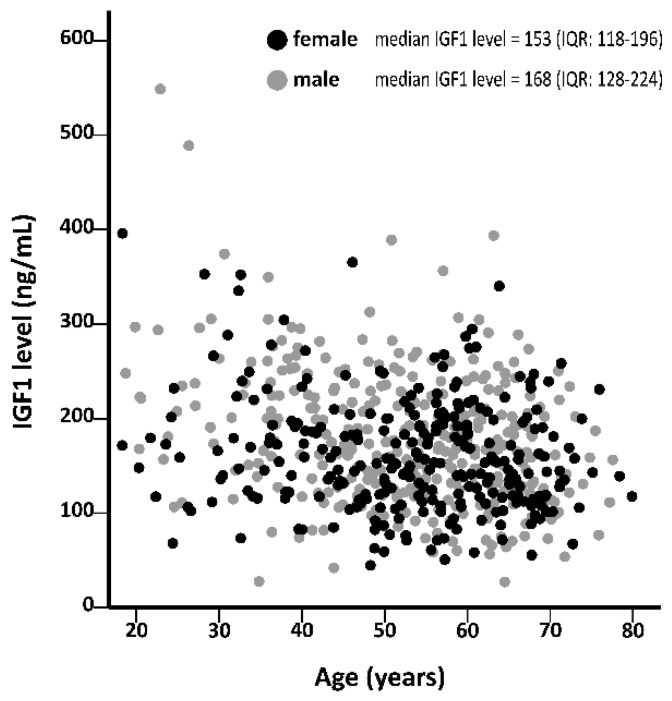
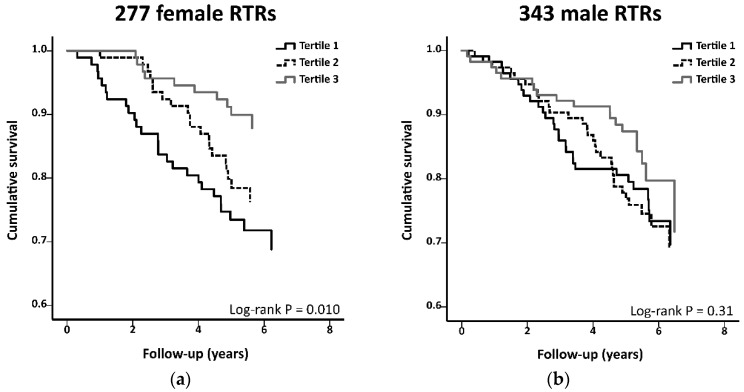
Associations between insulin-like growth factor 1 (IGF1) and mortality have been reported to be female specific in mice and in human nonagenarians. Intervention in the growth hormone (GH)-IGF1 axis may particularly benefit patients with high risk of losing muscle mass, including renal transplant recipients (RTR). We investigated whether a potential association of circulating IGF1 with all-cause mortality in stable RTR could be female specific and mediated by variation in muscle mass. To this end, plasma IGF1 levels were measured in 277 female and 343 male RTR by mass spectrometry, and their association with mortality was assessed by Cox regression. During a median follow-up time of 5.4 years, 56 female and 77 male RTR died. In females, IGF1 was inversely associated with risk (hazard ratio (HR) per 1-unit increment in log2-transformed (doubling of) IGF1 levels, 95% confidence interval (CI)) of mortality (0.40, 0.24-0.65; < 0.001), independent of age and the estimated Glomerular filtration rate (eGFR). In equivalent analyses, no significant association was observed for males (0.85, 0.56-1.29; = 0.44), for which it should be noted that in males, age was negatively and strongly associated with IGF1 levels. The association for females remained materially unchanged upon adjustment for potential confounders and was furthermore found to be mediated for 39% by 24 h urinary creatinine excretion. In conclusion, low IGF1 levels associate with an increased risk of all-cause mortality in female RTR, which may link to conditions of low muscle mass that are known to be associated with poor outcomes in transplantation patients. For males, the strongly negative association of age with IGF1 levels may explain why low IGF1 levels were not found to be associated with an increased risk of all-cause mortality.
据报道,胰岛素样生长因子1(IGF1)与死亡率之间的关联在小鼠和人类九旬老人中具有女性特异性。干预生长激素(GH)-IGF1轴可能对肌肉量流失风险高的患者特别有益,包括肾移植受者(RTR)。我们调查了循环IGF1与稳定RTR全因死亡率之间的潜在关联是否具有女性特异性,并是否由肌肉量的变化介导。为此,通过质谱法测量了277名女性和343名男性RTR的血浆IGF1水平,并通过Cox回归评估了其与死亡率的关联。在中位随访时间5.4年期间,56名女性和77名男性RTR死亡。在女性中,IGF1与死亡率风险(风险比(HR),log2转换后的(翻倍)IGF1水平每增加1个单位,95%置信区间(CI))呈负相关(0.40,0.24 - 0.65;<0.001),独立于年龄和估计的肾小球滤过率(eGFR)。在等效分析中,未观察到男性有显著关联(0.85,0.56 - 1.29;=0.44),需要注意的是,在男性中,年龄与IGF1水平呈负且强相关。在调整潜在混杂因素后,女性的关联基本保持不变,并且还发现24小时尿肌酐排泄介导了39%的关联。总之,低IGF1水平与女性RTR全因死亡率增加相关,这可能与低肌肉量状况有关,已知低肌肉量与移植患者的不良结局相关。对于男性,年龄与IGF1水平的强负相关可能解释了为何未发现低IGF1水平与全因死亡率增加相关。