Division of Clinical Haematology, Department of Medicine, Faculty of Health Sciences, University of Cape Town and Groote Schuur Hospital, Cape Town, South Africa.
Division of Anatomical Pathology, Department of Pathology, Faculty of Health Sciences, University of Cape Town and National Health Laboratory Service, Groote Schuur Hospital, Cape Town, South Africa.
Pathology. 2021 Aug;53(5):628-634. doi: 10.1016/j.pathol.2020.11.004. Epub 2021 Feb 6.
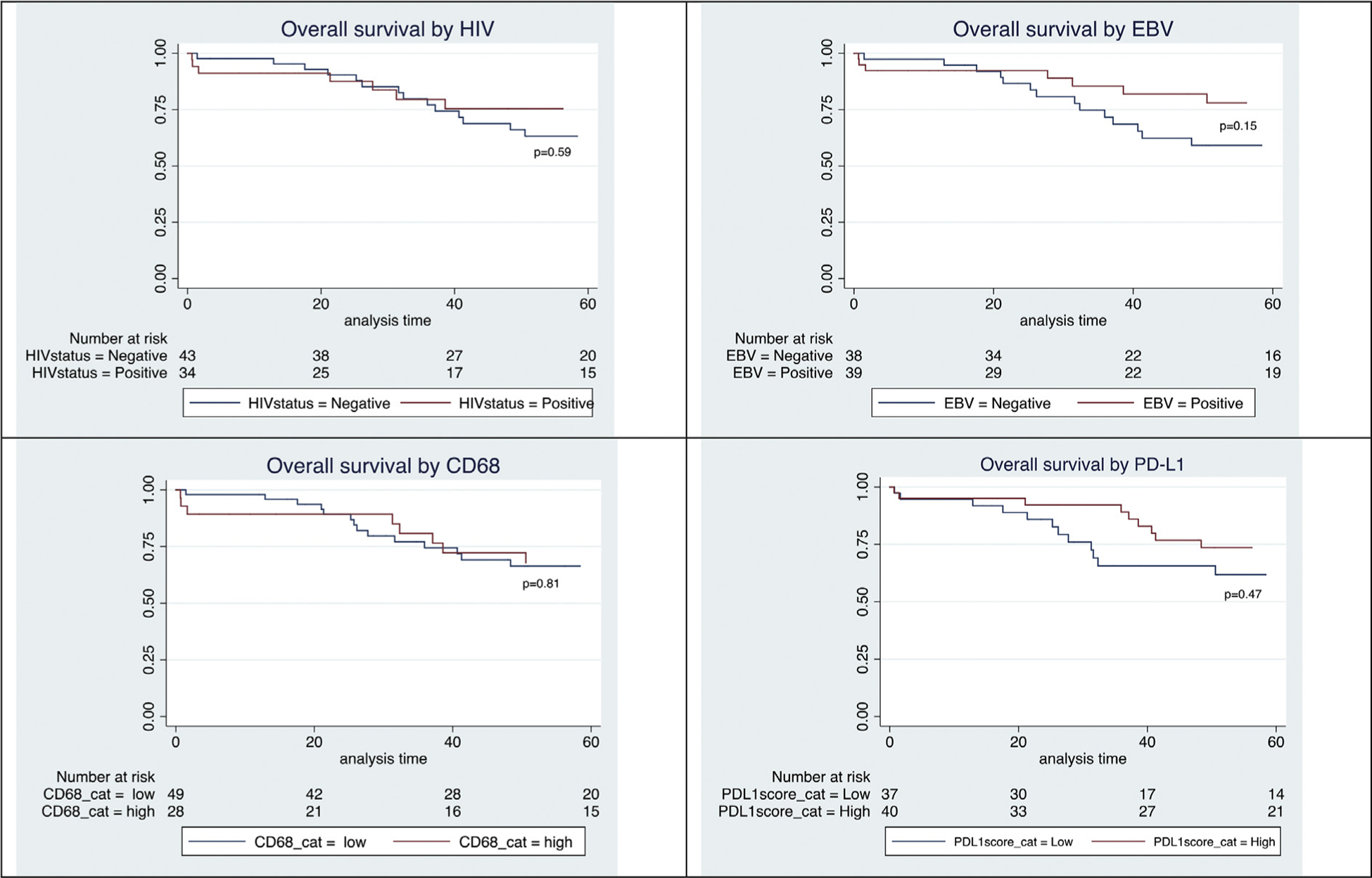
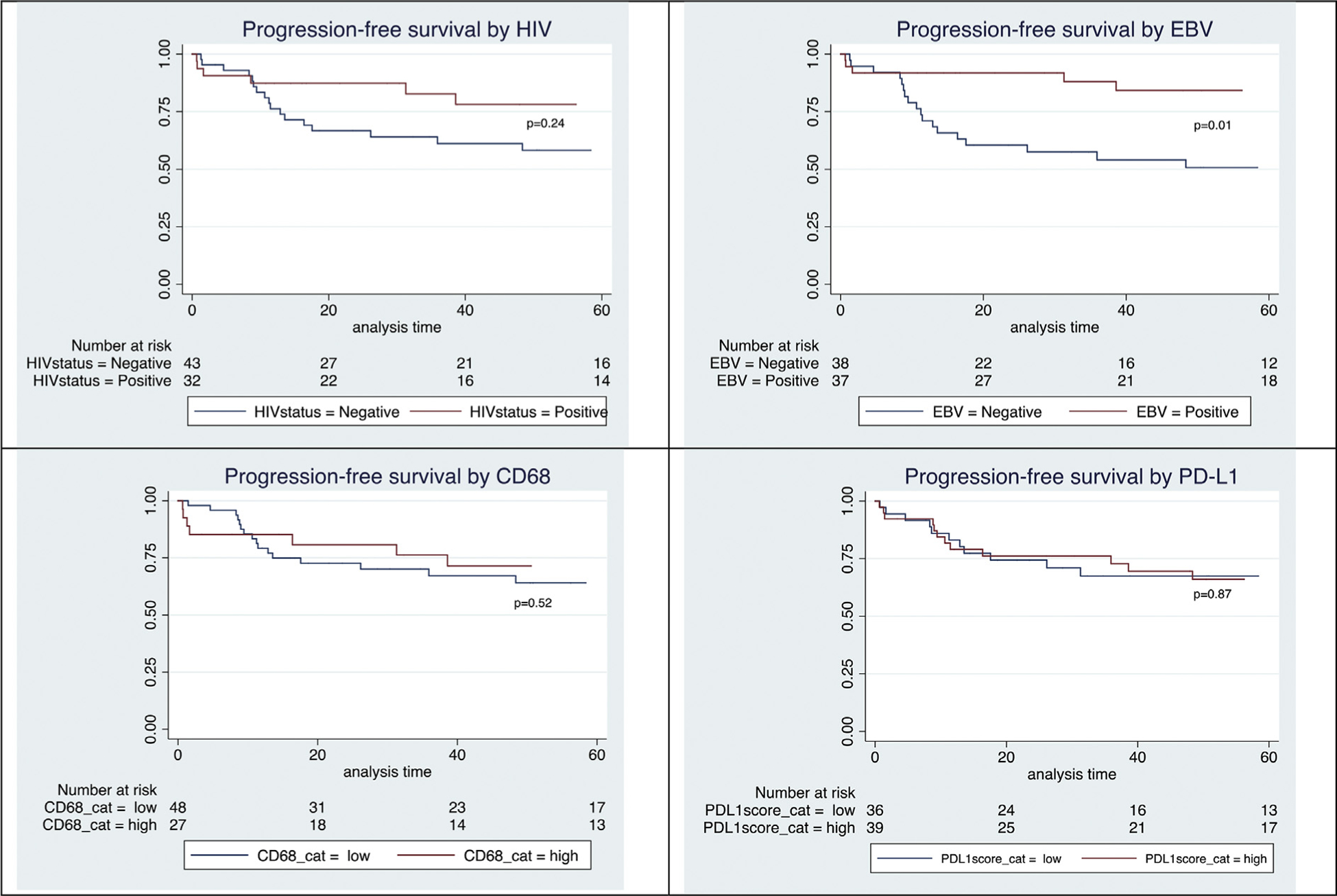
A higher proportion of CD68-positive tumour associated macrophages (TAMs) has been associated with poorer outcomes in HIV-negative patients with Hodgkin lymphoma (HL), but whether this is true in HIV-positive patients with HL is not known. In this study, we investigated the number of CD68-positive TAMs and expression of programmed cell death-ligand 1 (PD-L1) in lymph node specimens from HL patients and correlated expression with clinical features (HIV status, disease severity and survival) and histopathological features (EBV latent positivity and subtype of HL). We stained archived lymph node specimens from 77 patients diagnosed with HL for CD68 and PD-L1. Stains were graded as: CD68 low (≤25%), CD68 high (>25%), PD-L1 low (≤50%), and PD-L1 high (>50%). Expression levels were correlated with the clinical and histopathological features using bivariate and multivariate analyses. Survival was analysed by overall and progression-free survival. Thirty-four of the 77 included patients (44%) were HIV-positive. EBV latency was detected in 97% of HIV-positive HL patients and in 14% of HIV-negative HL patients. A high CD68 score was associated with lower median haemoglobin levels (9.4 vs 11.4 g/dL; p=0.02), platelet numbers (262 vs 424 cells ×10/L; p=0.01), and lymphocyte numbers (0.99 vs 1.70 cells ×10/L, p=0.01) and a trend towards advanced disease (international prognostic score ≥4; hazard ratio 2.4; confidence interval 0.89-6.47; p=0.08). HIV status did not affect CD68 or PD-L1 expression. A higher proportion of CD68-positive TAMs was found in samples that were EBV-positive. HIV positivity and EBV negativity correlated with poorer survival. CD68 and PD-L1 expression were not predictive of survival. High CD68 expression was associated with EBV positivity but not HIV positivity and did not predict adverse outcomes. PD-L1 expression was unaffected by HIV status or EBV positivity and did predict adverse outcomes.
更多的 CD68 阳性肿瘤相关巨噬细胞(TAMs)与 HIV 阴性霍奇金淋巴瘤(HL)患者的不良预后相关,但在 HIV 阳性 HL 患者中是否如此尚不清楚。在这项研究中,我们检测了 HL 患者淋巴结标本中 CD68 阳性 TAMs 的数量和程序性细胞死亡配体 1(PD-L1)的表达,并将其表达与临床特征(HIV 状态、疾病严重程度和生存)和组织病理学特征(EBV 潜伏阳性和 HL 亚型)相关联。我们对 77 例 HL 患者的存档淋巴结标本进行了 CD68 和 PD-L1 的染色。染色分为:CD68 低(≤25%)、CD68 高(>25%)、PD-L1 低(≤50%)和 PD-L1 高(>50%)。使用双变量和多变量分析,将表达水平与临床和组织病理学特征相关联。通过总生存率和无进展生存率进行生存分析。77 例纳入患者中,34 例(44%)为 HIV 阳性。HIV 阳性 HL 患者中有 97%存在 EBV 潜伏,而 HIV 阴性 HL 患者中有 14%存在 EBV 潜伏。高 CD68 评分与较低的中位血红蛋白水平(9.4 与 11.4 g/dL;p=0.02)、血小板数量(262 与 424 细胞×10/L;p=0.01)和淋巴细胞数量(0.99 与 1.70 细胞×10/L,p=0.01)以及疾病晚期(国际预后评分≥4;风险比 2.4;95%置信区间 0.89-6.47;p=0.08)相关。HIV 状态并不影响 CD68 或 PD-L1 的表达。在 EBV 阳性的样本中发现了更高比例的 CD68 阳性 TAMs。HIV 阳性和 EBV 阴性与较差的生存相关。CD68 和 PD-L1 的表达与生存无关。高 CD68 表达与 EBV 阳性相关,与 HIV 阳性无关,与不良预后无关。PD-L1 的表达不受 HIV 状态或 EBV 阳性的影响,可预测不良预后。高 CD68 表达与 EBV 阳性相关,而与 HIV 阳性无关,与不良预后无关。PD-L1 表达不受 HIV 状态或 EBV 阳性的影响,与不良预后相关。