From the Department of Neurology (D.M., A.L.-G.), Los Angeles Medical Center, Southern California Permanente Medical Group; Department of Drug Use Management, Los Angeles Medical Center, Kaiser Permanente (N.N.H.); Department of Research & Evaluation (J.B.S.), Southern California Permanente Medical Group, Pasadena; and Department of Neurology (A.S.N.), Fontana Medical Center, Southern California Permanente Medical Group.
Neurol Neuroimmunol Neuroinflamm. 2021 Feb 8;8(2). doi: 10.1212/NXI.0000000000000960. Print 2021 Mar.
To determine whether MS disease-modifying therapies (DMTs) can be safely discontinued in patients aged 50 years or older with suspected benign/burnt-out MS and to define criteria to identify such patients.
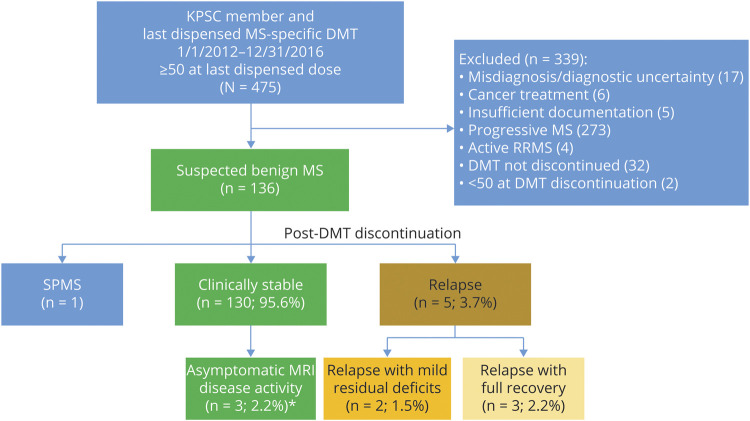
We conducted a retrospective cohort study of 136 patients with suspected benign/burnt-out MS who discontinued DMTs from the electronic health record (EHR) at Kaiser Permanente Southern California.
The majority discontinued an injectable DMT (n = 131, 96%). At the time of DMT discontinuation, mean and SD for age was 60.6 (6.2) years, disease duration 19.5 (10.7) years, and time since last relapse 11.0 (7.2) years. After a mean duration of follow-up of 5.0 years post-DMT discontinuation, 5 (3.7%) patients had a relapse, 2 (1.5%) had mild residual deficits, and 3 (2.2%) had asymptomatic MRI disease activity. Patients with MS disease activity following DMT discontinuation were younger (median = 53.6 years) than those who remained disease activity free. Fifty patients (36.8%) had only 1 lifetime relapse, of whom 1 relapsed post-DMT discontinuation. Sixty (56.6%) of 106 patients with spinal cord MRIs before discontinuation showed demyelinating lesions.
DMT discontinuation in older patients with suspected benign/burnt-out MS appears safe. Our findings suggest that MRI evidence of spinal cord involvement does not preclude the possibility of benign/burnt-out MS, and for those with 2 or more lifetime relapses, a benign/burn-out classification is best reserved for those aged 55 years and older. Future studies to determine whether DMT discontinuation is safe at a younger age in patients with a single lifetime relapse are needed.
The study provides Class IV evidence that DMTs can be safely discontinued in older patients with suspected benign/burnt-out MS.
确定年龄在 50 岁及以上、疑似良性/耗竭型多发性硬化症(MS)的患者是否可以安全停用 MS 疾病修正治疗(DMT),并确定识别此类患者的标准。
我们对 136 例在加利福尼亚州南部凯撒永久医疗集团的电子健康记录(EHR)中停用 DMT 的疑似良性/耗竭型 MS 患者进行了回顾性队列研究。
大多数患者停用了一种注射用 DMT(n = 131,96%)。在 DMT 停药时,年龄的平均值和标准差为 60.6(6.2)岁,病程为 19.5(10.7)年,末次复发后时间为 11.0(7.2)年。在 DMT 停药后平均 5.0 年的随访期间,有 5 例(3.7%)患者复发,2 例(1.5%)有轻度残留缺陷,3 例(2.2%)有无症状的 MRI 疾病活动。DMT 停药后有 MS 疾病活动的患者年龄较轻(中位数=53.6 岁),无疾病活动的患者年龄较大。50 例(36.8%)患者仅有 1 次终生复发,其中 1 例在 DMT 停药后复发。在 106 例停用 DMT 前有脊髓 MRI 的患者中,60 例(56.6%)显示脱髓鞘病变。
在年龄较大的疑似良性/耗竭型 MS 患者中停用 DMT 似乎是安全的。我们的研究结果表明,脊髓 MRI 有病变证据并不能排除良性/耗竭型 MS 的可能性,对于有 2 次或以上终生复发的患者,良性/耗竭分类最好保留给年龄在 55 岁及以上的患者。需要进一步研究以确定在仅有 1 次终生复发的患者中,年龄较小的患者是否可以安全停用 DMT。
本研究提供了 IV 级证据,表明年龄较大的疑似良性/耗竭型 MS 患者可以安全停用 DMT。