Roelands Jessica, Mall Raghvendra, Almeer Hossam, Thomas Remy, Mohamed Mahmoud G, Bedri Shahinaz, Al-Bader Salha Bujassoum, Junejo Kulsoom, Ziv Elad, Sayaman Rosalyn W, Kuppen Peter J K, Bedognetti Davide, Hendrickx Wouter, Decock Julie
Functional Cancer Omics Lab, Cancer Group, Research Branch, Sidra Medicine, Doha, Qatar.
Department of Surgery, Leiden University Medical Center, Leiden, Netherlands.
NPJ Breast Cancer. 2021 Feb 8;7(1):10. doi: 10.1038/s41523-021-00215-x.
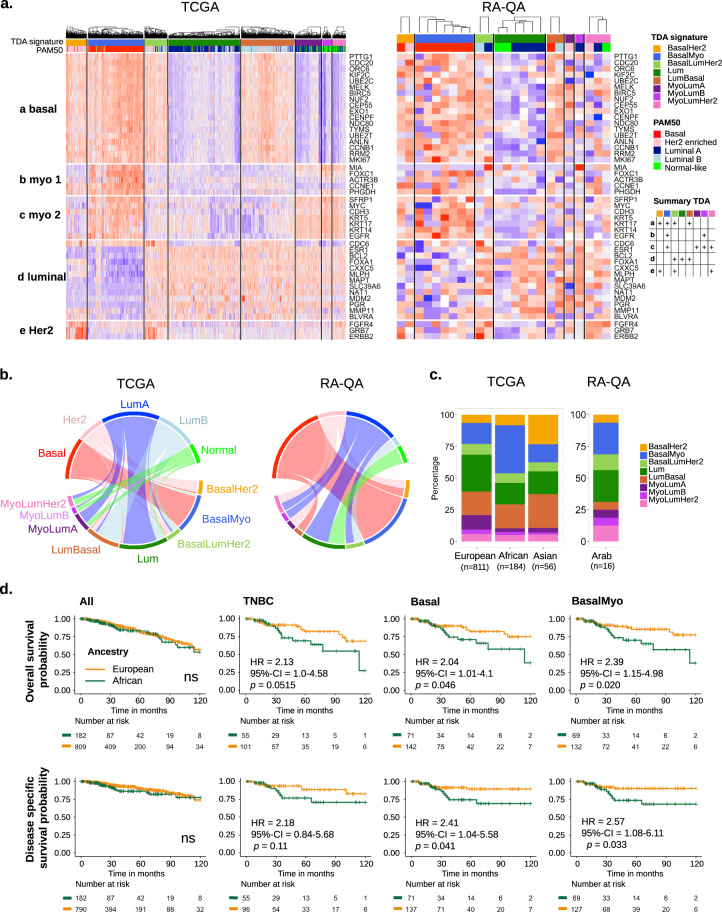
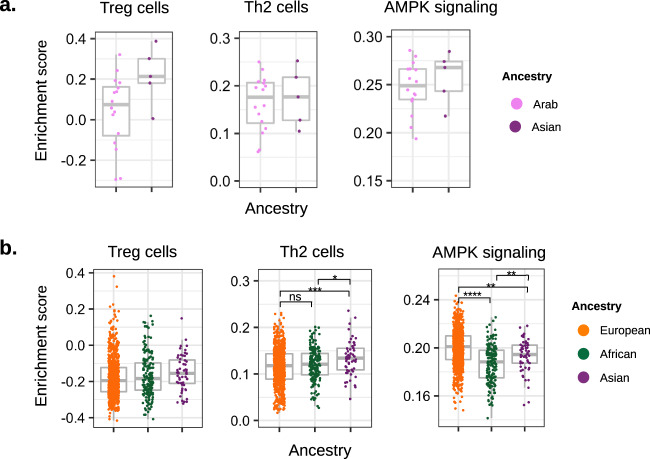
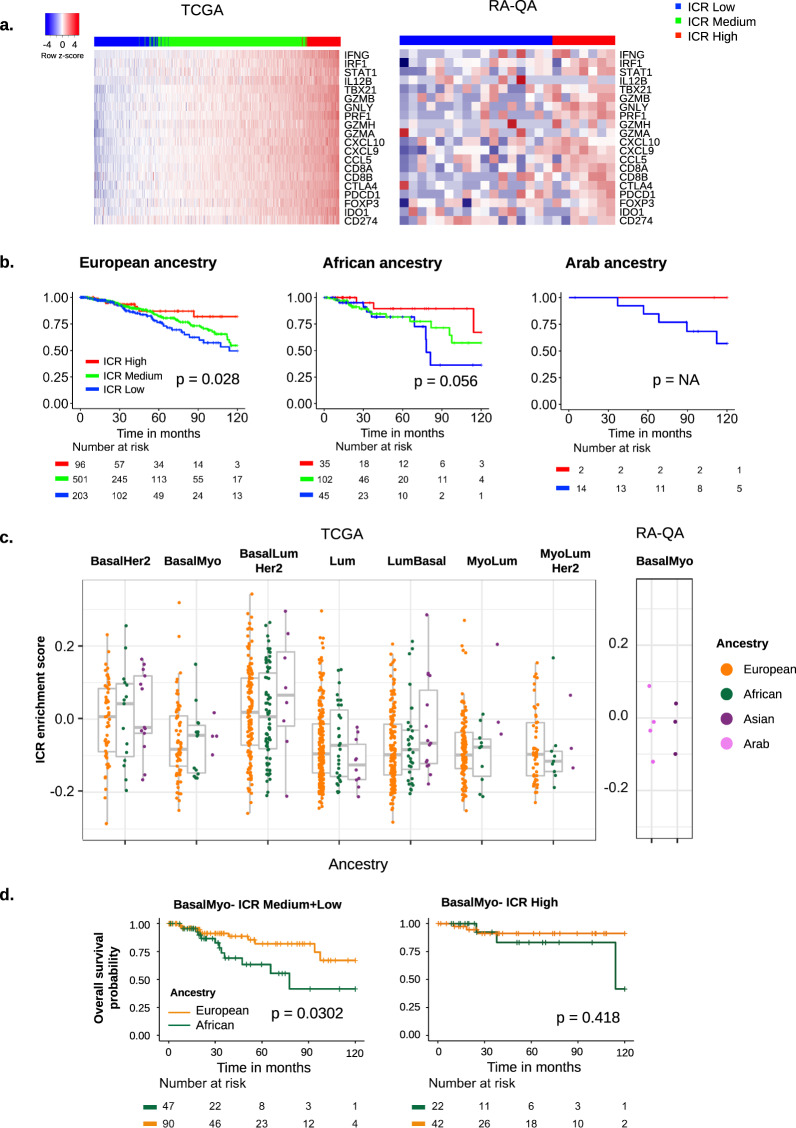
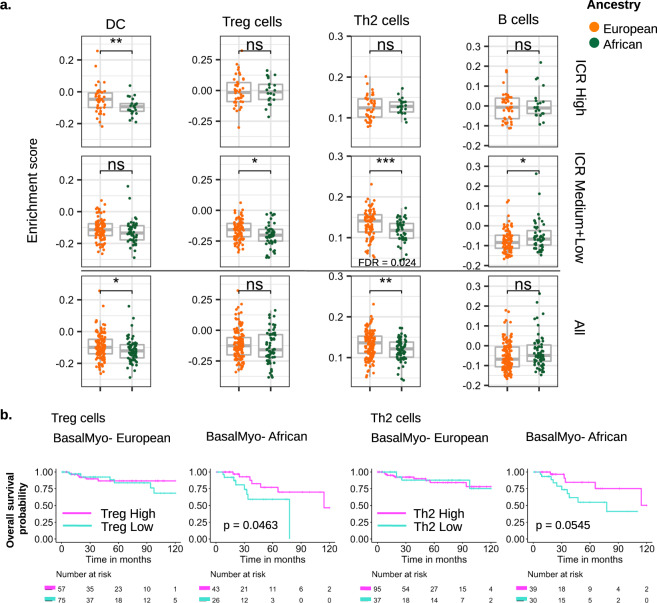
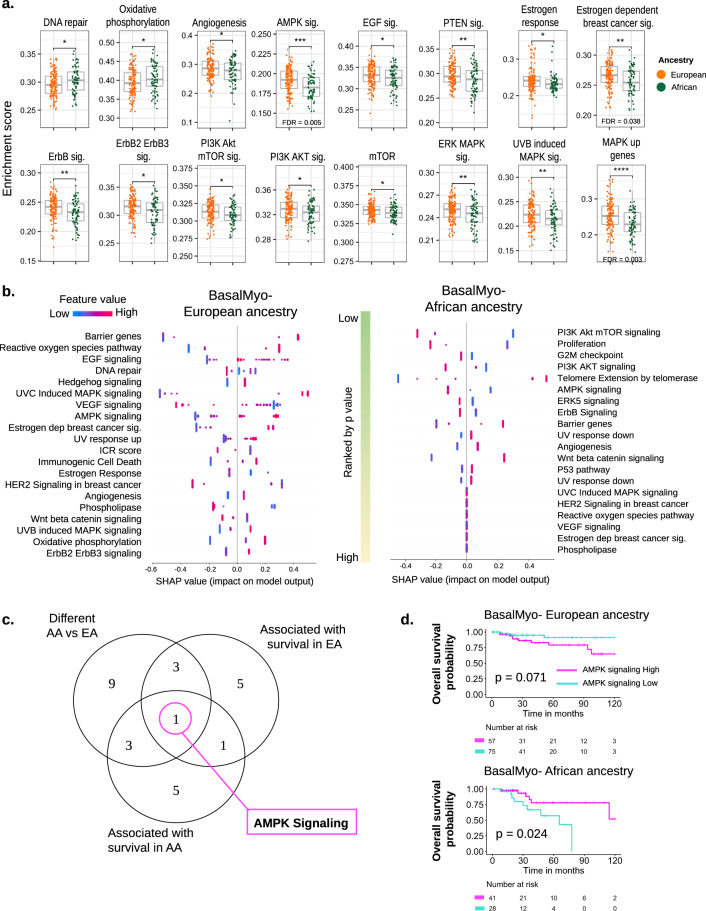
Breast cancer largely dominates the global cancer burden statistics; however, there are striking disparities in mortality rates across countries. While socioeconomic factors contribute to population-based differences in mortality, they do not fully explain disparity among women of African ancestry (AA) and Arab ancestry (ArA) compared to women of European ancestry (EA). In this study, we sought to identify molecular differences that could provide insight into the biology of ancestry-associated disparities in clinical outcomes. We applied a unique approach that combines the use of curated survival data from The Cancer Genome Atlas (TCGA) Pan-Cancer clinical data resource, improved single-nucleotide polymorphism-based inferred ancestry assignment, and a novel breast cancer subtype classification to interrogate the TCGA and a local Arab breast cancer dataset. We observed an enrichment of BasalMyo tumors in AA patients (38 vs 16.5% in EA, p = 1.30E - 10), associated with a significant worse overall (hazard ratio (HR) = 2.39, p = 0.02) and disease-specific survival (HR = 2.57, p = 0.03). Gene set enrichment analysis of BasalMyo AA and EA samples revealed differences in the abundance of T-regulatory and T-helper type 2 cells, and enrichment of cancer-related pathways with prognostic implications (AA: PI3K-Akt-mTOR and ErbB signaling; EA: EGF, estrogen-dependent and DNA repair signaling). Strikingly, AMPK signaling was associated with opposing prognostic connotation (AA: 10-year HR = 2.79, EA: 10-year HR = 0.34). Analysis of ArA patients suggests enrichment of BasalMyo tumors with a trend for differential enrichment of T-regulatory cells and AMPK signaling. Together, our findings suggest that the disparity in the clinical outcome of AA breast cancer patients is likely related to differences in cancer-related and microenvironmental features.
乳腺癌在全球癌症负担统计中占据主导地位;然而,各国的死亡率存在显著差异。虽然社会经济因素导致了基于人群的死亡率差异,但与欧洲血统(EA)女性相比,它们并不能完全解释非洲血统(AA)和阿拉伯血统(ArA)女性之间的差异。在本研究中,我们试图确定分子差异,以深入了解临床结果中与血统相关的差异生物学机制。我们采用了一种独特的方法,结合使用来自癌症基因组图谱(TCGA)泛癌临床数据资源的精心整理的生存数据、改进的基于单核苷酸多态性的推断血统分配方法,以及一种新颖的乳腺癌亚型分类方法,对TCGA和一个本地阿拉伯乳腺癌数据集进行分析。我们观察到AA患者中基底肌上皮瘤(BasalMyo)富集(AA患者中占38%,EA患者中占16.5%,p = 1.30E - 10),这与总体生存率显著较差(风险比(HR)= 2.39,p = 0.02)和疾病特异性生存率较差(HR = 2.57,p = 0.03)相关。对BasalMyo AA和EA样本进行基因集富集分析,发现调节性T细胞和2型辅助性T细胞丰度存在差异,以及具有预后意义的癌症相关通路富集(AA:PI3K - Akt - mTOR和ErbB信号通路;EA:表皮生长因子(EGF)、雌激素依赖性和DNA修复信号通路)。令人惊讶的是,AMPK信号通路与相反的预后含义相关(AA:10年HR = 2.79,EA:10年HR = 0.34)。对ArA患者的分析表明,基底肌上皮瘤富集,调节性T细胞和AMPK信号通路存在差异富集趋势。总之,我们的研究结果表明,AA乳腺癌患者临床结果的差异可能与癌症相关特征和微环境特征的差异有关。