Exercise Medicine Research Institute, Edith Cowan University, Joondalup, WA, Australia.
School of Medical and Health Sciences, Edith Cowan University, Joondalup, WA, Australia.
Prostate Cancer Prostatic Dis. 2021 Sep;24(3):758-766. doi: 10.1038/s41391-021-00327-2. Epub 2021 Feb 8.
To assess the long-term effects of various exercise modes on psychological distress in men with prostate cancer on androgen deprivation therapy (ADT).
135 prostate cancer patients aged 43-90 years on ADT were randomized to twice weekly supervised impact loading and resistance exercise (ImpRes), supervised aerobic and resistance exercise (AerRes), and usual care/delayed supervised aerobic exercise (DelAer) for 12 months, and completed measures of psychological distress using the Brief Symptom Inventory-18 (BSI-18). BSI-18 provides three subscales for anxiety, depression, and somatisation, as well as the global severity index (GSI) where higher scores indicate higher distress.
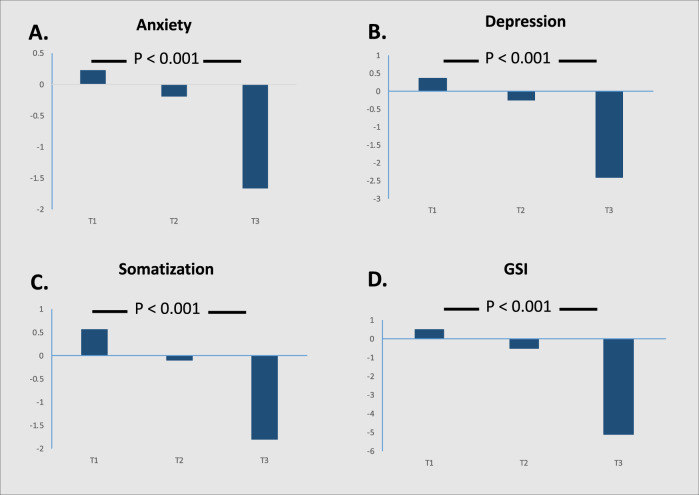
Following the intervention, somatization was not different to baseline, however, there were significant interactions (p < 0.01) for depression, anxiety, and the GSI. In ImpRes, depression was reduced at 12 months compared to baseline and 6 months (0.78 ± 1.39 vs. 1.88 ± 3.24 and 1.48 ± 2.65, p < 0.001), as was the GSI (3.67 ± 4.34 vs. 5.94 ± 7.46 and 4.64 ± 4.73, p < 0.001) with anxiety reduced compared to baseline (1.08 ± 1.54 vs. 1.98 ± 2.56). Depression and the GSI decreased (p < 0.05) in AerRes at 6 months but increased by 12 months, while in DelAer the GSI was reduced at 12 months compared to 6 months (3.78 ± 3.94 vs. 5.25 ± 4.22, p = 0.031). Men with the highest level of anxiety, depression, somatization, and the GSI improved the most with exercise (p < 0.001).
Various supervised exercise modes (aerobic, resistance and impact loading) are effective in reducing psychological distress in men with prostate cancer on ADT. Those with the highest level of psychological distress improved the most. Supervised exercise should be prescribed to improve psychological health in prostate cancer patients on ADT.
评估各种运动模式对接受雄激素剥夺治疗(ADT)的前列腺癌男性患者心理困扰的长期影响。
135 名年龄在 43-90 岁之间接受 ADT 的前列腺癌患者被随机分配至每周两次监督冲击负荷和抗阻运动(ImpRes)、监督有氧运动和抗阻运动(AerRes)以及常规护理/延迟监督有氧运动(DelAer),持续 12 个月,并使用 Brief Symptom Inventory-18(BSI-18)完成心理困扰评估。BSI-18 提供焦虑、抑郁和躯体化三个子量表,以及全球严重指数(GSI),得分越高表示困扰越严重。
干预后,躯体化与基线相比没有差异,但抑郁、焦虑和 GSI 存在显著的交互作用(p<0.01)。在 ImpRes 组中,与基线和 6 个月相比,抑郁在 12 个月时得到了改善(0.78±1.39 与 1.88±3.24 和 1.48±2.65,p<0.001),GSI 也是如此(3.67±4.34 与 5.94±7.46 和 4.64±4.73,p<0.001),焦虑也与基线相比有所降低(1.08±1.54 与 1.98±2.56)。AerRes 组在 6 个月时抑郁和 GSI 降低(p<0.05),但 12 个月时增加,而 DelAer 组在 12 个月时 GSI 较 6 个月时降低(3.78±3.94 与 5.25±4.22,p=0.031)。焦虑、抑郁、躯体化和 GSI 水平最高的男性患者通过运动改善最明显(p<0.001)。
各种监督运动模式(有氧运动、抗阻运动和冲击负荷)对接受 ADT 的前列腺癌男性患者的心理困扰均有效。那些心理困扰程度最高的患者获益最大。应开具监督运动处方以改善接受 ADT 的前列腺癌患者的心理健康。