Gupta Manjul, Shoja Amin, Mikalef Patrick
College of Business, Florida International University, Miami, FL USA.
Department of Computer Science, Norwegian University of Science and Technology (NTNU), Trondheim, Norway.
Ann Oper Res. 2022;319(1):1433-1450. doi: 10.1007/s10479-021-03962-z. Epub 2021 Feb 3.
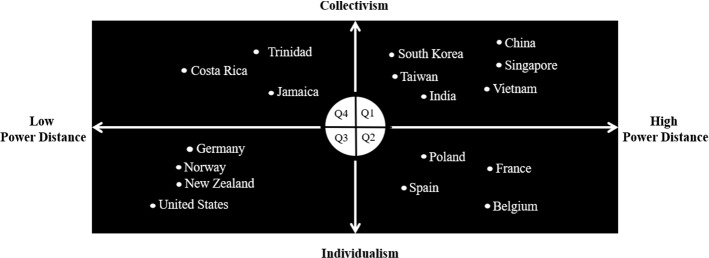
This study conceptually explores the relationship between a nation's culture and the success of utilizing various digital technologies to mitigate the spread of a pandemic, such as novel coronavirus (COVID-19). In the absence of a cure or vaccine of COVID-19, the national governments and public health authorities have been aggressively utilizing digital technologies to mitigate the pandemic spread. Given the urgency caused by COVID-19, this study highlights the importance of considering a country's national culture in evaluating the efficacy of a given digital technology, despite how promising or groundbreaking it may sound, in combating the spread of an infectious disease. Relying on the two critical dimensions of national culture, power distance and individualism/collectivism, this study proposes a framework that describes how people from different countries, depending on their prevalent national cultural values, would be receptive (or intolerant) to using government-run technology solutions meant for curbing the pandemic spread.
本研究从概念上探讨了一个国家的文化与利用各种数字技术来缓解大流行病(如新型冠状病毒,即COVID-19)传播的成效之间的关系。在缺乏针对COVID-19的治愈方法或疫苗的情况下,各国政府和公共卫生当局一直在积极利用数字技术来缓解大流行病的传播。鉴于COVID-19所造成的紧迫性,本研究强调,在评估特定数字技术在抗击传染病传播方面的功效时,无论其听起来多么有前景或具有开创性,考虑一个国家的民族文化都很重要。本研究基于民族文化的两个关键维度,即权力距离和个人主义/集体主义,提出了一个框架,该框架描述了来自不同国家的人们,根据其普遍的民族文化价值观,会如何接受(或不接受)使用旨在遏制大流行病传播的政府主导的技术解决方案。