Department of Chemistry and Biochemistry, International Forensic Research Institute, Florida International University, 11200 SW 8th St, Miami, FL 33199, USA.
Laboratory of Analytical Chemistry, Department of Chemistry, Aristotle University of Thessaloniki, 54124 Thessaloniki, Greece.
Molecules. 2021 Feb 6;26(4):865. doi: 10.3390/molecules26040865.
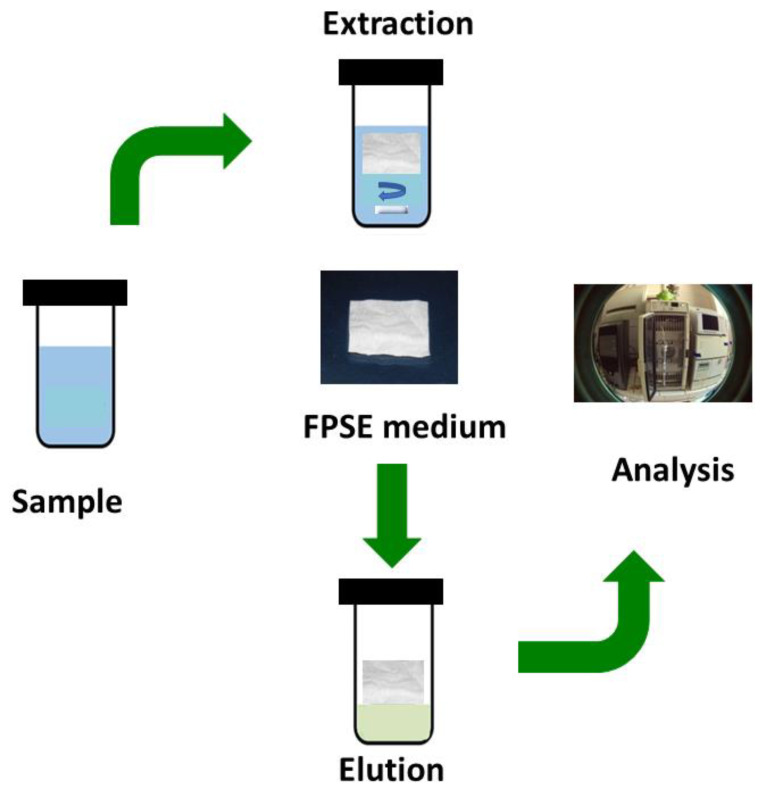
Fabric phase sorptive extraction (FPSE) is an evolutionary sample preparation approach which was introduced in 2014, meeting all green analytical chemistry (GAC) requirements by implementing a natural or synthetic permeable and flexible fabric substrate to host a chemically coated sol-gel organic-inorganic hybrid sorbent in the form of an ultra-thin coating. This construction results in a versatile, fast, and sensitive micro-extraction device. The user-friendly FPSE membrane allows direct extraction of analytes with no sample modification, thus eliminating/minimizing the sample pre-treatment steps, which are not only time consuming, but are also considered the primary source of major analyte loss. Sol-gel sorbent-coated FPSE membranes possess high chemical, solvent, and thermal stability due to the strong covalent bonding between the fabric substrate and the sol-gel sorbent coating. Subsequent to the extraction on FPSE membrane, a wide range of organic solvents can be used in a small volume to exhaustively back-extract the analytes after FPSE process, leading to a high preconcentration factor. In most cases, no solvent evaporation and sample reconstitution are necessary. In addition to the extensive simplification of the sample preparation workflow, FPSE has also innovatively combined the extraction principle of two major, yet competing sample preparation techniques: solid phase extraction (SPE) with its characteristic exhaustive extraction, and solid phase microextraction (SPME) with its characteristic equilibrium driven extraction mechanism. Furthermore, FPSE has offered the most comprehensive cache of sorbent chemistry by successfully combining almost all of the sorbents traditionally used exclusively in either SPE or in SPME. FPSE is the first sample preparation technique to exploit the substrate surface chemistry that complements the overall selectivity and the extraction efficiency of the device. As such, FPSE indeed represents a paradigm shift approach in analytical/bioanalytical sample preparation. Furthermore, an FPSE membrane can be used as an SPME fiber or as an SPE disk for sample preparation, owing to its special geometric advantage. So far, FPSE has overwhelmingly attracted the interest of the separation scientist community, and many analytical scientists have been developing new methodologies by implementing this cutting-edge technique for the extraction and determination of many analytes at their trace and ultra-trace level concentrations in environmental samples as well as in food, pharmaceutical, and biological samples. FPSE offers a total sample preparation solution by providing neutral, cation exchanger, anion exchanger, mixed mode cation exchanger, mixed mode anion exchanger, zwitterionic, and mixed mode zwitterionic sorbents to deal with any analyte regardless of its polarity, ionic state, or the sample matrix where it resides. Herein we present the theoretical background, synthesis, mechanisms of extraction and desorption, the types of sorbents, and the main applications of FPSE so far according to different sample categories, and to briefly show the progress, advantages, and the main principles of the proposed technique.
纤维增强型固相萃取(FPSE)是一种进化的样品制备方法,于 2014 年引入,通过使用天然或合成的可渗透和灵活的织物基质来承载化学涂覆的溶胶-凝胶有机-无机杂化吸附剂,以超薄膜的形式,满足所有绿色分析化学(GAC)的要求。这种结构形成了一种多功能、快速且灵敏的微萃取装置。用户友好的 FPSE 膜允许直接提取分析物,无需样品修饰,从而消除/最小化了样品预处理步骤,这些步骤不仅耗时,而且被认为是主要分析物损失的主要来源。由于织物基质和溶胶-凝胶吸附剂涂层之间存在强共价键,因此涂覆溶胶-凝胶吸附剂的 FPSE 膜具有高化学、溶剂和热稳定性。在 FPSE 膜上进行萃取后,可以使用少量的多种有机溶剂来彻底反萃取 FPSE 过程后的分析物,从而实现高的预浓缩因子。在大多数情况下,不需要蒸发溶剂和重新配制样品。除了广泛简化样品制备工作流程外,FPSE 还创新性地结合了两种主要的竞争样品制备技术的萃取原理:具有完全萃取特性的固相萃取(SPE)和具有平衡驱动萃取机制的固相微萃取(SPME)。此外,FPSE 通过成功结合传统上仅在 SPE 或 SPME 中使用的几乎所有吸附剂,提供了最全面的吸附剂化学库。FPSE 是第一种利用基质表面化学的样品制备技术,这种表面化学可以补充装置的整体选择性和萃取效率。因此,FPSE 确实代表了分析/生物分析样品制备中的一种范式转变方法。此外,由于其特殊的几何优势,FPSE 膜可用作 SPME 纤维或 SPE 圆盘进行样品制备。到目前为止,FPSE 已经极大地吸引了分离科学家社区的兴趣,许多分析科学家一直在开发新的方法学,通过实施这种前沿技术,从环境样品以及食品、制药和生物样品中提取和测定痕量和超痕量浓度的许多分析物。FPSE 通过提供中性、阳离子交换剂、阴离子交换剂、混合模式阳离子交换剂、混合模式阴离子交换剂、两性离子和混合模式两性离子吸附剂,为样品制备提供了完整的解决方案,以处理任何分析物,无论其极性、离子状态或所在的样品基质如何。本文根据不同的样品类别,介绍了 FPSE 的理论背景、合成、萃取和解吸机制、吸附剂类型以及迄今为止的主要应用,并简要展示了该技术的进展、优势和主要原理。