CRC Scotland & London, Eccleston Square, London SW1V 1PX, UK.
Department of Medical Sciences, Division of Internal Medicine and Chronobiology Laboratory, Fondazione IRCCS "Casa Sollievo della Sofferenza", 71013 San Giovanni Rotondo, Italy.
Int J Mol Sci. 2021 Feb 5;22(4):1597. doi: 10.3390/ijms22041597.
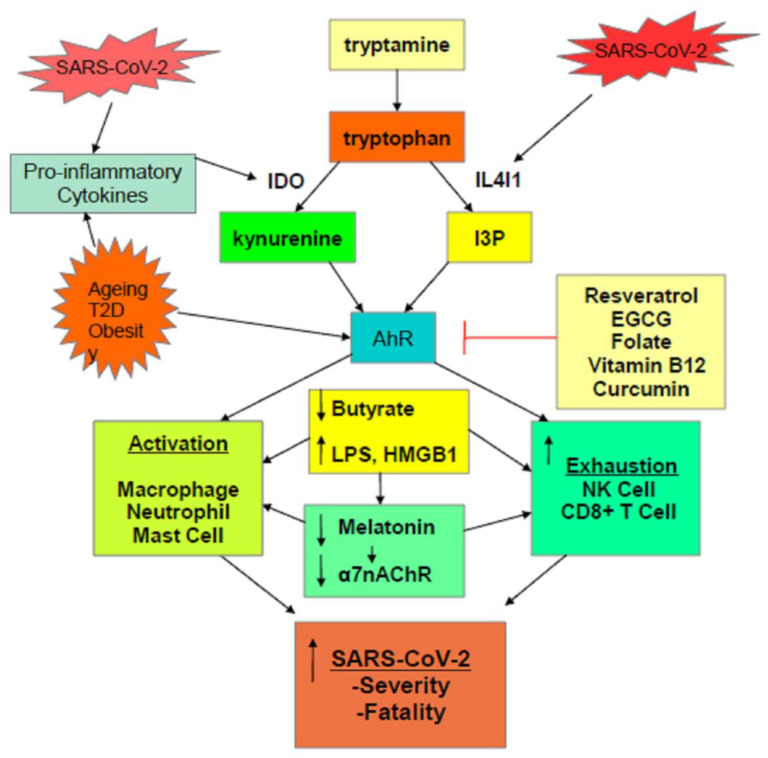
The metabolism of tryptophan is intimately associated with the differential regulation of diverse physiological processes, including in the regulation of responses to severe acute respiratory syndrome, coronavirus-2 (SARS-CoV-2) infection that underpins the COVID-19 pandemic. Two important products of tryptophan metabolism, viz kynurenine and interleukin (IL)4-inducible1 (IL41)-driven indole 3 pyruvate (I3P), activate the aryl hydrocarbon receptor (AhR), thereby altering the nature of immune responses to SARS-CoV-2 infection. AhR activation dysregulates the initial pro-inflammatory cytokines production driven by neutrophils, macrophages, and mast cells, whilst AhR activation suppresses the endogenous antiviral responses of natural killer cells and CD8+ T cells. Such immune responses become further dysregulated by the increased and prolonged pro-inflammatory cytokine suppression of pineal melatonin production coupled to increased gut dysbiosis and gut permeability. The suppression of pineal melatonin and gut microbiome-derived butyrate, coupled to an increase in circulating lipopolysaccharide (LPS) further dysregulates the immune response. The AhR mediates its effects via alterations in the regulation of mitochondrial function in immune cells. The increased risk of severe/fatal SARS-CoV-2 infection by high risk conditions, such as elderly age, obesity, and diabetes are mediated by these conditions having expression levels of melatonin, AhR, butyrate, and LPS that are closer to those driven by SARS-CoV-2 infection. This has a number of future research and treatment implications, including the utilization of melatonin and nutraceuticals that inhibit the AhR, including the polyphenols, epigallocatechin gallate (EGCG), and resveratrol.
色氨酸的代谢与多种生理过程的差异调节密切相关,包括严重急性呼吸综合征冠状病毒 2 (SARS-CoV-2)感染的调节,而后者是 COVID-19 大流行的基础。色氨酸代谢的两个重要产物,即犬尿氨酸和白细胞介素 (IL)4 诱导的 1 (IL41)-驱动吲哚 3 丙酮酸 (I3P),激活芳香烃受体 (AhR),从而改变对 SARS-CoV-2 感染的免疫反应性质。AhR 的激活会使中性粒细胞、巨噬细胞和肥大细胞驱动的初始促炎细胞因子产生失调,而 AhR 的激活抑制了自然杀伤细胞和 CD8+T 细胞的内源性抗病毒反应。这种免疫反应由于松果腺褪黑素产生的促炎细胞因子抑制增加和延长而进一步失调,这与肠道微生物失调和肠道通透性增加有关。松果腺褪黑素和肠道微生物群衍生的丁酸盐的抑制,加上循环脂多糖 (LPS) 的增加,进一步使免疫反应失调。AhR 通过改变免疫细胞中线粒体功能的调节来发挥其作用。老年人、肥胖和糖尿病等高危条件下 SARS-CoV-2 感染严重/致命的风险增加是由这些条件的褪黑素、AhR、丁酸盐和 LPS 的表达水平更接近 SARS-CoV-2 感染驱动的表达水平所介导的。这对未来的研究和治疗有一些影响,包括利用褪黑素和抑制 AhR 的营养保健品,包括多酚、表没食子儿茶素没食子酸酯 (EGCG) 和白藜芦醇。