Department of Neurology, Institute of Clinical Medicine, University of Eastern Finland, P.O. Box 1627, Kuopio, 70211, Finland.
J Mol Med (Berl). 2023 Mar;101(3):201-222. doi: 10.1007/s00109-023-02289-5. Epub 2023 Feb 9.
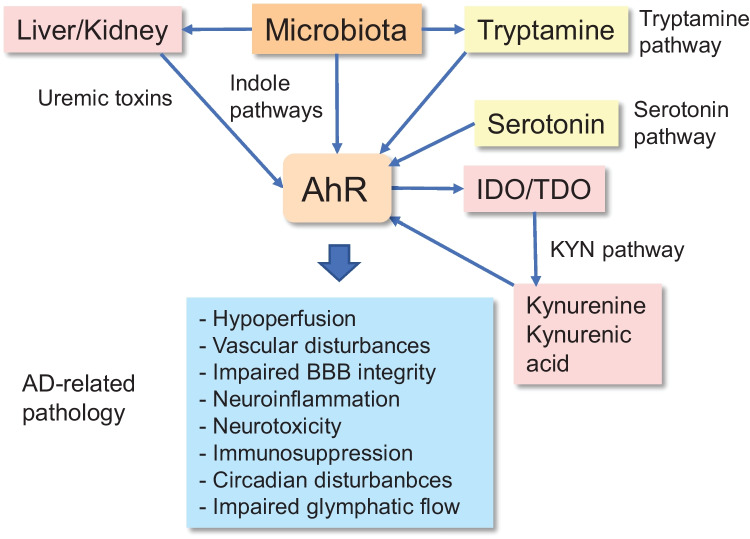
Gut microbiota in interaction with intestinal host tissues influences many brain functions and microbial dysbiosis has been linked with brain disorders, such as neuropsychiatric conditions and Alzheimer's disease (AD). L-tryptophan metabolites and short-chained fatty acids (SCFA) are major messengers in the microbiota-brain axis. Aryl hydrocarbon receptors (AhR) are main targets of tryptophan metabolites in brain microvessels which possess an enriched expression of AhR protein. The Ah receptor is an evolutionarily conserved, ligand-activated transcription factor which is not only a sensor of xenobiotic toxins but also a pleiotropic regulator of both developmental processes and age-related tissue degeneration. Major microbiota-produced tryptophan metabolites involve indole derivatives, e.g., indole 3-pyruvic acid, indole 3-acetaldehyde, and indoxyl sulfate, whereas indoleamine and tryptophan 2,3-dioxygenases (IDO/TDO) of intestine host cells activate the kynurenine (KYN) pathway generating KYN metabolites, many of which are activators of AhR signaling. Chronic kidney disease (CKD) increases the serum level of indoxyl sulfate which promotes AD pathogenesis, e.g., it disrupts integrity of blood-brain barrier (BBB) and impairs cognitive functions. Activation of AhR signaling disturbs vascular homeostasis in brain; (i) it controls blood flow via the renin-angiotensin system, (ii) it inactivates endothelial nitric oxide synthase (eNOS), thus impairing NO production and vasodilatation, and (iii) it induces oxidative stress, stimulates inflammation, promotes cellular senescence, and enhances calcification of vascular walls. All these alterations are evident in cerebral amyloid angiopathy (CAA) in AD pathology. Moreover, AhR signaling can disturb circadian regulation and probably affect glymphatic flow. It seems plausible that dysbiosis of gut microbiota impairs the integrity of BBB via the activation of AhR signaling and thus aggravates AD pathology. KEY MESSAGES: Dysbiosis of gut microbiota is associated with dementia and Alzheimer's disease. Tryptophan metabolites are major messengers from the gut host-microbiota to brain. Tryptophan metabolites activate aryl hydrocarbon receptor (AhR) signaling in brain. The expression of AhR protein is enriched in brain microvessels and blood-brain barrier. Tryptophan metabolites disturb brain vascular integrity via AhR signaling. Dysbiosis of gut microbiota promotes inflammation and AD pathology via AhR signaling.
肠道微生物群与肠道宿主组织相互作用,影响许多大脑功能,微生物失调与大脑紊乱有关,如神经精神疾病和阿尔茨海默病 (AD)。L-色氨酸代谢物和短链脂肪酸 (SCFA) 是微生物群-大脑轴中的主要信使。芳香烃受体 (AhR) 是大脑微血管中色氨酸代谢物的主要靶标,AhR 蛋白在大脑微血管中表达丰富。Ah 受体是一种进化上保守的、配体激活的转录因子,不仅是外源性毒素的传感器,也是发育过程和与年龄相关的组织退化的多效调节剂。主要由微生物群产生的色氨酸代谢物包括吲哚衍生物,例如吲哚 3-丙酮酸、吲哚 3-乙醛和吲哚硫酸盐,而肠道宿主细胞的色氨酸胺和色氨酸 2,3-加氧酶 (IDO/TDO) 激活犬尿氨酸 (KYN) 途径,生成 KYN 代谢物,其中许多是 AhR 信号的激活剂。慢性肾脏病 (CKD) 会增加血清吲哚硫酸盐水平,从而促进 AD 发病机制,例如破坏血脑屏障 (BBB) 的完整性并损害认知功能。AhR 信号的激活会扰乱大脑中的血管稳态;(i) 通过肾素-血管紧张素系统控制血流,(ii) 使内皮型一氧化氮合酶 (eNOS) 失活,从而损害 NO 产生和血管舒张,(iii) 诱导氧化应激,刺激炎症,促进细胞衰老,并增强血管壁的钙化。这些改变在 AD 病理中的脑淀粉样血管病 (CAA) 中都很明显。此外,AhR 信号可能会干扰昼夜节律调节,并可能影响糖质淋流。肠道微生物群失调可能通过激活 AhR 信号破坏 BBB 的完整性,从而加重 AD 病理,这似乎是合理的。关键信息:肠道微生物群失调与痴呆和阿尔茨海默病有关。色氨酸代谢物是肠道宿主-微生物群向大脑传递的主要信使。色氨酸代谢物激活大脑中的芳香烃受体 (AhR) 信号。AhR 蛋白在脑微血管和血脑屏障中表达丰富。色氨酸代谢物通过 AhR 信号干扰脑血管完整性。肠道微生物群失调通过 AhR 信号促进炎症和 AD 病理。