Anti Malaria Campaign, 555/5 Public Health Building, Narahenpita, Sri Lanka.
World Health Organization Regional Office for South-East Asia, New Delhi, India.
Malar J. 2021 Feb 9;20(1):80. doi: 10.1186/s12936-021-03621-5.
Sri Lanka sustained its malaria-free status by implementing, among other interventions, three core case detection strategies namely Passive Case Detection (PCD), Reactive Case Detection (RACD) and Proactive Case Detection (PACD). The outcomes of these strategies were analysed in terms of their effectiveness in detecting malaria infections for the period from 2017 to 2019.
Comparisons were made between the surveillance methods and between years, based on data obtained from the national malaria database and individual case reports of malaria patients. The number of blood smears examined microscopically was used as the measure of the volume of tests conducted. The yield from each case detection method was calculated as the proportion of blood smears which were positive for malaria. Within RACD and PACD, the yield of sub categories of travel cohorts and spatial cohorts was ascertained for 2019.
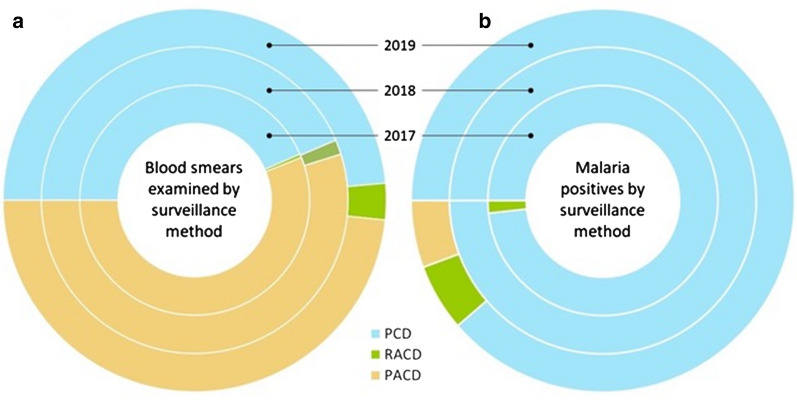
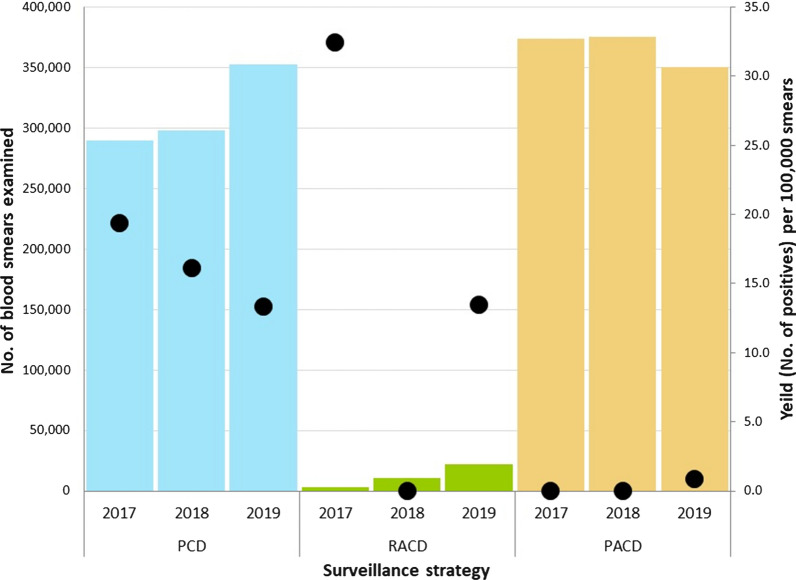
A total of 158 malaria cases were reported in 2017-2019. During this period between 666,325 and 725,149 blood smears were examined annually. PCD detected 95.6 %, with a yield of 16.1 cases per 100,000 blood smears examined. RACD and PACD produced a yield of 11.2 and 0.3, respectively. The yield of screening the sub category of travel cohorts was very high for RACD and PACD being 806.5 and 44.9 malaria cases per 100,000 smears, respectively. Despite over half of the blood smears examined being obtained by screening spatial cohorts within RACD and PACD, the yield of both was zero over all three years.
The PCD arm of case surveillance is the most effective and, therefore, has to continue and be further strengthened as the mainstay of malaria surveillance. Focus on travel cohorts within RACD and PACD should be even greater. Screening of spatial cohorts, on a routine basis and solely because people are resident in previously malarious areas, may be wasteful, except in situations where the risk of local transmission is very high, or is imminent. These findings may apply more broadly to most countries in the post-elimination phase.
斯里兰卡通过实施包括被动病例检测(PCD)、主动病例检测(PACD)和反应性病例检测(RACD)在内的三项核心病例发现策略,维持了无疟疾状态。本研究分析了这些策略在 2017 年至 2019 年期间发现疟疾感染的效果。
基于从国家疟疾数据库和疟疾病例的个体报告中获得的数据,比较了监测方法和年份之间的差异。检查的显微镜血涂片数量用作测试量的衡量标准。从每个病例发现方法中获得的产量计算为疟疾阳性血涂片的比例。在 RACD 和 PACD 中,确定了 2019 年旅行队列和空间队列的亚类的产量。
2017-2019 年共报告 158 例疟疾病例。在此期间,每年检查的血涂片数量在 666325 至 725149 之间。PCD 检测出 95.6%,每 100000 张血涂片检测出 16.1 例。RACD 和 PACD 的产量分别为 11.2%和 0.3%。RACD 和 PACD 对旅行队列亚类的筛查产量非常高,分别为每 100000 张涂片 806.5 和 44.9 例疟疾病例。尽管 RACD 和 PACD 中超过一半的血涂片是通过筛查空间队列获得的,但在所有三年中,这两种方法的产量均为零。
病例监测的 PCD 部分是最有效的,因此必须继续并进一步加强,作为疟疾监测的主要手段。应该更加关注 RACD 和 PACD 中的旅行队列。除了在本地传播风险非常高或迫在眉睫的情况下,常规筛查空间队列可能是浪费的,除非人们居住在以前疟疾流行的地区。这些发现可能更广泛地适用于大多数消除疟疾后的国家。