Özel Duygan B D, Rey S, Leocata S, Baroux L, Seyfried M, van der Meer J R
Department of Fundamental Microbiology, University of Lausanne, Lausanne, Switzerland
Biotechnology and Natural Process Development Department, Firmenich SA, Geneva, Switzerland.
mSystems. 2021 Feb 9;6(1):e01143-20. doi: 10.1128/mSystems.01143-20.
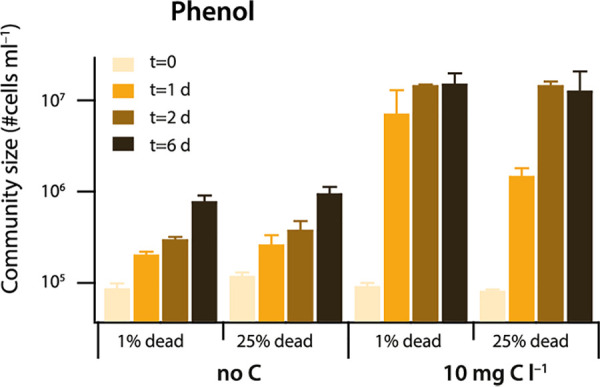
Compound biodegradability tests with natural microbial communities form an important keystone in the ecological assessment of chemicals. However, biodegradability tests are frequently limited by a singular focus either on the chemical and potential transformation products or on the individual microbial species degrading the compound. Here, we investigated a methodology to simultaneously analyze community compositional changes and biomass growth on dosed test compound from flow cytometry (FCM) data coupled to machine-learned cell type recognition. We quantified the growth of freshwater microbial communities on a range of carbon dosages of three readily biodegradable reference compounds, phenol, 1-octanol, and benzoate, in comparison to three fragrances, methyl jasmonate, myrcene, and musk xylene (as a nonbiodegradable control). Compound mass balances with between 0.1 to 10 mg C · liter phenol or 1-octanol, inferred from cell numbers, parent compound analysis, and CO evolution, as well as use of C-labeled compounds, showed between 6 and 25% mg C · mg C substrate incorporation into biomass within 2 to 4 days and 25 to 45% released as CO In contrast, similar dosage of methyl jasmonate and myrcene supported slower (4 to 10 days) and less (2.6 to 6.6% mg C · mg C with 4.9 to 22% CO) community growth. Community compositions inferred from machine-learned cell type recognition and 16S rRNA amplicon sequencing showed substrate- and concentration-dependent changes, with visible enrichment of microbial subgroups already at 0.1 mg C · liter phenol and 1-octanol. In general, community compositions were similar at the start and after the stationary phase of the microbial growth, except at the highest used substrate concentrations of 100 to 1,000 mg C · liter Flow cytometry cell counting coupled to deconvolution of communities into subgroups is thus suitable to infer biodegradability of organic chemicals, permitting biomass balances and near-real-time assessment of relevant subgroup changes. The manifold effects of potentially toxic compounds on microbial communities are often difficult to discern. Some compounds may be transformed or completely degraded by few or multiple strains in the community, whereas others may present inhibitory effects. In this study, we benchmark a new method based on machine-learned microbial cell recognition to rapidly follow dynamic changes in aquatic communities. We further determine productive biodegradation upon dosing of a number of well-known readily biodegradable tester compounds at a variety of concentrations. Microbial community growth was quantified using flow cytometry, and the multiple cell parameters measured were used in parallel to deconvolute the community on the basis of similarity to previously standardized cell types. Biodegradation was further confirmed by chemical analysis, showing how distinct changes in specific populations correlate to degradation. The method holds great promise for near-real-time community composition changes and deduction of compound biodegradation in natural microbial communities.

利用天然微生物群落进行的化合物生物降解性测试是化学品生态评估的重要基石。然而,生物降解性测试常常受到限制,要么只关注化学品及其潜在转化产物,要么只关注降解该化合物的单个微生物物种。在此,我们研究了一种方法,通过将流式细胞术(FCM)数据与机器学习细胞类型识别相结合,同时分析受试化合物剂量下群落组成变化和生物量增长。我们量化了淡水微生物群落在三种易生物降解参考化合物(苯酚、1-辛醇和苯甲酸盐)的一系列碳剂量下的生长情况,并与三种香料(茉莉酸甲酯、月桂烯和二甲苯麝香,作为不可生物降解对照)进行比较。从细胞数量、母体化合物分析和CO释放以及使用C标记化合物推断出的0.1至10 mg C·升苯酚或1-辛醇的化合物质量平衡表明,在2至4天内,有6%至25%的mg C·mg C底物掺入生物量,25%至45%以CO形式释放。相比之下,类似剂量的茉莉酸甲酯和月桂烯支持较慢(4至10天)且较少(2.6%至6.6% mg C·mg C,4.9%至22% CO)的群落生长。从机器学习细胞类型识别和16S rRNA扩增子测序推断出的群落组成显示出底物和浓度依赖性变化,在0.1 mg C·升苯酚和1-辛醇时就已可见微生物亚群的明显富集。一般来说,在微生物生长的起始阶段和稳定期之后,群落组成相似,除了在最高使用的底物浓度100至1000 mg C·升时。因此,结合群落解卷积为亚群的流式细胞术细胞计数适用于推断有机化学品的生物降解性,允许进行生物量平衡和对相关亚群变化的近实时评估。潜在有毒化合物对微生物群落的多种影响往往难以辨别。一些化合物可能被群落中的少数或多种菌株转化或完全降解,而其他化合物可能具有抑制作用。在本研究中,我们对一种基于机器学习微生物细胞识别的新方法进行了基准测试,以快速跟踪水生群落的动态变化。我们进一步确定了在多种浓度下添加一些众所周知的易生物降解测试化合物后的生产性生物降解情况。使用流式细胞术对微生物群落生长进行了量化,并基于与先前标准化细胞类型的相似性,并行使用测量的多个细胞参数对群落进行解卷积。通过化学分析进一步证实了生物降解,显示了特定种群的明显变化与降解之间的关联。该方法在近实时群落组成变化和推断天然微生物群落中化合物生物降解方面具有很大潜力。