Villacorta Javier, Diaz-Crespo Francisco, Guerrero Carmen, Acevedo Mercedes, Cavero Teresa, Fernandez-Juarez Gema
Department of Nephrology, Hospital Universitario Fundacion Alcorcon, Alcorcon, Spain.
Department of Pathology, Hospital Virgen de la Salud, Toledo, Spain.
Clin Kidney J. 2020 Jun 29;14(1):220-225. doi: 10.1093/ckj/sfaa073. eCollection 2021 Jan.
Recently, renal risk score on the basis of three clinicopathologic features to predict end-stage renal disease (ESRD) in antineutrophil cytoplasmic antibody (ANCA)-associated renal vasculitis has been proposed. The aim of this multi-centre study was to validate this renal risk score in a large cohort of southern European patients.
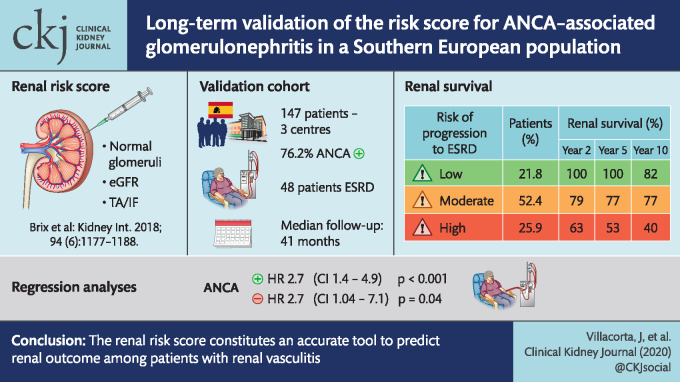
Data were retrospectively collected from the time of diagnosis by systematic review of medical records from 147 patients with renal vasculitis recruited from three Spanish centres. The renal risk score was calculated in every patient, and renal and global outcomes were analysed according to the risk group assessment.
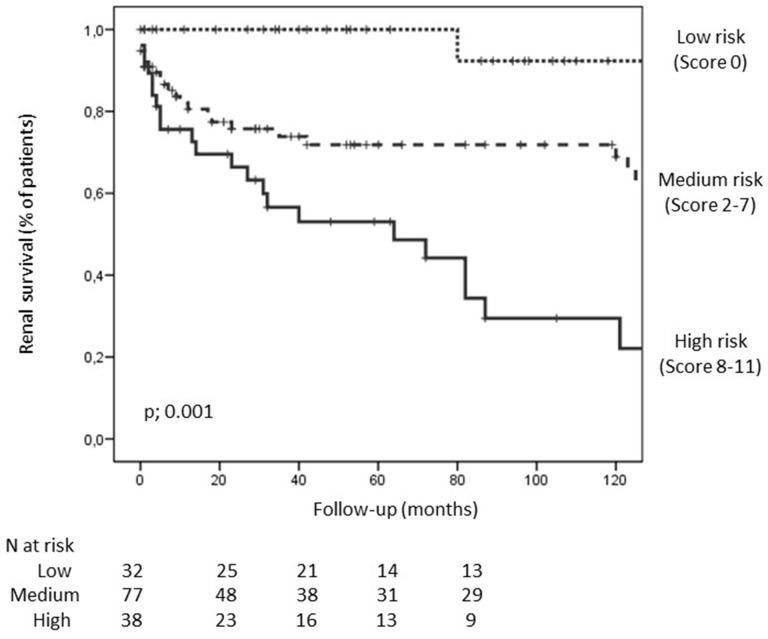
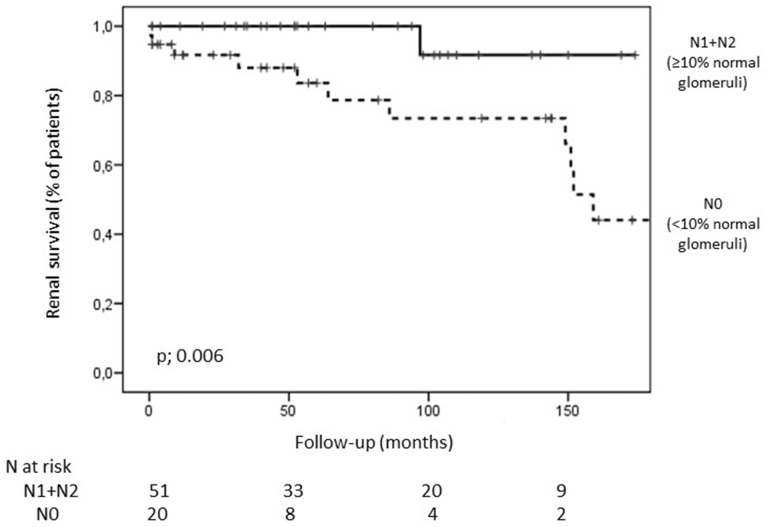
ANCA serology was positive in 76.2% of patients: 64.6% showed activity against myeloperoxidase (MPO) and 12.2% against proteinase 3 (PR3). The median (interquartile range) follow-up period was 41 months (9.6-104). Forty-eight patients (32.7%) reached ESRD. Patients were classified into the three groups according to the risk of progression to ESRD: 21.8% of patients were classified into low risk, 52.4% were classified into moderate risk and the remaining 25.9% were classified into high risk. The cumulative proportion of renal survival at 2, 5 and 10 years was 100, 100 and 82% in the low-risk group, 79, 77 and 77% in the medium-risk group and 63, 53 and 40% in the high-risk group (P < 0.001). In regression analysis, the risk score was a good predictor for the development of the ESRD among ANCA positive [hazard ratio (HR) = 2.7, 95% confidence interval (CI) 1.4-4.9; P < 0.001] and ANCA negative (HR = 2.7, 95% CI 1.04-7.1, P = 0.04) patients.
The renal risk score constitutes an accurate tool to predict renal outcome among patients with renal vasculitis. This study contributes to validate the risk scoring system in a MPO-predominant population, but also among ANCA-negative vasculitis patients.
最近,有人提出基于三种临床病理特征的肾脏风险评分来预测抗中性粒细胞胞浆抗体(ANCA)相关肾血管炎患者的终末期肾病(ESRD)。这项多中心研究的目的是在一大群南欧患者中验证这种肾脏风险评分。
通过系统回顾从三个西班牙中心招募的147例肾血管炎患者的病历,回顾性收集诊断时的数据。计算每位患者的肾脏风险评分,并根据风险组评估分析肾脏和整体结局。
76.2%的患者ANCA血清学呈阳性:64.6%的患者显示抗髓过氧化物酶(MPO)活性,12.2%的患者显示抗蛋白酶3(PR3)活性。中位(四分位间距)随访期为41个月(9.6 - 104个月)。48例患者(32.7%)发展至终末期肾病。根据进展至终末期肾病的风险将患者分为三组:21.8%的患者被分类为低风险,52.4%的患者被分类为中度风险,其余25.9%的患者被分类为高风险。低风险组2年、5年和10年的肾脏生存率累积比例分别为100%、100%和82%,中度风险组分别为79%、77%和77%,高风险组分别为63%、53%和40%(P < 0.001)。在回归分析中,风险评分是ANCA阳性[风险比(HR)= 2.7,95%置信区间(CI)1.4 - 4.9;P < 0.001]和ANCA阴性(HR = 2.7,95% CI 1.04 - 7.1,P = 0.04)患者发生终末期肾病的良好预测指标。
肾脏风险评分是预测肾血管炎患者肾脏结局的准确工具。本研究有助于在以MPO为主的人群以及ANCA阴性血管炎患者中验证风险评分系统。