Almas Talal, Ehtesham Maryam, Khan Abdul Wali, Khedro Tarek, Hussain Salman, Kaneez Mehwish, Alsufyani Reema, Almubarak Dana, Alahmed Fatimah, Alaeddin Hasan
Internal Medicine, Royal College of Surgeons in Ireland, Dublin, IRL.
Internal Medicine, College of Physician and Surgeons Pakistan, Peshawar, PAK.
Cureus. 2021 Jan 7;13(1):e12544. doi: 10.7759/cureus.12544.
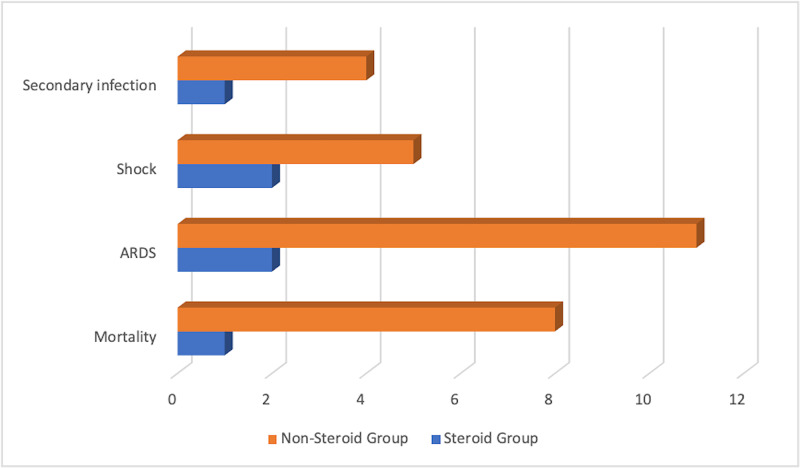
Background To date, several pharmacological agents have been employed in the treatment and management of the coronavirus disease 2019 (COVID-19). While the utility of corticosteroids in severe COVID-19 infection is now widely touted, their efficacy in thwarting the progression of non-severe disease remains elusive. Methods A retrospective cohort study involving 25 patients with a confirmed diagnosis of non-severe COVID-19 infection was conducted. Subjects were assigned to either the steroid or the non-steroid group. A low-dose, short-course corticosteroid regimen was administered for seven days and the disease outcomes were recorded and compared among the two groups. The Kolmogorov-Smirnov test was employed to discern the data normality. Results In patients treated with low-dose, short-course steroids, the overall all-cause mortality was significantly lower compared with the non-steroid group (8.3% and 61.5%, respectively; p = 0.005). The prevalence of acute respiratory distress syndrome in the steroid group was significantly lower than that in the non-steroid group at the seven-day mark (16.7% and 84.6%, respectively; p = 0.002). Within the steroid group, the incidence of developing secondary complications was also markedly lower than that in the non-steroid group. Conclusions In patients afflicted with non-severe COVID-19, the employment of low-dose, short-course corticosteroids may confer a therapeutic advantage, significantly curtailing the mortality rate, the length of hospital stay, and the risk of developing secondary complications.
背景 迄今为止,已有多种药物被用于治疗和管理2019冠状病毒病(COVID-19)。虽然糖皮质激素在重症COVID-19感染中的作用现在广受推崇,但其在阻止非重症疾病进展方面的疗效仍不明确。方法 进行了一项回顾性队列研究,纳入25例确诊为非重症COVID-19感染的患者。将受试者分为激素组和非激素组。给予低剂量、短疗程的糖皮质激素治疗7天,并记录和比较两组的疾病转归。采用柯尔莫哥洛夫-斯米尔诺夫检验来判断数据的正态性。结果 在接受低剂量、短疗程糖皮质激素治疗的患者中,总体全因死亡率显著低于非激素组(分别为8.3%和61.5%;p = 0.005)。在第7天时,激素组急性呼吸窘迫综合征的患病率显著低于非激素组(分别为16.7%和84.6%;p = 0.002)。在激素组中,发生继发并发症的发生率也明显低于非激素组。结论 在非重症COVID-19患者中,使用低剂量、短疗程的糖皮质激素可能具有治疗优势,可显著降低死亡率、缩短住院时间并降低发生继发并发症的风险。