Melin Amanda D, Orkin Joseph D, Janiak Mareike C, Valenzuela Alejandro, Kuderna Lukas, Marrone Frank, Ramangason Hasinala, Horvath Julie E, Roos Christian, Kitchener Andrew C, Khor Chiea Chuen, Lim Weng Khong, Lee Jessica G H, Tan Patrick, Umapathy Govindhaswamy, Raveendran Muthuswamy, Harris R Alan, Gut Ivo, Gut Marta, Lizano Esther, Nadler Tilo, Zinner Dietmar, Johnson Steig E, Jarvis Erich D, Fedrigo Olivier, Wu Dongdong, Zhang Guojie, Farh Kyle Kai-How, Rogers Jeffrey, Marques-Bonet Tomas, Navarro Arcadi, Juan David, Arora Paramjit S, Higham James P
Department of Anthropology and Archaeology, University of Calgary, Canada.
Department of Medical Genetics, University of Calgary, Canada.
bioRxiv. 2021 Feb 3:2021.02.03.429540. doi: 10.1101/2021.02.03.429540.
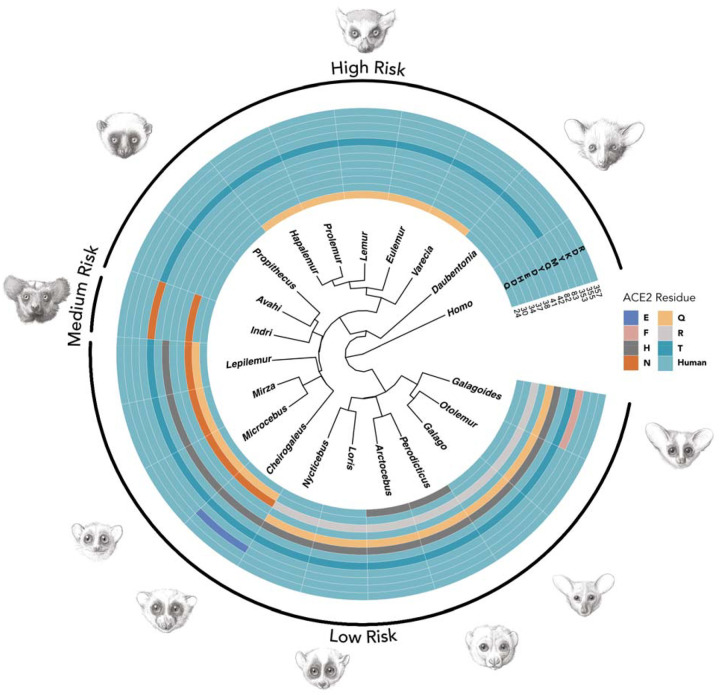
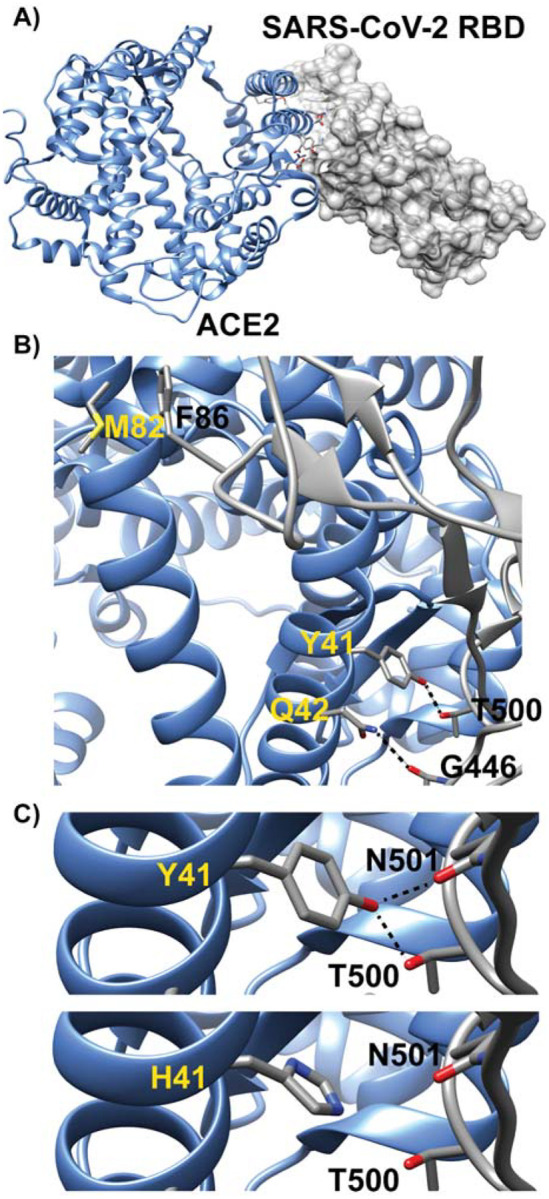
The novel coronavirus SARS-CoV-2, which in humans leads to the disease COVID-19, has caused global disruption and more than 1.5 million fatalities since it first emerged in late 2019. As we write, infection rates are currently at their highest point globally and are rising extremely rapidly in some areas due to more infectious variants. The primary viral target is the cellular receptor angiotensin-converting enzyme-2 (ACE2). Recent sequence analyses of the gene predicts that many nonhuman primates are also likely to be highly susceptible to infection. However, the anticipated risk is not equal across the Order. Furthermore, some taxonomic groups show high ACE2 amino acid conservation, while others exhibit high variability at this locus. As an example of the latter, analyses of strepsirrhine primate sequences to date indicate large variation among lemurs and lorises compared to other primate clades despite low sampling effort. Here, we report gene and protein sequences for 71 individual strepsirrhines, spanning 51 species and 19 genera. Our study reinforces previous results and finds additional variability in other strepsirrhine species, and suggests several clades of lemurs have high potential susceptibility to SARS-CoV-2 infection. Troublingly, some species, including the rare and Endangered aye-aye (), as well as those in the genera and , may be at high risk. Given that lemurs are endemic to Madagascar and among the primates at highest risk of extinction globally, further understanding of the potential threat of COVID-19 to their health should be a conservation priority. All feasible actions should be taken to limit their exposure to SARS-CoV-2.
新型冠状病毒SARS-CoV-2在人类中会引发COVID-19疾病,自2019年末首次出现以来,已造成全球混乱并导致超过150万人死亡。在撰写本文时,全球感染率目前处于最高点,并且由于更具传染性的变异毒株,一些地区的感染率正在极速上升。病毒的主要靶点是细胞受体血管紧张素转换酶2(ACE2)。对该基因的最新序列分析预测,许多非人类灵长类动物也很可能极易感染。然而,整个灵长目动物的预期风险并不相同。此外,一些分类群体在该位点显示出较高的ACE2氨基酸保守性,而其他分类群体则表现出高度变异性。作为后者的一个例子,迄今为止对狐猴型灵长类动物序列的分析表明,尽管采样量较少,但与其他灵长类分支相比,狐猴和懒猴之间存在很大差异。在这里,我们报告了71只狐猴型灵长类动物的基因和蛋白质序列,涵盖51个物种和19个属。我们的研究强化了先前的结果,并在其他狐猴型灵长类物种中发现了更多变异性,表明几个狐猴分支对SARS-CoV-2感染具有很高的潜在易感性。令人担忧的是,一些物种,包括珍稀濒危的指猴,以及鼬狐猴属和叉斑鼠狐猴属的物种,可能面临高风险。鉴于狐猴是马达加斯加的特有物种,并且是全球灭绝风险最高的灵长类动物之一,进一步了解COVID-19对它们健康的潜在威胁应成为保护工作的重点。应采取一切可行措施,限制它们接触SARS-CoV-2。